The GBP to AUD conversion begins 2016 in fine form, but is it too early to suggest the multi-month decline is over?

A break, however, definitively above the pivot and then above 2.0600 would probably confirm a continuation higher
The pound to Australian dollar exchange rate conversion is on the way up - every day of January 2016 has seen the pair settle at higher range.
Sparking the move higher are developments in China where manufacturing data showed an even bigger slow-down than analysts had predicted on the 4th of January leading to fears the continued slowdown would reduce demand for Australian exports to a greater extent than currently priced into the currency markets.
An unforseen slow-down in exports would inevitably prompt another interest rate cut at the Reserve Bank of Australia - a move that would seriously undermine the attractiveness of the AUD.
At the present time it is too soon to call the end of the decline seen in the exchange rate which has been in place since August/September 2015 as the pair remains well within its downward-facing channel.
Outlook for 2016: Who is the Biggest Loser?
In terms of their longer-term forecasts for 2016, it’s more a case of least ugly, as most analysts are predominantly bearish about both the currencies.
Sterling is expected to be weighed down by the prospect of a referendum on E.U membership which could see the UK being voted out of the European Union.
The aussie, meanwhile, is expected to be pressured lower by continued weak demand for commodities as Beijing seeks to recalibrate its economy from early industrial to more modern service-orientated.
On the upside, analysts have pointed to recent data from Australia which has shown lower-than-expected unemployment, as well as a rise in the growth of the non-mining sector of the economy.
Latest Pound / Australian Dollar Exchange Rates
  | Live: 1.8796▲ + 0.1%12 Month Best:2.0851 |
*Your Bank's Retail Rate
| 1.8157 - 1.8232 |
**Independent Specialist | 1.8533 - 1.8608 Find out why this is a better rate |
* Bank rates according to latest IMTI data.
** RationalFX dealing desk quotation.
In the U.K, there has been some signs – though inconsistent – of wage growth, and the BOE remains the second most likely central bank in G10 to follow in the footsteps of the Fed and hike rates, with some analysts even still seeing a possible May hike on the cards.
Given that both are expected to decline versus the dollar, it’s a more a question of which will decline the most, and currently, the risk of a Brexit is such that it overshadows most other factors and may be biasing the potential for a major re-valuation of the pound, which could drop like a stone in a potential currency crisis aftermath – therefore, if one of the two is going to weaken the most, it’s probably the pound at the moment.
Forecasting Lower Sterling v Australian Dollar
The charts echo this slight bias towards the down-side, with the longer-term monthly chart of GBP/AUD, showing two very weak months in November and December.
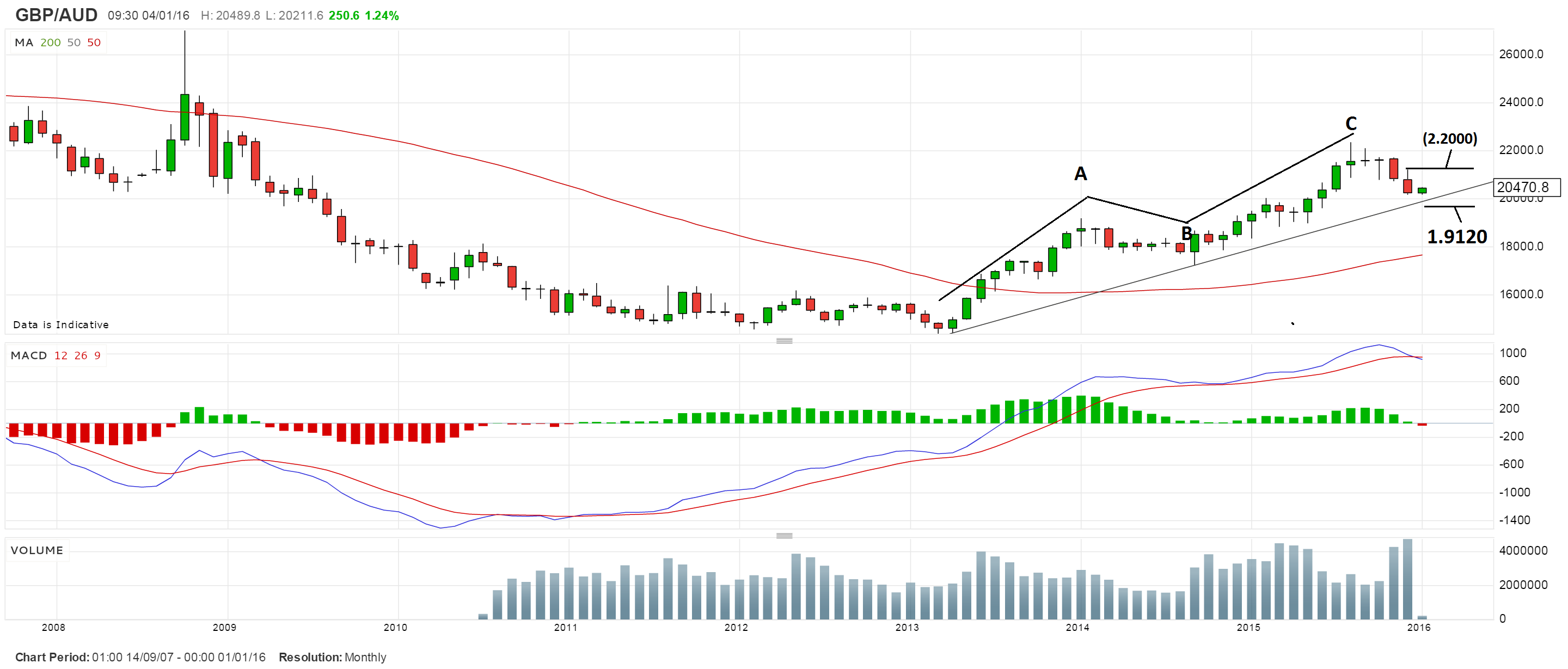
Whilst these do not yet constitute a reversal of the up-trend which began in March 2013, they nevertheless, are quite bearish signs, especially due to the heavy selling volume seen during those two months.
If this month is a downer too then that will materially increase the risk of a reversal as it will form a 3-black-crows pattern, which – coming after a 3-wave measured move – has heightened probability of signalling a reversal.
Indeed, the 3-wave move from 2013 could be a massive 3-year corrective a-b-c pattern within a broader down-trend, which may be about to resume.
Nevertheless, despite these bearish signs on the horizon I would want to see a clear break below the 2.0000 handle for confirmation of further downside, with a move below the 1.9860 S1 Monthly Pivot ‘sealing the deal’ for bears, and probably then seeing the start of a more aggressive slide down to an eventual end target of 1.9120.
Of course, upside is also possible, but for that I would want to see a move above the December 2.1218 highs, with the next longer-term target then at 2.2000.
Short-term forecast
As far as short-term outlook goes, today is a strong up-day, which on one of my charting packages at least, is looking like a bullish engulfing candlestick pattern, with short-term up-side potential.
The exchange rate, also appears to be at the bottom of a clear down-sloping channel, which further enhances the chances of more upside evolving from here.
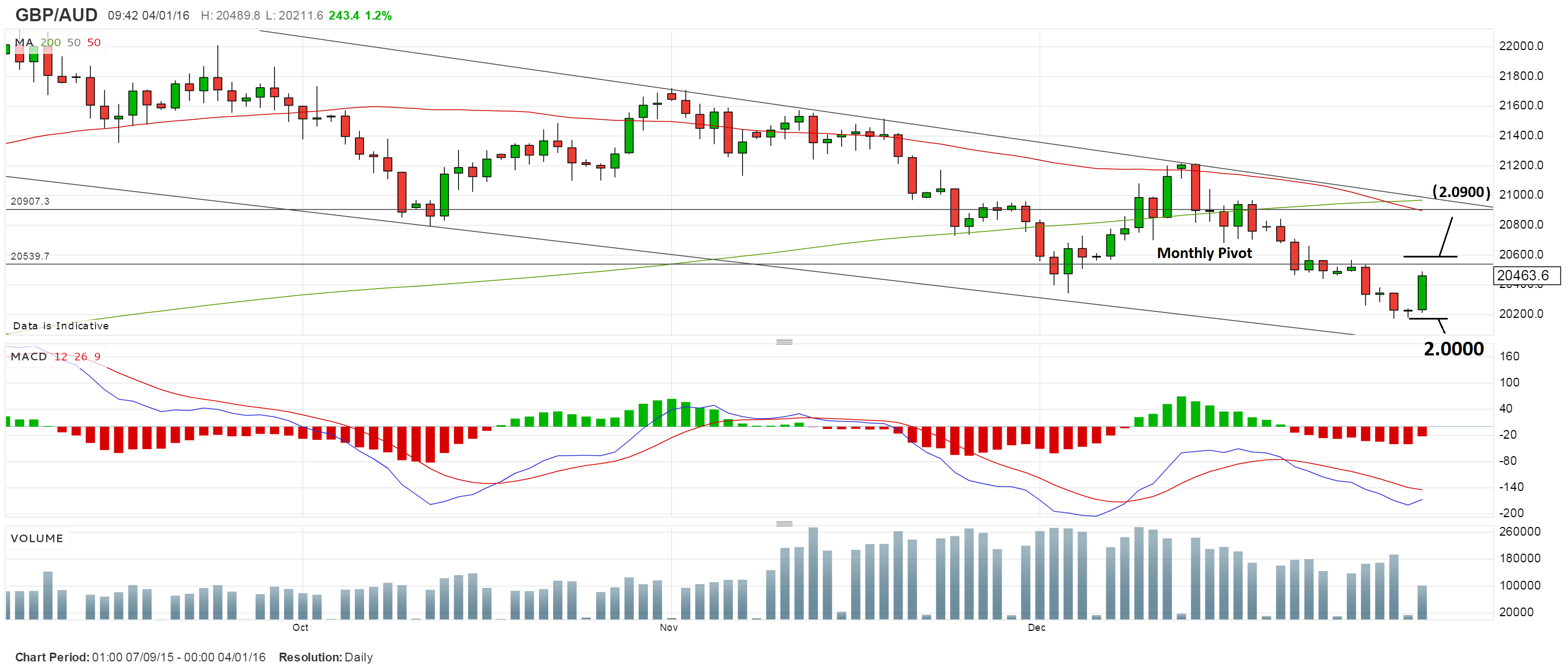
Nevertheless, the exchange rate has hit formidable resistance this morning, in the shape of the 50-week moving average at 2.0483, and although it has successfully managed to move above it so far, by at least 30 points, could still be dragged down.
Furthermore, the Monthly Pivot lies not far above at 2.0539, and would also be expected to provide firm resistance; as such, upside for the pair is capped.
A break, however, definitively above the pivot and then above 2.0600 would probably confirm a continuation higher to an eventual target at the top of the channel at .20900.
More down-side could result from the pivot and 50-week successfully resisting price, and the rate might also fall back down, continuing the mini-down-trend lower.
In such a scenario, a break below the 2.0175 lows would probably confirm a short run down to 2.0000.