
Picture by Simon Dawson / No 10 Downing Street.
... Buy GBP/NZD this summer.
Deutsche Bank says that while the bearish case for pound sterling is well known, the market may already have priced in too much negativity.
And that's an opportunity to tactically position for upside.
The call is made in the bank's mid-year strategy update, where say some familiar bearish arguments continue to be made against the UK currency:
• The Bank of England is unlikely to deliver as many rate hikes as markets currently price.
• UK political risks remain elevated.
• UK fiscal risks remain elevated.
However, Deutsche Bank strategists argue that "too much negativity is already priced into the pound" and therefore favour "tactical GBP longs over the summer."
A 'long' position is where a trader buys a currency in order to profit from upside, and for Deutsche Bank, the trade's counterpart should be the New Zealand dollar.
Why GBP could outperform
1. Political risk may not worsen as much as feared
DB says the market has become heavily focused on UK political risk after local election results and speculation around Andy Burnham ascending to Number 10 Downing Street.
However, several potential developments could reduce sterling's risk premium, including any confirmation that Rachel Reeves remains Chancellor to ensure fiscal continuity.
Commitments not to loosen fiscal rules, something Burnham has strongly hinted at, and signs that markets will constrain any move towards more expansionary policies, will also help.
2. UK external balances have improved, notes Deutsche:
• The UK's underlying current account deficit has narrowed significantly.
• The deficit is now around 1.5% of GDP.
• Services exports continue to trend higher.
As a result, the bank's FEER valuation model shows GBP as the second-cheapest currency in G10
3. Gilt yields are attractive
Following the sharp rise in UK bond yields UK rates now look attractive relative to peers, which has helped foreign inflows recover.
In fact, analysts note thaat pound sterling continues to benefit more from debt-market flows than equity-market flows.
The below chart shows how the pound rose against the euro as UK bond yields rose in response to expectations that the Middle East conflict would boost inflation and prompt the Bank of England to raise interest rates again:
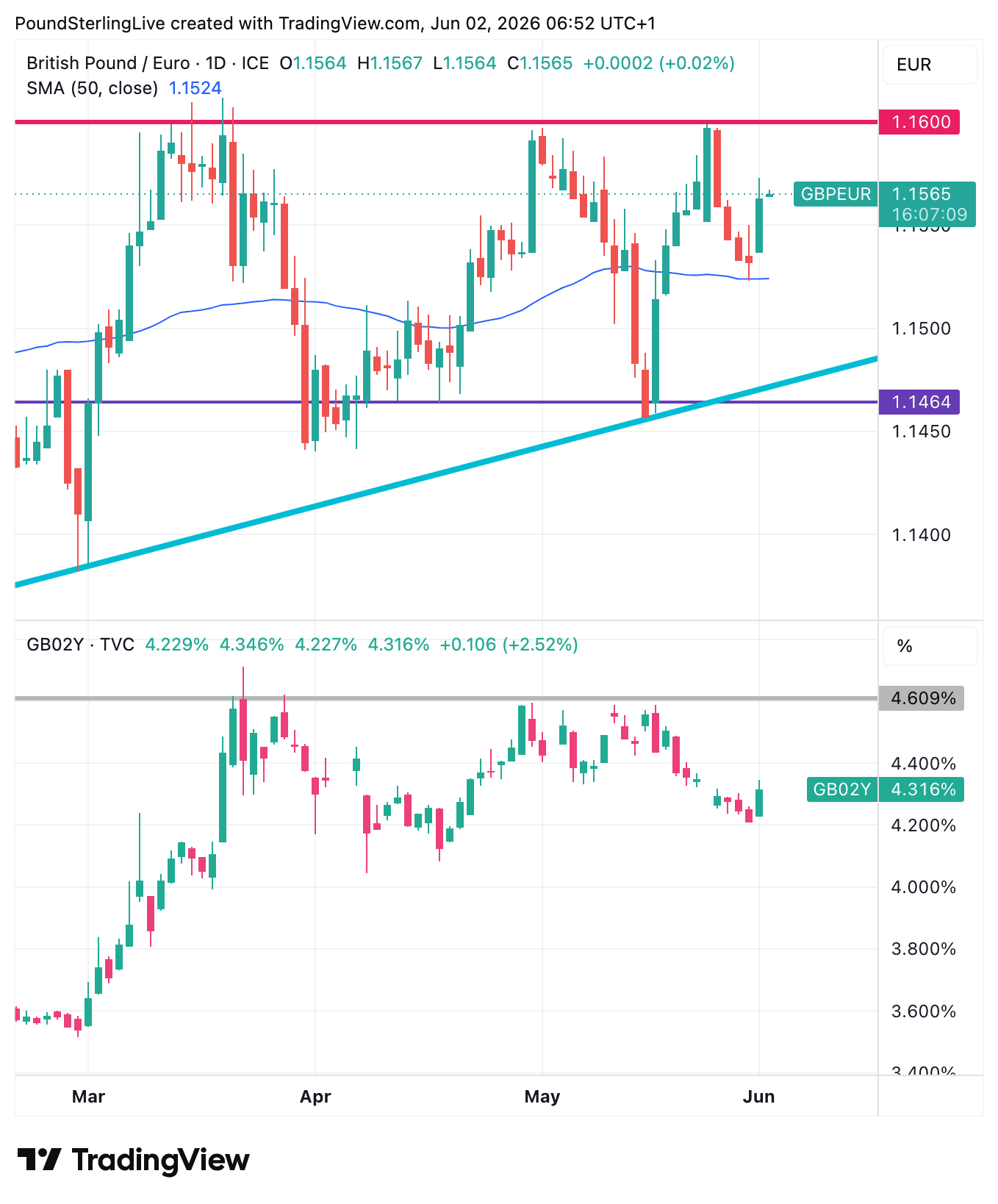
Above: GBP/EUR (top) and the lift in two-year bond yields that followed the Middle East war.
Why GBP/NZD specifically?
DB wants sterling exposure against a currency where it also sees downside risks.
The bank argues New Zealand still has substantial spare capacity in the economy and growth momentum has weakened again.
PMIs have slipped back towards levels consistent with zero or negative GDP growth and market pricing for RBNZ tightening appears too aggressive.
A headwind to the trade would be last week's RBNZ policy decision where rates were left on hold, but the Bank signalled clearly it is ready to hike. That caught the market off guard and pushed GBP/NZD lower to 2.2443, bringing into view the significant 2.24 support zone.
Nevertheless, Deutsche Bank sees NZD as vulnerable and believes GBP/NZD offers an energy-neutral and largely risk-neutral way to express a constructive sterling view.
Risks to the View
Deutsche stresses that buying sterling is effectively a bet that the UK does not move towards large-scale nationalisation.
Fiscal policy remains broadly market-friendly and political developments become less alarming than investors currently fear.
HSBC: The pound faces harsher tests
In light of those risks, it's worth flagging that analysts at HSBC say the biggest test is yet to come in their mid-year market update.
Their research shows international developments remain the dominant driver of the pound, and that so far this has been supportive.
For instance, the war in the Middle East has lifted UK bond yields while not having a negative impact on global risk sentiment; after all, U.S. markets are in an impressive record-setting streak.
However, HSBC warns that renewed concerns about UK policymaking could quickly re-emerge.
“We cannot ignore emerging policy uncertainty,” says the note.
The report points to growing pressure on the Prime Minister from within the Labour Party and notes that sterling has previously struggled when investors become concerned about fiscal discipline.