
Image © Adobe Images
For the pound, core and services CPI inflation is too high as Britain heads into another inflationary shock.
The British pound saw a small, albeit noticeable, bid in the wake of news that UK inflation stayed at 3.0% y/y in February. However, we think the currency's sanguine reaction reflects an underlying anxiety about where the economy is headed.
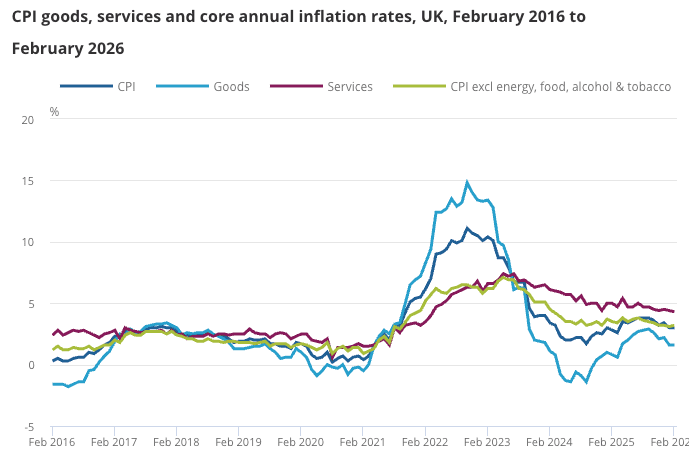
Because, beyond the headlines we see signs of underlying inflationary stubbornness ahead of another spike in inflation due to the Iran conflict: Core CPI was at 3.2% vs. 3.1% expected and 3.1% prior. Services CPI was at 4.3% vs. 4.2% expected and 4.4% prior.
Core and services CPI are important as they signal to the Bank of England what the underlying inflationary trend is doing. In short, these two components must fall further if headline CPI is to settle at the Bank's 2.0% target on an enduring basis.
Although there has been some progress in services inflation, it has been too slow to be of comfort ahead of another rise in energy, food and good prices.
Tuesday's release of PMI survey data from S&P Global shows that British businesses are already seeing a big pickup in cost pressures, which will ultimately be felt by consumers in the coming months.
"Inflationary pressures have surged higher on the back of rising energy prices and fractured supply chains. The acceleration in cost growth in the manufacturing sector was especially severe, being the sharpest since the depreciation of sterling following Black Wednesday in 1992," says Chris Williamson, Chief Business Economist at S&P Global Market Intelligence.
What Today's Data Means for Your Money Transfer
The pound has edged higher, but the move lacks strong momentum, suggesting markets are not yet convinced of a sustained trend.
For those planning a transfer, this creates a more balanced risk environment rather than a clear directional signal.
If you are buying foreign currency, there is no immediate pressure to act, but the lack of upward momentum in GBP limits the potential for significantly better rates.
If you are selling foreign currency, current levels remain broadly stable, but gains may be gradual rather than sharp.
👉 You can compare current GBP rates here to see how the market is pricing transfers.
According to Tuesday's PMI release, 47% of goods producers reported a rise in their input costs, while only 2% reported a decline. This pointed to the sharpest rate of input price inflation in the manufacturing sector for nearly three-and-a-half years.
Also, the acceleration in price pressures since February was the largest seen for over three decades.
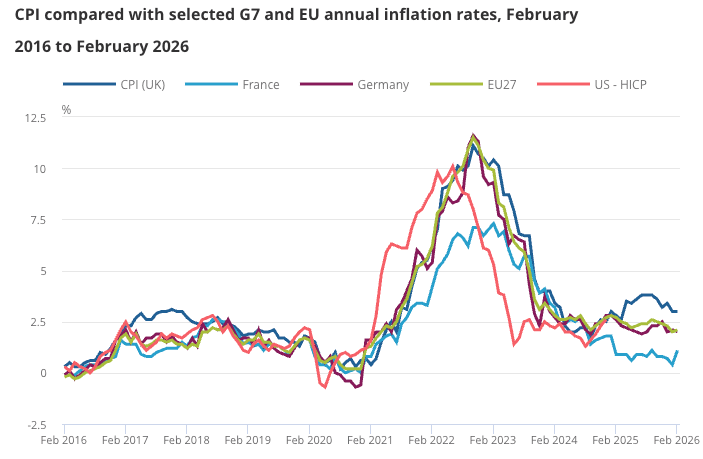
The UK meanwhile enters a new inflationary cycle with higher inflation than comparable countries, which explains why UK borrowing costs are higher than elsewhere and why markets see it as particularly vulnerable to the impact of higher energy prices caused by the war.
According to the PMI data, service providers also recorded a marked increase in their average cost burdens, with 38% of the survey panel reporting a rise and only 2% experiencing a fall.
Higher inflation will mean the Bank of England will have to hold interest rates for an extended period, at the very least.
Market pricing, meanwhile, suggests that the Bank won't have this luxury and will have to hike; in fact, money markets show a minimum of at least two hikes are expected this year.
On balance, this should support the pound relative to currencies belonging to central banks that will be less hawkish.
However, it's a fine balance: at what point does high inflation and a struggling economy become a headwind to the currency? After all, assets attached to stagflationary economies are hardly compelling.
"While faster hikes from the BoE and ECB may offer some near-term support for the euro and pound by lifting yields, those gains could ultimately prove short-lived if tighter monetary policy alongside higher energy prices trigger a deeper economic slowdown/recession for European economies," says Hardman.
Take Control of Your GBP Transfer
With markets lacking strong direction, current conditions favour control and optimisation rather than urgency.
If you need certainty:
If your timing is flexible:
👉 Get a quote and compare rates
Even small differences in pricing can have a meaningful impact on larger transfers.