Consensus projections for the next four quarters, compiled from leading investment banks.
Access the full forecast →

Image © Adobe Images
The pound is a sell against the euro as the labour market indicates recessionary risks are rising says BCA Research.
The British pound is vulnerable in the face of an increased likelihood of a recession shows a new analysis from an independent research house.
"UK recession risks are rising. Between falling inflation and a deteriorating labour market, we see room for a more aggressive BoE easing cycle," says Robert Timper, Chief Global Fixed Income Strategist at BCA Research.
As a result, UK government bonds are rated by strategists as the most favoured in the developed bond market space, "while GBP looks vulnerable."
BCA Research was founded in 1949 and is an independent provider of global investment research.
The company's recession warning rests on the observation that UK growth indicators remain weak, with business confidence and labour market data flashing recessionary signals.
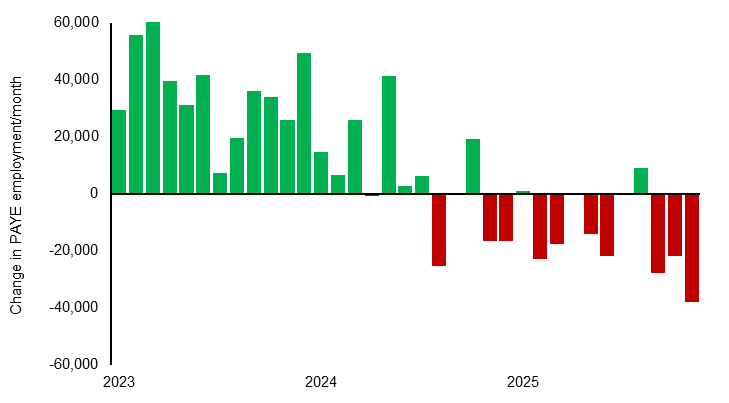
According to the ONS, payrolled employment has fallen in nearly every month since the new government took office in 2024.
Consensus projections for the next four quarters, compiled from leading investment banks.
Access the full forecast →
Yet, layoffs remain low for now, but BCA warns falling profit growth raises the risk of job cuts.
Timper explains that the rise in unemployment has triggered the Sahm rule:
"Historically, once the unemployment rate has risen past the Sahm Rule’s threshold, it creates a negative feedback loop and has therefore been a good recession indicator for the UK," he says.
The Sahm rule states: "When the three-month moving average of the national unemployment rate is 0.5 percentage point or more above its low over the prior twelve months, we are in the early months of recession."
To be sure, January's above-consensus PMI numbers released last week suggest the British economy rebounded at the start of 2026.
However, BCA sees this as a post-budget relief bump.
"Financial conditions remain a headwind, and we expect these positive surprises to remain short-lived," says Timper.
What does this mean for the pound?
With unemployment set to rise further, wage inflation will fall, ensuring disinflation trends continue.
The consensus amongst economists is the Bank of England will cut interest rates further as a result of an expected fall in inflation, but the extent of those cuts is debated.
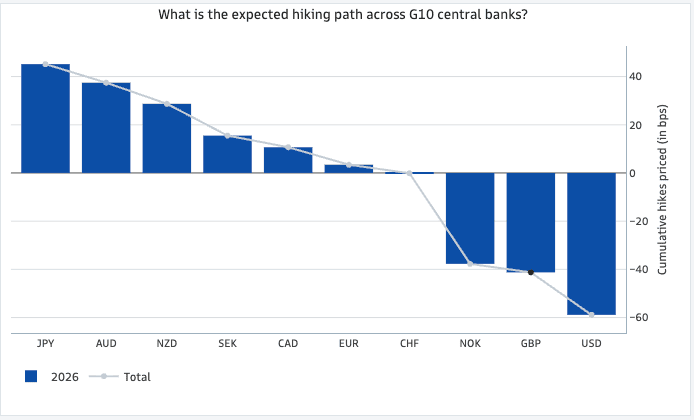
Above: The Bank of England is expected to cut more aggressively than most peers this year.
The market's rule of thumb is that any downshift in UK rate expectations should weigh on the pound.
"All else equal, a weak UK economy and a dovish BoE will be bearish for the pound. Our FX strategists, therefore, remain underweight the pound," he adds.
This is best expressed against non-dollar pairs, such as the pound to euro, owing to the significant dollar decline underway.
"We are more optimistic on the economic outlook in the euro area and therefore expect the BoE to surprise dovish relative to the ECB, which should favour our long EUR/GBP positioning," says Timper.
(Long EUR/GBP means buying euros and selling pounds).