
Image © Adobe Images
The British pound's biggest headwind this year will be the deteriorating jobs market.
A surge in redundancy notifications confirms the deterioration in the UK labour market could accelerate in the coming months.
The Insolvency Service reports the number of potential redundancies jumped to 33,392 in the four weeks ending December 14, the second-highest level in the post-pandemic period.
Redundancies are considered a leading indicator of labour market trends and signal further job losses, which will worry the Bank of England.
"Recent labour market loosening likely has further to run, as the support from strong public sector job creation wanes," says Oxford Economics in a recent UK economic overview.
Seasonal dynamics show redundancies tend to ease off in December, making these figures particularly worrying.
The Bank of England sees the labour market as a crucial component of inflation trends, judging that job losses will weigh on wage growth which is in turn disinflationary.
Currently, the market sees two further Bank Rate cuts in 2026, but this could rise if upcoming job market data are poor.
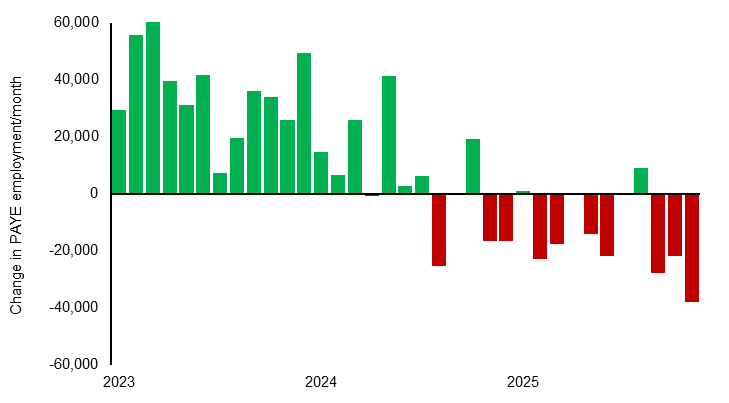
Payrolled jobs have fallen consistently since the new administration took over.
Analysts say falling UK rates are one reason to expect sterling to weaken in 2026.
Redundancy data is gathered from companies that plan to cut more than 20 workers per site, meaning it vastly underestimates the true scale of the deterioration underway.
The redundancy data follows the November 26 budget that saw the government announce £26BN in additional tax hikes.
Leading into the budget, surveys revealed chronic uncertainty as businesses and households braced for further tax announcements.
The UK has lost 190K jobs and unemployment has climbed to a near five-year high of 5.1% since Labour's 2024 budget announcement, prompting the Bank of England to lower interest rates.
The pound was a top-performing currency in 2023 and 2024, held aloft by the UK's elevated interest rates, but that outperformance waned in 2025 as the reductions to Bank Rate on four occasions.