

















The SNB’s resolve to keep its currency weak against the Euro by intervening in the markets and selling Swiss Francs looks to be waning according to strategists at Deutsche Bank.
The Swiss National Bank (SNB) has had a long history of trying to devalue their currency to maintain the competitiveness of their exports.
With news that Swiss watch exports have plummeted to fresh multi-year lows this month - largely thanks to a strong currency pricing them out of international markets - it is not hard to understand why a weaker currency is needed.
But analysts at Deutsche Bank argue this is a losing battle and they see the SNB potentially giving way at the current defence level of 1.08.
Indeed, the believe EUR/CHF could even fall to parity:
“Once politically sensitive dividends to the cantons are out of the way in January, the SNB will have more capacity to incur valuation losses associated with a mini EUR/CHF peg break to parity.
An historically low-interest rate of -0.75%, brought down by the SNB as part of the strategy mix to keep the Franc from evaluating, is having negative repercussions for the banking sector, and its ability to make profits on loans.
Switzerland’s high balance of payments surplus due to it being such a major exporter, and its inability to recycle the surplus by investing it abroad is causing the SNB to ‘backstop the balance’, potentially causing financial instability.
“The capital outflows required to recycle current account surpluses have persistently failed to materialize, and the SNB cannot backstop the basic balance indefinitely without jeopardizing financial stability,” say Deutsche.
Deutsche Bank targets EUR/CHF at 1.06, 1.04, 1.02, and 1.00 at the end of Q1, Q2, Q3, and Q4 of 2017 respectively.

First 1.20 and now 1.08
The SNB caused a perfect storm in currency markets in 2015 when it removed the EUR/CHF peg at 1.20.
The central bank had felt unable to defend 1.20 after news emerged that the ECB was about to launch a stimulus programme which would have the effect of devaluing the Euro.
The SNB’s withdrawal led to a sudden extreme drop in the exchange rate to 0.8690, destroying many brokers and speculators who had been relying on the SNB’s defence of 1.20 in the process.
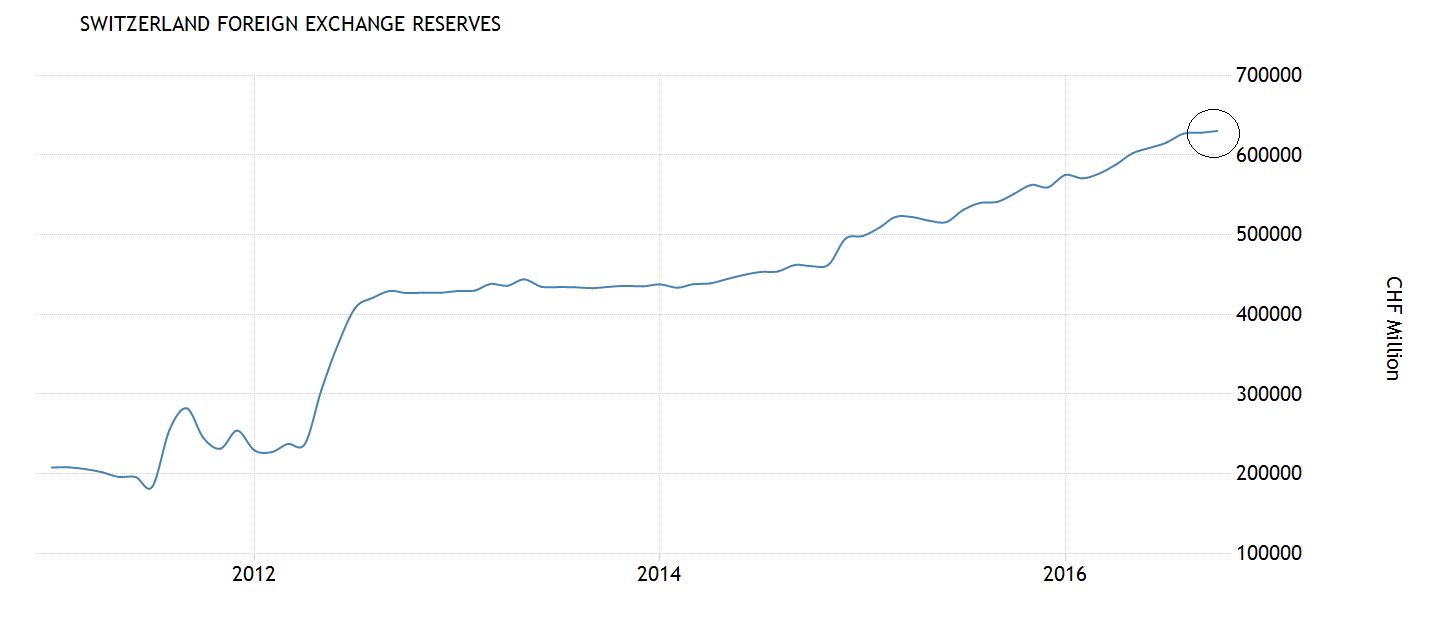
The SNB has since continued defending the Franc but at a higher level as shown by its rising foreign exchange reserves which are testament to intervention purchases made to weaken the Franc.
Recently the pace of upside momentum in the increase in Reserves has slowed, however (circled below), signaling a possible tapered withdrawal from the SNB.
We see a break below the 1.0610 spike lows as being key to establishing a downtrend, with a target at support at 1.0260 from previous lows.
Near-Term EUR/CHF Gains Forecast to Extend
From a technical perspective, we are told to expect EUR/CHF to extend recent gains in the near-term by analysts at Blackwell Global.
Analyst Matthew Ashley tells clients gains could potentially see the exchange rate move as high as the 1.0824 mark.
"Technical forces are largely responsible for the gains seen so far and, as a result, they will be the primary focus moving ahead. However, it remains worthwhile to keep an eye on the fundamentals due later in the week as the impending figures carry somewhat more clout than those released on Monday and Tuesday," says Ashley.
Ashley notes that on the four-hour chart there is a demonstrable uptrend taking shape which has ostensibly ended the October-November decline:
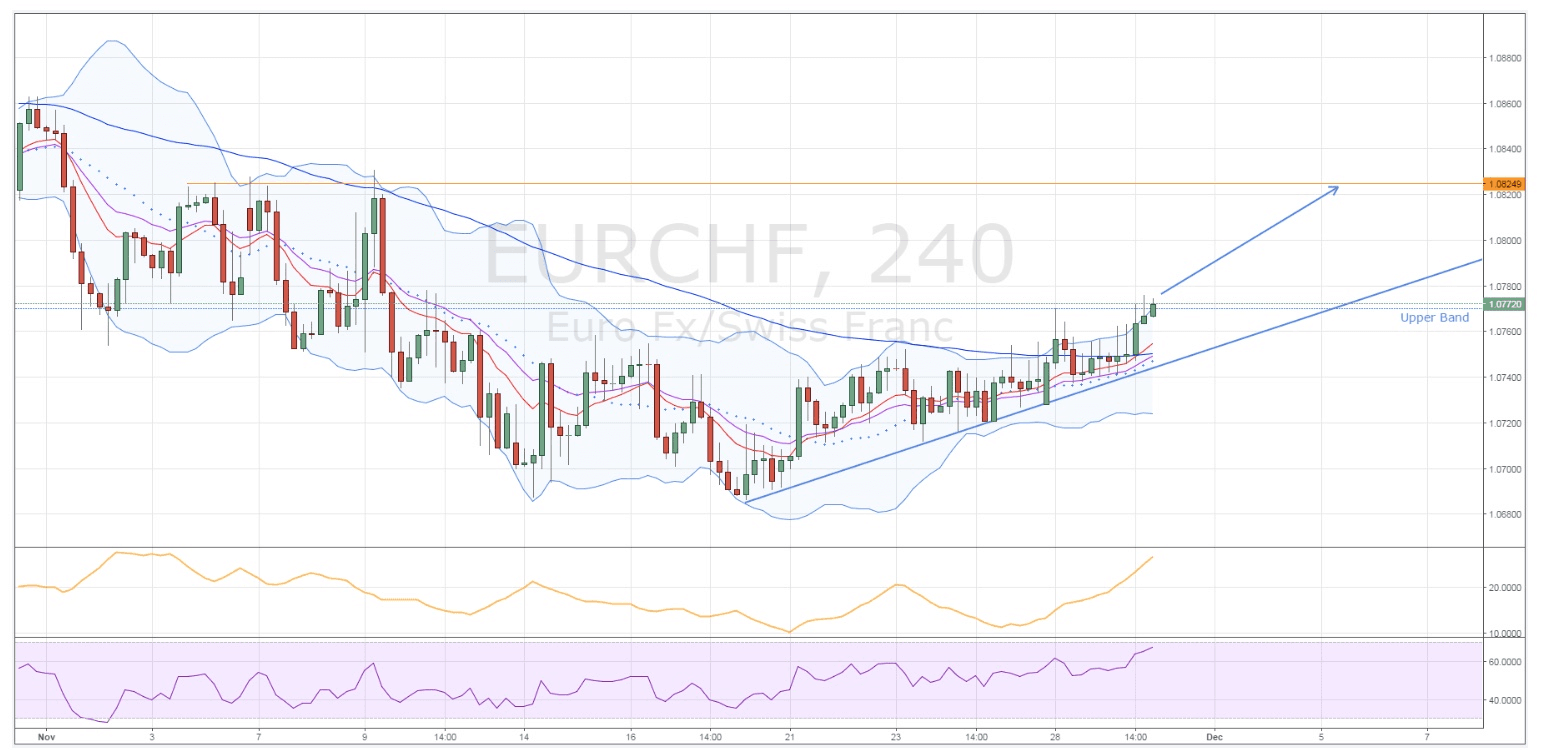
"Confirming that we are, in fact, seeing a change in bias for the pair is the EMA activity as it has now moved above the 100 period average," says Ashley. "What’s more, this particular average is on the verge of completing a bullish crossover with the 20 period average, much as it did with the 12 period EMA."
In addition to the EMA configuration, the change in trend is being signalled by the parabolic SAR readings as well.
Whilst not shown, on both the four-hour and daily charts the trend detecting indicator is now firmly bullish says the analyst.
Moreover, the four-hour ADX oscillator is currently above the key 25.0 mark which signals that a relatively strong trend is now crystallising, much to the chagrin of the EURCHF bears.
"Further adding to the body of evidence suggestive of more upsides moving forward comes from the Bollinger Bands. As is clear on the above chart, the recent spate of gains has seen the pair push above the upper band. Typically, such a manoeuvre is indicative of some strong underlying buying pressure which could be enough to keep the EURCHF’s momentum going as the week continues," says Ashley.