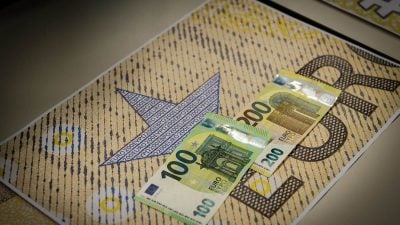
Image © European Central Bank.
The European Central Bank (ECB) should do enough to reinforce the solid floor underneath most euro exchange rates.
The ECB won't change interest rates on Thursday but markets will be keenly tuned into what President Lagarde and her colleagues say about the likelihood of a rate rise coming as soon as June.
Don't expect anything the ECB says or does to ignite currency markets; instead, expect it to keep a solid bid under the euro that should allow it to strengthen more noticeably once the Middle East conflict is resolved.
"The ECB is likely to keep interest rates unchanged this week as it gathers more information about the implications of the war in the Middle East for price stability. We think that the inflation shock in the pipeline will lead the central bank to hike rates in June and September by a cumulative 50bp," say economists at Italian bank UniCredit.
UniCredit's FX Strategist, Roberto Mialich, says that puts the ECB on course to 'out hike' the Federal Reserve this year:
"Tighter interest rate differentials could drive EUR-USD higher again, probably even back towards the YTD peak of 1.2078, but not before the current war-driven risk premium has fully unwound."
So the war is a handbrake on the euro's short-term prospects; understandably so, as the Eurozone economy is a net importer of energy and will endure a growth slowdown owing to the war's impact on energy prices.
The ECB will be keen to point out that the Eurozone is less exposed than it was in 2022 when gas flows from Russia suddenly stopped, meaning the economy should be resilient enough to keep chugging along.
"The ECB hiking into a crisis could be bad for the EUR. But if they are hiking because oil is higher-for-longer, labour markets are tight, equities are ripping, and life is okay, that’s bullish EUR," says Brent Donnelly, analyst at Spectra Markets.
Strategists at TD Bank see a 40% chance that the ECB strikes a 'hawkish' tone where the euro responds with a 0.20% advance against the dollar.
Here, "President Lagarde focuses on the energy shock and the risk of inflation expectations becoming unanchored as a result," explains TD Securities. "She emphasises that though the situation still needs more time to evolve, the ECB will not hesitate to move off the perch sooner to ensure energy and food second-round effects do not take off."
However, downside risks to the euro cannot be discounted. Interestingly, TD Securities sees the euro shifting lower (-0.3%) even under a more neutral scenario where the ECB simply holds the line and commits to nothing, arguing that it wants to see more data before acting.
The market could interpret such a stance as a subtle push-back against the build-up in expectations for rate hikes we have seen of late.
Lagarde would emphasise recent economic data that points to growth slowing, which means euro exchange rates could come under pressure on the day.
"We note the BLS survey showed tighter bank credit standards, which limit the need for ECB tightening. Coupled with last week's weak PMIs, we expect growth concerns to increasingly dominate the thinking in the Governing Council and favour fading any pricing of hikes beyond September," says a preview note from Danske Bank, issued Wednesday.
The flash estimate of the Eurozone composite PMI fell into contraction territory at 48.6 in April. Inflationary pressures continued to strengthen, suggesting the region faced a stagflationary shock from the recent rise in energy prices.
"However, the current PMI report shows that, despite the slowdown, some second-round price effects are already arising. That might push the central bank into at least one rate hike later this year, to prevent the current inflation increase from raising inflation expectations," says Peter Vanden Houte, Chief Economist for the Eurozone at ING Bank.
For now, the prospect of higher Eurozone rates, despite signs of slowing growth, should be enough to underpin euro exchange rates.
However, the risk is that the growth slowdown becomes more pronounced, in which case the bullish thesis for the euro into year-end will be questioned.