
Image © Adobe Images
The Euro looks better supported this week.
The Euro to Dollar exchange rate (EUR/USD) could cross 1.16 again this week as momentum sways away from the Dollar back to the Euro.
Friday's 1.52% gain in EUR/USD was impressively strong, and might just be enough to shift the underlying technical structure from the downside to the upside.
To be sure, there is more work to be done; for instance, a close above the nine-day exponential moving average (EMA), to confirm the near-term trend has turned bullish again.
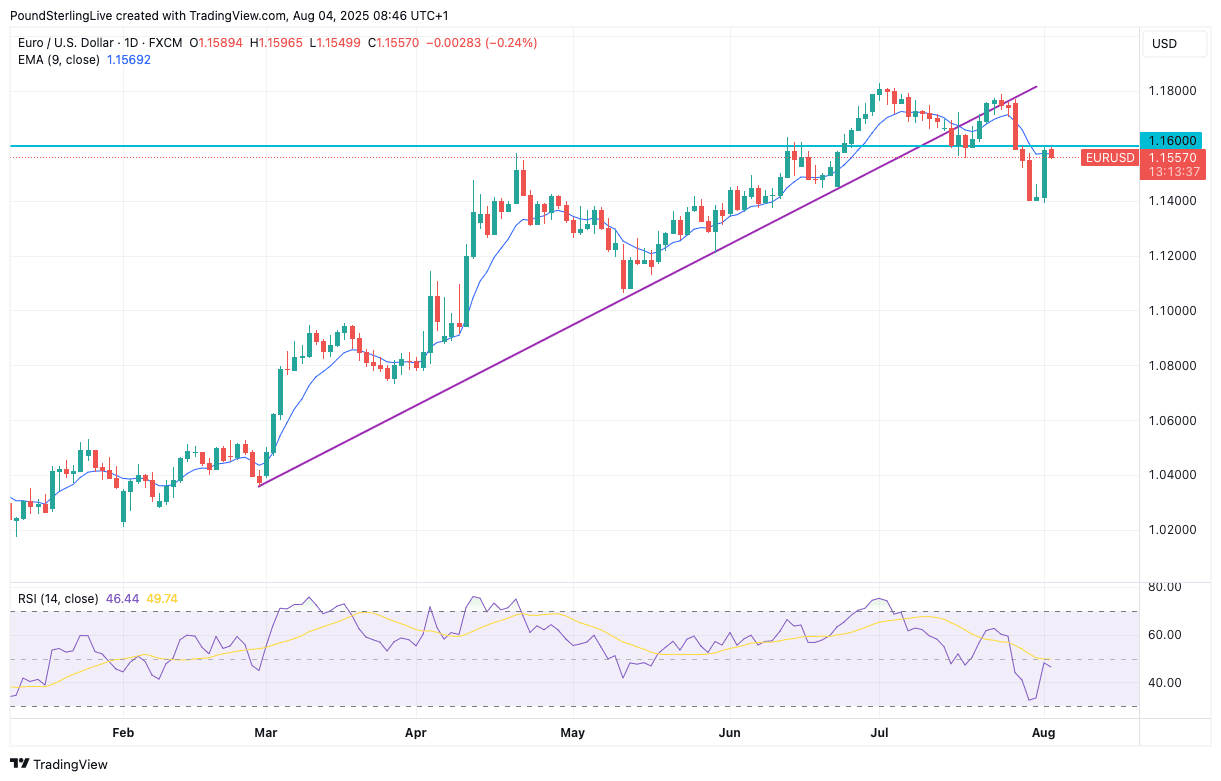
Above: EUR/USD at daily intervals.
And, the chart shows that the 1.16 graphical resistance line is back in play Monday, which could thwart upside in the coming hours and early stages of the week.
Yet, despite some near-term hurdles, we think they are relatively minor, and suspect the fundamental backdrop and the strength of the move on Friday will prove enough to allow further near-term gains, with a drift above 1.16 likely in the coming days.
The trigger behind the lift in EUR/USD was the stock market fall that followed Friday's U.S. labour report that showed just 73K non-farm jobs were added in July, disappointing versus the 104k median expected by analysts.
"Quite a brutal non-farm payrolls report all in," says Sam Hill, Head of Markets Insights at Lloyds Bank. "Revisions were sharply lower. They slashed jobs growth in June to 14k from the 147k initially reported and left the cumulative two-month revision 258k jobs lower. Revisions over the first half of the year now sum to -461k."
These data send the sober message that the U.S. economy could yet feel the impact of a destabilising six months of frantic policy adjustment in the U.S. under its new president. The most important development is, of course, the imposition of import tariffs to levels last seen in the 1930s.
"We remain constructive toward EUR-USD over the medium term. The factors behind the USD weakness that has emerged so far this year remain alive. And kicking," says Roberto Mialich, FX strategist at UniCredit.
Tariffs will have the effect of raising inflation and forcing readjustments amongst domestic businesses. But, from a market perspective, the more significant development is that this still-high inflation limits the Federal Reserve's ability to cut interest rates.
Sure, the Fed will probably cut rates in September following this jobs report, but it will still be constrained by inflation going forward.
Since 2008 investors have known they can count on the Fed to jump in and support them on the first signs of danger. But we are in a world now where inflation is uncomfortably high, limiting the Fed's ability to help.
It is little wonder then that markets fell, and the Dollar was dragged down too. These data mean the end of U.S. market exceptionalism remains a theme to consider, and it is the Euro that stands to benefit the most from any rebalancing in global portfolios as international investors seek greater diversification.
"The euro remains the default option for global investors diversifying out of the USD," says Bolz. "The fiscal measures in Germany and increased European defence spending should give the EUR another boost. We therefore retain our Attractive rating on the euro," says Constantin Bolz, CFA, Strategist, UBS Switzerland AG.