
Image © European Central Bank.
The Euro has been hammered by the Dollar's reboot.
Dollars are in demand again following a spate of strong U.S. economic data and signals that the Federal Reserve will maintain interest rates at current levels for even longer.
"Markets responded firmly to stronger-than-expected U.S. macro data and an unexpectedly hawkish tone from Chair Powell, sending the dollar up 1% on the day and 2.5% over the past five sessions. This marks its strongest five-day performance since September 2022," says Kevin Ford, FX & Macro Strategist at Convera.
Investors were effectively prepared for U.S. interest rates to fall in September, but Wednesday's update from monetary policy makers in Washington saw expectations for that reduction fade to 47% from 70%.
This was after Federal Reserve Chair Jerome Powell said, "you could argue we are a bit looking through goods inflation by not raising rates." The mere mention of "raising rates" was enough to castigate a sanguine market that had grown too used to the idea that we are on the cusp of another cycle of reductions.
Instead, Powell indicated that the Fed will continue to monitor data ahead of September, confirming cuts are no shoe-in.
In response to the Fed's message, yields on U.S. two-year bonds, an important driver of currencies, posted the biggest rise in six weeks (+7.3bps to 3.94%).
"Higher rates and solid data meant the dollar index (+1.06%) advanced for a fifth consecutive day, marking its largest daily increase since May and its longest winning run since February. With a +2.22% rise since Friday, it is on course to post its biggest weekly gain since 2022," says Peter Sidorov, a strategist at Deutsche Bank.
The Euro to Dollar exchange rate (EUR/USD) fell 1.24% on the day to 1.14, taking the week's cumulative loss to 2.50%. From a technical perspective, this puts the uptrend to rest for a while, and we can even start to see some oversold conditions creep into some technical indicators, for example the RSI and bollinger bands:
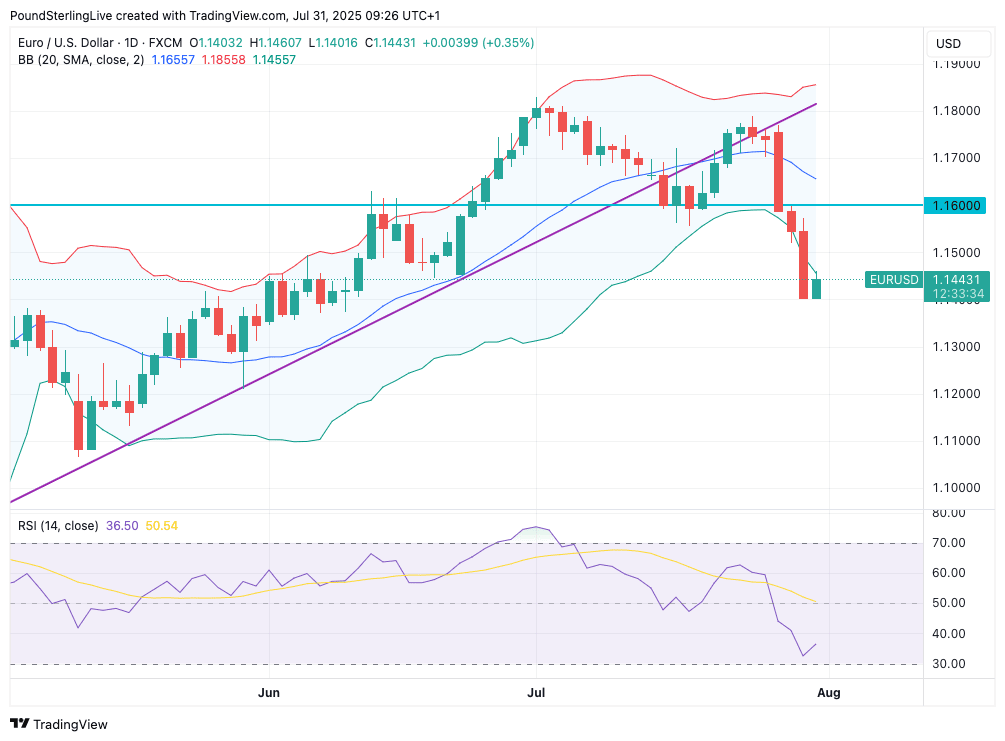
Above: EUR/USD at daily intervals with bollinger bands and RSI in lower panel, suggesting oversold conditions.
Some near-term consolidation in Euro-Dollar now looks possible in light of the recent pace of change, although a substantive rebound looks to be off the cards owing to the reconfiguration in market fundamentals.
The Fed decision followed news the U.S. economy grew by 3.0% annualised in the second quarter, which was ahead of expectations, and lessens the need for the Fed to come to the rescue with a series of cuts.
However, an interrogation of the data suggested there were some trade-related one-offs that flattered the headline economic growth print, with sub-components showing some notable slowing in consumer and business expenditures.
"Underlying growth was weak in Q2 and took a material step down in the first half of this year compared to 2024," says Oliver Allen, Senior U.S. Economist at Pantheon Macroeconomics. "Consumers’ spending grew by 1.4%, an improvement on the meagre 0.5% increase in Q1, but still a clear step down from 2024... Fixed investment was also meagre in the round, rising by just 0.4%."
Economists say the economy will cool in the third quarter, which should show up in the August data cycle. This can yet convince the Fed it needs to lend a hand by cutting rates.
If this proves to be the case, then the U.S. Dollar might face some resistance, albeit we will have to wait a couple of weeks for the data to arrive.
"We remain constructive toward EUR-USD over the medium term. The factors behind the USD weakness that has emerged so far this year remain alive. And kicking," says Roberto Mialich, FX Strategist at UniCredit.
In the meatime, the recovery can continue, pressing Euro-Dollar below 1.14 in the coming days after a period of consolidation that would allow aformentioned oversold conditions to unwind.