- Pound to Euro exchange rate reference (21-2-17): 1.1791
- Euro to Pound Sterling exchange rate reference: 0.8486
- Euro to Dollar exchange rate reference: 1.0539
Alan Greenspan believes the Euro will collapse and the ECB Mario Draghi should come clean on the state of the Eurozone economy.
The former Chair of the US Federal Reserve says it’s only a matter of time before the Euro collapses.
"Northern Europe has, in effect, been funding the deficits of the South; that cannot continue indefinitely. The Eurozone is not working,” says Greenspan.
The call comes at a time Greece is suffering yet another debt crisis, Italy is also having to bail out its banks wiping out the savings of many Italian investors, Deutsche Bank has issues and Brexit may cause further economic consternation.
And there are notable counter-establishment political movements on the rise with fears that the Brexit vote has opened the door for other anti-EU votes.
But for Greenspan, "Brexit is not the end of the set of problems, which I always thought were going to start with the euro because the euro is a very serious problem."
Some have suggested the former central banker would do well to look at his own backyard.
“While we agree with many of Greenspan’s comments and views we wonder how concerned he is about the mountain of US debt which exists and which is likely to grow under the Trump administration,” says John Meyer at SP Angel, a brokerage based in London.
But Greenspan counters, ”the European Central Bank (ECB) has greater problems than the Federal Reserve.”
"The asset side of the ECB’s balance sheet is larger than ever before, having grown steadily since Mario Draghi said he would do whatever it took to preserve the euro,” says Greenspan. "And I have grave concerns about the future of the Euro itself.”
SP Angel reflect that with so much debt and banking issues in the world it is no wonder that investors are increasingly buying gold as a preferred currency.
The Debate over the future of the Eurozone comes at a time of increased political uncertainty and continued Greek debt issues.
Yet, analysts argue the problem for the Eurozone really started with the Great Financial Crisis, triggered by the financial collapse of 2008.
A strategy note from Australia’s Macquarie Bank suggests that the crisis uncovered the long-established fractures on Euro which largely run along cultural lines.

The argument made by Macquarie is that the Eurozone needs many, many more years of stability to merge the fractures and fledge into a viable super-state.
If these fractures are to continue growing we are likely to hear more and more pronouncements of the Euro’s doom.
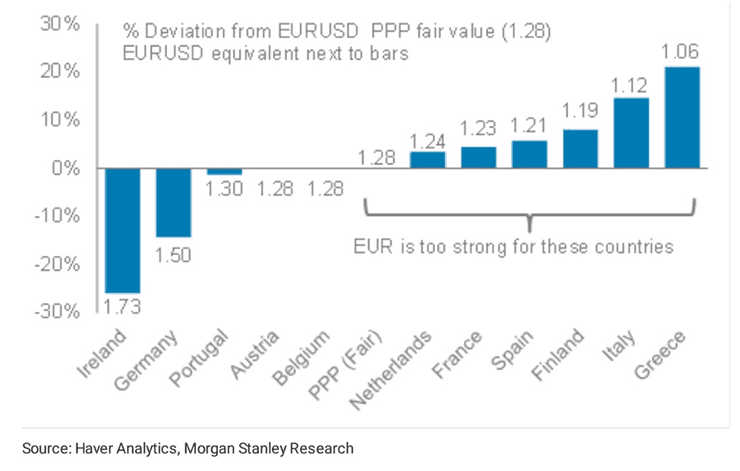
Above: One size doesn't fit all - the Euro is too expensive for some of the Eurozone's most troubled members.
Yet, the monetary union still has its backers.
“I’ll be the first to agree that the eurozone suffers from a number of inefficiencies, but you have to keep things in perspective,” says Eric Nielsen, Group Chief Economist at UniCredit Bank in London.
On the “eurozone sustainability issue”, including whether Greece is a reflection of a broader issue of sustainability of the Eurozone construct, his answer is “no.”
Nielsen’s argument is that the Eurozone is ultimately no worse off than the US.
“Even though the Eurozone has had two recessions since its start, while the US had only one (the first imported from the US, the second self-inflicted via fiscal austerity), Eurozone per capita GDP growth for the “bottom 90%” has been virtually the same as in the US,” says Nielsen.
Recently, productivity growth has been stronger – also stronger than in the UK.
“Yes, unemployment is higher than in the US, but that is more than accounted for by increases in the participation rate: In the Eurozone, an increasing share of the adult population want to work; in the US it’s been the opposite,” says Nielsen.
Four Reasons Euro Exchange Rates are Under Pressure
At the start of a new week in global foreign exchange we see the Euro is down against both the US Dollar and British Pound.
With politics increasingly weighing on the currency, perhaps these latest developments explain why the shared currency is failing to find upside traction:
Le Pen Gains on Rivals
Monday’s daily OpinionWay poll showed that first-round support for anti-euro candidate Le Pen rose 1 percentage point to 27 percent, with Macron and Republican Francois Fillon unchanged at 20 percent each.
While no surveys so far have shown Le Pen even close to a victory in May’s run-off, she’s quickly narrowing the gap to her rivals.
OpinionWay showed Macron would defeat Le Pen by 58 percent to 42 percent in the second round, his advantage has halved in less than two weeks.
Greek Debt Saga Continues
Ahead of key talks over Greece's debt saga, German Finance Minister Schaeuble told ARD public television he was "starting from the principle" that the IMF would continue to support Greece alongside the Eurozone.
Athens has said that it intends to reach "a political agreement in principle" with its creditors on Monday, in order to unblock loans required to repay its debts.
Schaeuble and other Eurozone finance ministers will meet in Brussels in Monday, with a key meeting between German Chancellor Merkel and IMF Managing Director Lagarde scheduled for Wednesday.
With so many failure points emerging as the crisis flares up it is no wonder the Euro is nervous.
European Commission To Warn Italy On Rising Debt
According to Reuters, the European Commission will issue a warning to Italy on Wednesday that the country risks EU disciplinary action for not reducing its huge public debt, unless Rome delivers the promised deficit-cutting measures. The Commission`s economic forecasts for Italy show that its public debt would rise to an all-time high of 133.3% of GDP this year, up from 132.8% in 2016.
Germany`s Social Democrats Overtake Conservatives In Latest Poll
The Social Democrats (SPD) have overtaken Chancellor Merkel's ruling conservative Christian Democrats (CDU/CSU) in the latest opinion poll by the Emnid institute, according to Bild am Sonntag.
Support for the SPD was up 1 percentage point to 33%. Support for the CDU/CSU was down 1 percentage point to 32%.
What would a leftist German government mean for the European politics going forward? We are not sure, but what you can bet is that the Euro would like the status quo under Team Merkel to continue.