Foreign exchange strategists at Credit Suisse have briefed clients that they are looking for further weakness in the EUR/GBP conversion rate in the near-term.
The call comes amidst a push higher in the broader Pound Sterling complex amidst quiet market conditions with one analysts saying markets could be aware that Sterling is cheap when viewed from a longer-term perspective.
The stronger Pound has pushed the Euro to 0.8489 at the time of writing ensuring a trend of EUR/GBP weakness that has been in place since mid-January runs into the mid-February period.
Those with an interest in this exchange rate will now be asking whether or not the Pound can extend its recent strength to deliver the lows in EUR/GBP last seen in December.
“EURGBP remains under pressure and continues to weigh on trendline and price support now at 0.8489/82,” says David Sneddon, an analyst with Credit Suisse based in London.
Sneddon looks for this area to hold further.
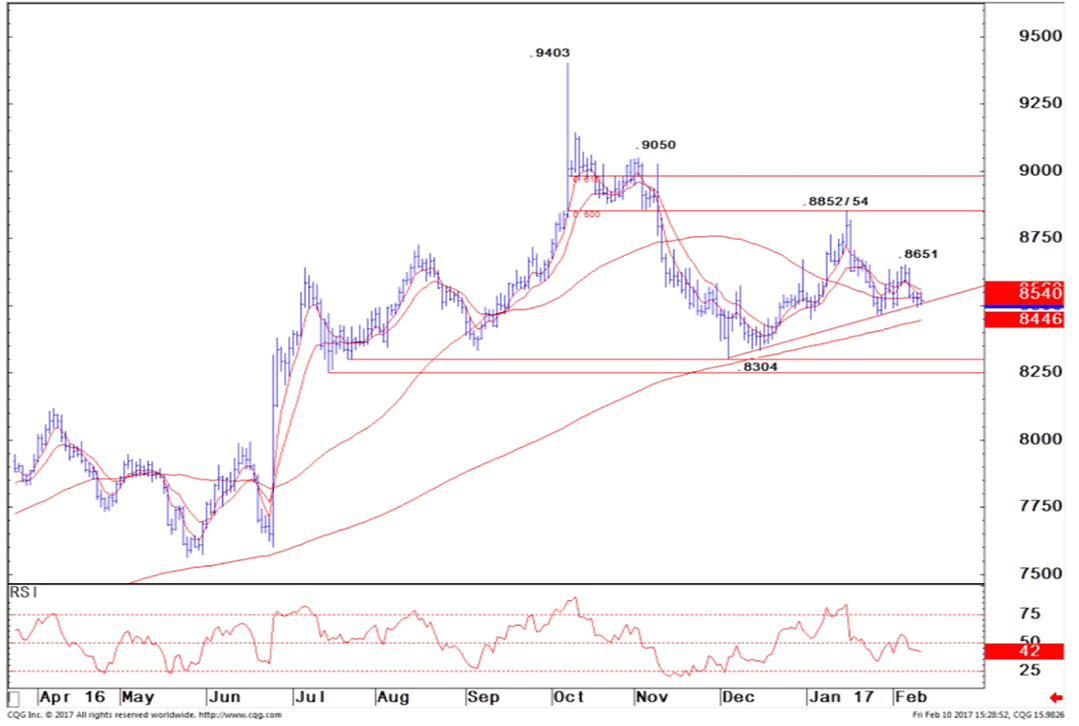
“However, the risks remain bearish and we look for an eventual break beneath here to test more important support at the 200-day average and low for the year at .8450/46. We look for a fresh floor here,” says Sneddon.
The analyst argues a break would warn of a potentially important top, and a move to the 0.8304 low of December.
“Resistance moves to 0.8552/60 initially, then 0.8584, and while below here the immediate risk can stay lower,” says Sneddon.
However, should the Euro enjoy a bout of strength and move above these aforementioned resistance points then the exchange rate could well recover further towards the 0.8640/51 region.
However, only once this region is broken would Sneddon entertain the prospect of a turn in the trend higher again.

Euro Weighed Down by Greece
While technical studies advocate for further gains by the Pound against the Euro, so too does the fundamental backdrop provided by the Eurozone’s political and monetary landscape.
The Euro is tipped to remain subdued by the ECB's monetary policy which looks to remain accommodative for some time yet.
The ECB is unlikely to indicate it is will to raise interest rates or aggressively ease back on its policy of quantitative easing in a year when major EU countries go to the ballot box.
European political risks have been heightened by the rise of euroscepticism in the Netherlands, France and Italy and also in Greece due to renewed fears of a Grexit.
“Financial markets are focused on the French presidential election, but there is another, nearer-term catalyst for euro weakness: the stalled talks between Greece and its international creditors,” says Mathieu Reaud at UBS.
Reaud argues that If the impasse isn't resolved by the time Eurozone finance ministers meet on Feb. 20, politics will make it hard to resolve afterwards.
“And if the IMF pulls out, both Germany and the Netherlands have said they won't participate further,” says Reaud.
As we note here, Greece exiting the Eurozone is probably a good thing for both Greece and the remaining Eurozone members.
However, the uncertainty provided in the run up to such an exit could be destabilising for the Euro.