The EUR/GBP exchange rate trades higher having found a near-term floor at 0.8330, however it may still be too soon to call the floor in the currency pair's decline.
The EUR/GBP rose strongly in mid-week trade amidst a broad-based British Pound sell-off.
Sterling has been the dominant force in global FX for two weeks now and many traders believe it right to book profit on the move at this stage having noted momentum signals suggest the currency is potentially overbought.
"With much of the recent bounce being positioning related, the current rally looks to be an attractive opportunity to be considering shorting the unit if not against USD then on commodity crosses & EUR," says a currency strategy note from Citibank.
The pair has fallen from September's open down to a low at 0.8330 before recovering to 0.8437 where we see the pair trade ahead of the important ECB event.
This leaves those looking to buy Pounds with their Euros looking at a spread of between 0.8201 and 0.8142 on their bank accounts and 0.8361 - 0.8302 with specialist payment providers.
Concerning the outlook, we would argue it is too early to call the end of the decline.
EUR/GBP remains in a mini-down-trend, which is part of a corrective phase within a broader longer-term up-trend.
The pair may also have formed a slanting double top reversal pattern at the highs:
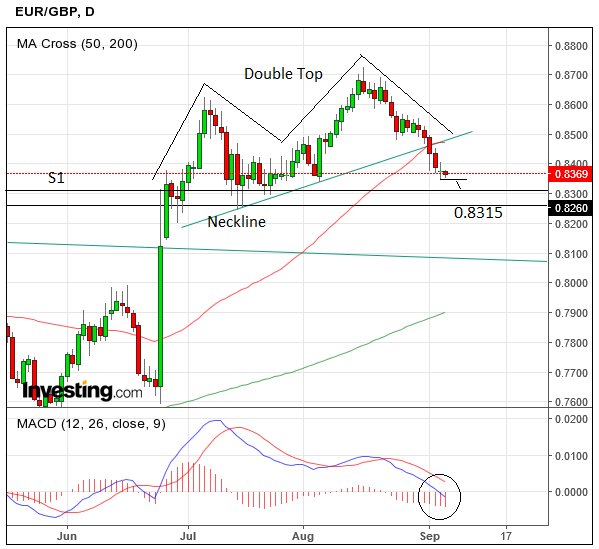
If so, then it is already on its way to an eventual minimum target of 0.8260, however, formidable support from the S1 monthly pivot at 0.8315 is likely to prevent further declines and could lead to a bounce if the exchange rate eventually gets all the way down to it.
Nevertheless, given the very short-term trend is lower and the pair has broken below a neckline for a potential double top, we see a probable extension lower - first to 0.8315, where the pivot is and then possibly after breaking below that to 0.8260.
Commerzbank’s Karen Jones sees the August lows at 0.8345 holding the exchange rate up.
She retains an upside bias, saying that, “longer term the market remains on course for the 0.8815 February 2013 peak.”

Yann Quelenn, of broker Swissqoute, holds the opposite view arguing the bias is to the downside after the pair recently reached a one-month low.
The analyst says the pair has underlying bearish momentum and sees “key” resistance at 0.8725 (16/08/2016 high) and, “hourly support is located at 0.8344 (04/08/2016 low).”
Lloyds Commercial Banking err on the side of bearish arguing they think a major top is now “in place”.
“Last week’s breakdown through 0.8475/70, subsequent post-NFP decline, and yesterday’s fall in response to UK Services PMI increase our conviction that 0.8720 was a significant medium term top.”
The pair is therefore no doubt expected to fall back down to, “Important support," which, "now lies at 0.8300-0.8280 region (July lows and weekly trend support).”
Lloyds, however, allows for the possibility of more upside to resistance at 0.8485-0.8515, and saying that a "rally through there would suggest a correction is developing, but one which should still form a lower high in the 0.8580-0.8655 region."
Latest Pound/Euro Exchange Rates
  | Live: 1.1871▲ + 0.1%12 Month Best:1.1913 |
*Your Bank's Retail Rate
| 1.1467 - 1.1515 |
**Independent Specialist | 1.1705 - 1.1752 Find out why this is a better rate |
* Bank rates according to latest IMTI data.
** RationalFX dealing desk quotation.
ECB Eyed on Thursday, Unlikely to Push Euro Lower
The case for expanding stimulus at the ECB has diminished recently as the impact of the Brexit vote on the Eurozone economy has not been as harsh as initially expected.
If more stimulus were to be announced at the Thursday meeting, we would expect it to lead to a lower Euro as has so often been the case in the past.
However, questions of the effectiveness of the ECB's ability to prompt Euro downside have been raised with the analysts arguing that the Bank has reached its 'zero lower bound' - a liquidity trap that ultimately means the Bank can no longer stimulate the economy via monetary policy.
Analysts at Morgan Stanley, meanwhile, believe the poor state of Eurozone bank balance sheets means they are unable to export capital which would typically be expected to add downward pressure on the single currency
As such euro downside, even in the event of more stimulus may be capped.