
We wrote yesterday that for the GBP/EUR exchange rate to turn more bullish we would like to see it break a key resistance area, it has. We now have a new target that we believe could challenge the Pound's rally.
- Pound to Euro rate today: 1.1727, 24 hour best: 1.1766
- Euro to Pound Sterling rate today: 0.8527, 24 hour best: 0.8528
Pound Sterling has been strong into mid-week with gains taking it above the €1.17 level for the first time in two weeks.
The rally has taken some pressure off those looking to make Euro-denominated payments with bank accounts seeing their rates rise through to 1.14-1.13 and independent payment specialists quoting between 1.1540 and 1.16.
We now start to ask just how far this rally can extend?
Technical levels are likely to play an increasingly important role in the GBP/EUR outlook at this stage owing to the lack of fundamental data coming out of the UK economy.
In fact we have to wait until early September before the first market-moving releases are made available.
With this in mind, we are looking for guidance from the moving averages on the GBP/EUR charts noting their ability to dictate direction in technically-inspired trading conditions.
The Pound-Euro rate has now risen and closed above its 20 day moving average, which was on Wednesday located at 1.1667.
This is significant in that moving averages levels can often result in a reversal of trend. Traders have two considerations when making decisions around the moving averages:
1) Sell, as traders bet others in the market will also be betting on a failure at this level - the rally will fail at this point. Time and again we have seen prices fall back after hitting a moving average.
2) Buy, in anticipation of the level being broken in which case it is anticipated that more buyers will step into the market once the break has been completed.
In essence, we are talking about self-fulfilling prophecies here.
Since the EU referendum we note that the 20 day moving average has had mixed success in its predictive abilities.
When the GBP/EUR closed above this level on 17th July what followed was ten days of sideways movement with the bears unable to force the market below the line:
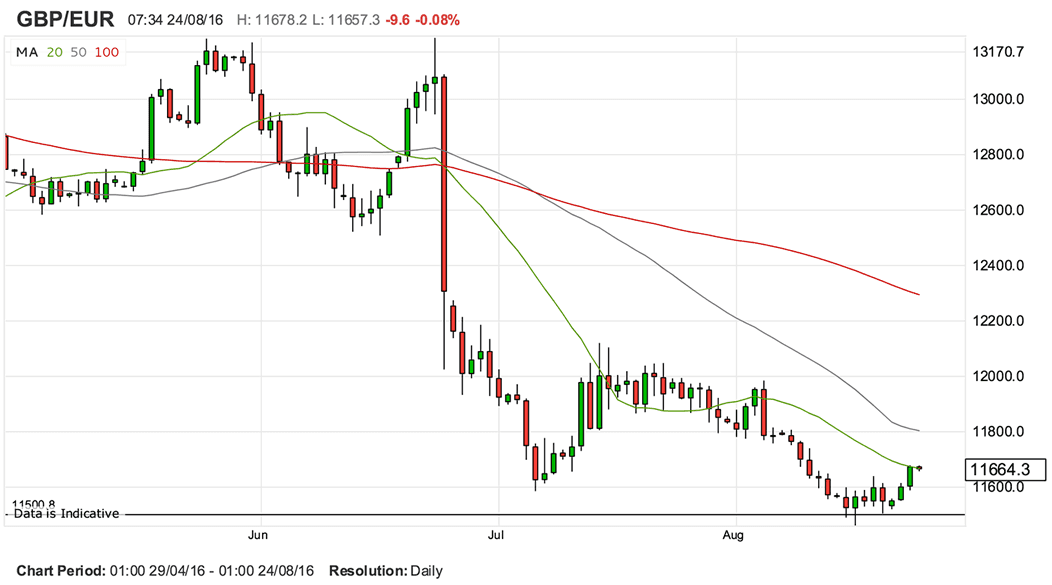
This has indeed happened and Sterling could solidify itself above 1.16 for days now.
It therefore becomes short-term support.
As the 20 day moving average has been broken we now look for the next resistance point to be the 50 day moving average, denoted by the grey line in the above.
It is presently at 1.18 which makes it a doubly important resistance point owing to it being a rounded number which are often psychologically significant.
This should be a harder nut for the bulls to crack and would expect the pair to now consolidate and move sideways.
Latest Pound/Euro Exchange Rates
  | Live: 1.1788▼ -0.02%12 Month Best:1.1828 |
*Your Bank's Retail Rate
| 1.1387 - 1.1434 |
**Independent Specialist | 1.1623 - 1.167 Find out why this is a better rate |
* Bank rates according to latest IMTI data.
** RationalFX dealing desk quotation.
The Euro's Rally is Suffering Exhaustion
The Euro is failing to convince at the moment.
A good set of Eurozone data released on the 23rd August were not enough to halt the Euro's decline against the Pound suggesting investors are growing increasingly wary of pushing the shared currency beyond currency valuations.
Activity in the Eurozone's services sector rose in August to 53.1 from the previous month's 52.9. Analysts had forecast a fall to 52.8.
Results for the manufacturing sector showed a lower-than-expected 51.8 score compared to the 52.0 forecast - however the miss was small change if we consider the number betrays a sector in robust growth.
The composite PMI reached a 7-month high of 53.3 when it had been expected to fall a basis point to 53.1.
Looking at the exchange rate market reaction we note there was little benefit to the EUR, though.
The Euro-Dollar exchange rate rose marginally by 0.11% after the release, trading higher at 1.1333.
The Euro fell a quarter of a percent against the Pound, as the latter's short-covering rally continued.
This suggests that the Euro could be getting expensive against both the Pound and US Dollar at present levels, and will require increasingly outlandish data beats to be pushed higher.
The data nevertheless helped diminish concerns that the Brexit vote had derailed the recovery in the Eurozone, which appears to continue steadily rising as before.
It also lessens the likelihood that the European Central Bank (ECB) will have to use more monetary easing to make up for an expected short-fall in growth caused by the vote to leave.
"Minutes seen from the ECB's July meeting showed policymakers recognized BREXIT had created challenges for the Eurozone but policymakers were adamant they wanted to wait until deciding whether additional stimulus was required. The data releases today will ease pressure for additional stimulus measures to be implemented at their September meeting," says Joe Manimbo, an analyst with Western Union.
Some Concerns
Nevertheless, behind the headline figures there were concerns that certain trends might be heralding a slowdown in months to come.
The accompanying report noted: “new orders received by factories grew at the slowest rate for one – and – a - half years.”
The report also highlighted that whilst services had seen strong, inflows of new business recently, participants noted a marked lack of optimism about the future:
“The future strength of demand in the service sector was meanwhile called into question as business expectations about the year ahead among service providers fell to its lowest since December 2014.”
The report also mentioned cooling job creation.
UniCredit's Edoardo Campanella warns that the outlook for the Eurozone could also be constrained by a weakening Pound:
"The significant depreciation of the GBP, coupled with a likely slowdown of the UK economy, might negatively impact the growth outlook in the eurozone via the trade channel in the coming months."
A strengthening Euro could ease exports to the UK which remains a key export destination for many Eurozone countries.
Despite some points of weakness, IHS Markit’s Chief Economist Chris Williamson, said the data was overall positive and indicative of future growth:
“The August flash PMI indicates that the Eurozone remains on a steady growth path in the third quarter, with no signs of the recovery being derailed by ‘Brexit’ uncertainty.”
He also added he felt the data would reduce the chances of the ECB feeling need to use more stimulus.
British Pound Aided by Strong CBI Manufacturing Data
While the Eurozone's economic stats failed to offer fuel to the Euro, the opposite was true for the UK.
Typically a second-tier event, the CBI Industrial Trends Survey would normally be overlooked.
However, in this time of Brexit economists and currency traders are grasping ahold of anything they can get.
The CBI's latest trends data read at -5, much better than the anticipated -9.
Of note though was the strong surge in exports demand recorded.
"The survey of 505 firms found that export order books reached a two-year high, suggesting that the depreciation of sterling since the end of last year may be feeding through to stronger overseas demand," report the CBI.
Furthermore, the forward-looking output expectations balance, which typically has a better relationship with the official measure of manufacturing output, rose from +6 to +11.
"All in all, then, while it is still early days, the latest survey evidence is another reason to think that the economy should avoid a deep recession. That said, given its relative importance, it will be up to the services sector to ensure that the recovery maintains some momentum over the coming quarters," says Paul Hollingsworth at Capital Economics.