The GBP to EUR exchange rate remains under considerable pressure after the UK's Chancellor George Osborne failed to offer the assurances required to stabilise the currency.
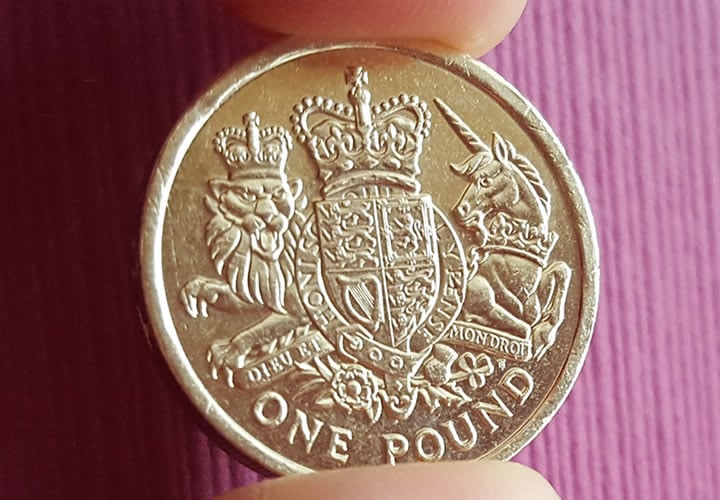
- Pound to euro exchange rate today = 1.2008, 0.13% up on previous day's close
- Euro to pound sterling exchange rate today = 0.8321
The British pound was in freefall at the start of the new week as investors showed they were not comfortable holding sterling at the seemingly rich levels above 1.24.
The speed and aggression of the declines appeared to have the qualities that could destabilise financial markets if left unchecked.
The matter looked to be made all the worse when late on Monday ratings agency S&P cut the UK's sovereign debt rating from AAA to AA.
However, it appears the move lower did run out of steam and on Tuesday we see GBP/EUR attempting to carve a base using the 1.20 support level.
"There are some signs of stabilisation this morning and the pound has recovered slightly it is still too early to expect a more sustained rebound for the pound. Both the effect of the Brexit vote on the UK economy and the political situation is still very uncertain although Prime Minister Cameron yesterday ruled out the possibility of a new Brexit vote," says Andreas Johnson at SEB.
We doubt a longer-term base is ready to form, yet stabalisation above 1.20 could offer relief for the under-pressure market to settle in the near-term.
Near-term trade will of course depend on how the political debate on the UK's future relationship with the EU develops.
David Cameron is in Europe today for a meeting of the European Council and markets will be keen to hear what words are said regarding the way forward.
What is desperately needed is for the large dose of uncertainty poured over markets on Thursday the 23rd to start evaporating.
What we do know is that there is a good chance of recession in the UK over comign months witha number of analysts pricing in two subsequent quarters of negative growth.
Analysts are also expecting the Bank of England to cut interest rates lower from the current 0.5% level.
Such a cut will shore up confidence in the economy however the side effect of such a move would be a notably lower pound.
Lower interest rate yields will ensure that foreign investors no longer have the incentive available to put money into the UK where it will earn returns, thus lowering demand for GBP.
The outlook is undeniably soft.
Latest Pound/Euro Exchange Rates
  | Live: 1.1864▲ + 0.04%12 Month Best:1.1913 |
*Your Bank's Retail Rate
| 1.1461 - 1.1508 |
**Independent Specialist | 1.1698 - 1.1745 Find out why this is a better rate |
* Bank rates according to latest IMTI data.
** RationalFX dealing desk quotation.
Initial Brexit Target for GBP/EUR Met, Slower Declines Ahead?
The size of the fall seen on Friday the 24th was arguably exacerbated because markets were so horrendously overconfident in their bets that the UK would vote to Remain.
The rally from 1.26 to 1.30 over the course of 14-23 June was sizeable and clearly misguided.
The fall back to 1.23 takes the pair back towards mid-June levels, a time when markets were agressively factoring in a Brexit. Therefore, the lion's share of the drop was just taking us back to where the pair should have been.
A similar period of heavy Brexit-discounting was seen back in April; when the pair was last seen in the 1.23s.
1.23 could therefore be argued as being an initial Brexit target.
This does not mean the declines are over, rather it suggests the size and pace of declines is likely to decline and give way to a more gentle slope of depreciation.
Forecasting Pound / Euro @ 1.10
Ultimately, the outlook is negative, owing to expectations of a UK recession over coming months.
The uncertainty posed by the UK vote to leave Europe brings a major headache to UK business, and it is caused by uncertainty.
What will the future of the UK’s relationship with Europe look like?
Can they depend on tariff free access to the world’s largest economy, if so, for how long?
Will the Eurozone seek to punish the UK in order to try and halt further splits in the Union?
With this uncertainty, expect investment decisions to be put on hold.
This will in turn see UK growth fall sharply over coming months.
“The increased risk of recession in the UK and looser BoE policy in the year ahead justify a weaker pound. Capital inflows into the UK will also be dampened making it more challenging to the finance the UK’s elevated current account deficit requiring a weaker pound,” says Lee Hardman, Currency Analyst at Bank of Tokyo Mitsubishi.
Hardman and his team believe this downturn in business activity will see the Bank of England take a look at cutting interest rates from their current record-low 0.50%.
Such a move will ensure the euro is able to advance further against the pound sterling.
“We expect further more modest upside for EUR/GBP as well rising towards the mid to high 0.8000’s in the second half of this year before falling back towards the 0.8000-level in 2017. It is consistent with our alternative Brexit scenario outlined prior to the release of the referendum results,” says Hardman.
If we turn the EUR/GBP equation around, 0.80 equates to 1.25 while 0.8500 equates to 1.17 and 0.90 is 1.10.
Therefore we are looking at levels sub 1.20 in the view of Bank of Tokyo.
Chancellor George Osborne Looks to Soothe Market Fears
The Governor of the Bank of England, Mark Carney, proved effective in settling market concerns when he released a statement on Friday the 24th saying the Bank would do whatever it takes to ensure the financial system retains an orderly character over coming days and weeks.
The pound's sharp decline ended on the intervention.
Now it is time for the British finance minister, George Osborne, to follow suit.
Osborne says the UK would not trigger article 50 of the EU treaty - which would formally initiate the exit - until there is a "clear view" of the future.
This will not please those Europeans who want Article 50 triggered this week in order to both send an aggressive message to other EU states toying with rebelling against the EU and to quickly eradicate market-stifling uncertainty created by Brexit.
Osborne says the authorities are "ready to deal with the consequences" and "let me clear you should not underestimate our resolve. We were prepared for the unexpected and we are equipped for whatever happens."
It appears sterling has settled following Osborne's words, but we get the sense there was not enough by way of specific measures to prompt any kind of recovery.
"It seems that George Osborne’s appearance this morning, his first since before the referendum results were announced, has somewhat calmed investors’ fears, the Chancellor joining many of his Tory colleagues in claiming there is no rush to trigger the dreaded Article 50 despite increasing pressure from Europe," says Connor Campbell at Spreadex.
Decisive Action Please
Markets hate uncertainty and it looks like we are yet to have the kind of decisive moves required to start patching out a path to the future.
"What we really need is some form of decisive action, as financial markets seek reassurance that things will be OK," says Joshua Mahony, a market commentator and analyst with IG, the spread betting provider based in London.
What we look likely to get is two months of political infighting, followed by another 20 months of uncertainty as the new leader somehow attempts to secure a deal which appeals to the many facets of the leave campaign.
"This will all take time and in the meanwhile, investors and businesses are left to ponder what the potential impact will be of this monumental decision," says Mahony.
We also know that the longer uncertainty regarding the UK’s relationship with the EU lasts, the bigger the negative economic hit on the basis of less investment demand and greater risk premiums.
Uncertainty regarding Scotland’s role also warrants higher risk premiums on UK financial markets.
"In turn, the deeper the economic hit, the deeper the trough in GBP," says Martin Enlund at Nordea Markets.
If for instance the UK were to strive for membership in the European Economic Area (EEA), and the rest of EU looks to agree, Enlund says would be as close to a status-quo outcome as possible.
Such an outcome would limit the short-term negative effects on growth in the UK and elsewhere (and quickly lessen the risk-premiums on UK & EA assets/GBP, meaning the Fed could hike rates sooner, and so on).
"It is however not up to the UK to decide on its own, and if the EU decides to 'make an example' of the UK, then the economic outcome will be much worse for the UK and the GBP, so, back to politics…" says Enlund.
Can Central Banks Stop the Rot?
The question now becomes one of when sterling's adjustment will end.
The pace of the declines leaves this market absolutely devoid of any technical support levels and it is therefore nigh impossible to divine any guidance from the charts.
Expect further 'forced selling' to come this week "as margin calls are made and businesses take the weekend to reassess their GBP exposure," say TD Securities in a note to clients.
Markets will keenly look to the central bank conference in Sintra, Portugal, where Draghi, Carney and Yellen will be in attendance.
(We hear though that Carney may have dropped out).
"We’ll surely see some sort of questions there on the monetary policy implications from Brexit, and with this many central bankers and policymakers in one place, we should see some interesting comments from the sidelines as well," say TD Securities.
Could this event offer the reassuring words markets are so desperate to hear?
"Whether it turns into a more dramatic negative shock will depend on how well markets respond to central banks’ reassuring words and actions," say ANZ Research.
Uncertainty Remains Rife
Welcome to a dis-United Kingdom.
As expected the Scottish nationalists are salivating over the prospect of breaking away from the rest of the UK.
The contradictions in the left are interesting - it's OK to break up political union if you are Scottish, but not OK if you are British.
The Labour party are in chaos as a prominent shadow front-bencher is sacked and others threaten resignation.
There is even talk of Labour in Scotland supporting independence.
The Conservative also look divided with a growing 'anyone but Johnson' movement.
Polls show pro-EU Theresa May could be a favourite option.
The Lib Dems have meanwhile suggested they will run on the ticket of returning the UK to the EU.
A great way back into contention for a party that was wiped out at the last election as there will be many out there who will back them on this one galvanising call to action, something they have lacked in the past.
This spells bad news for the Conservatives whose parliamentary majority in the last election was founded on a swing from Lib Dem to Conservative.
Could another coalition happen should the next PM call a snap poll?
Uncertainty remains rife with Germany and France giving mixed signals as to how Europe should proceed with the unprecedented divorce.
It has been said many times that the European Union has more to lose than the UK does on Brexit - and the lack of a unified message on how to approach the Brexit question only amplifies this suspicion.
This week we will look for more official guidance on the matter.
"We’re now seeing various views expressed on what the result could mean for the UK and Europe, and the global economy for that matter. Some believe it is calamitous, others not so much. But the bottom line is that no one can confidently say how events will play out from here as it depends on a number of highly uncertain elements," says a note from ANZ Research in New Zealand, released at the opening of market trade.