The euro has taken back the initiative against pound sterling after a soft start to March and is likely to continue its ascent until mid-year 2016.
The euro to pound exchange rate (EUR/GBP) is on the move higher; from a starting point down at the 0.6981 lows of November 2015, up to the current highs at 0.7925.
Most of the gains have been put down to investors selling the pound on the risk that the UK might vote to leave the EU.
This has put pressure on the pound as there is uncertainty as to whether a Brexit would reduce foreign investment into the UK leading to a fall in demand for sterling.
The marketplace for the pound and euro therefore remains structurally biased in favour of the single currency.
The market has gradually, yet confidently, develop a pro-EUR bias which is likely to remain in place for some time.
Of late though the pound has found some support ensuring the exchange rate has been restricted to a tighter range:
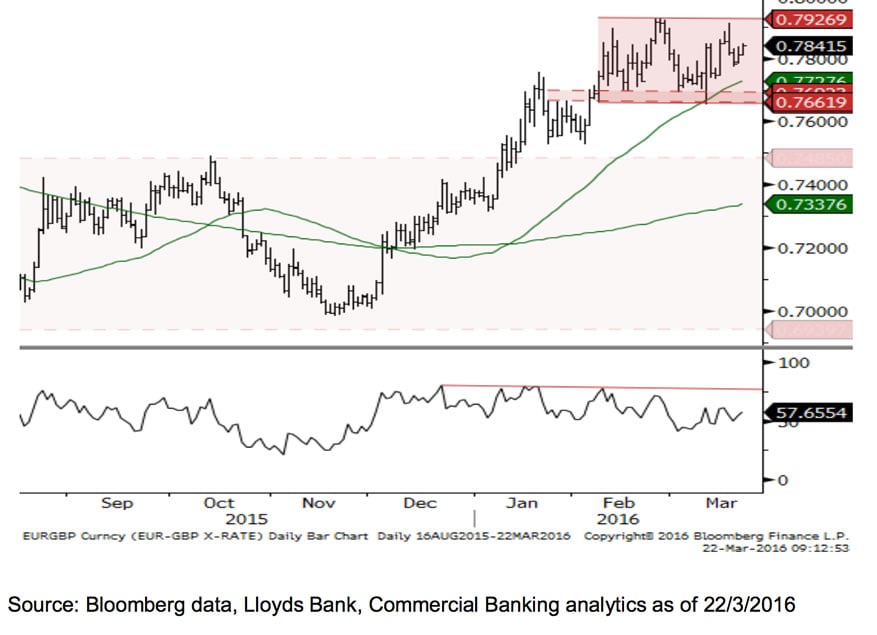
We see this as a corrective move that will likely give way to the dominant trend higher.
That said, others believe the period of pound strengthening and euro weakening could extend a while longer.
“EURGBP is currently trading in the middle of a 0.7650 to 0.7925 range. Intra-day momentum studies continue to support a bearish bias, with a move back towards 0.7695/65 possible,” says Robin Wilkins at Lloyds Bank.
Note that we are currenly at the top of the range, if a breakout can occur, and be held, then the bias quickly turns more positive.
Latest Pound/Euro Exchange Rates
  | Live: 1.1661▲ + 0.17%12 Month Best:1.1828 |
*Your Bank's Retail Rate
| 1.1265 - 1.1311 |
**Independent Specialist | 1.1498 - 1.1544 Find out why this is a better rate |
* Bank rates according to latest IMTI data.
** RationalFX dealing desk quotation.
Should the pound get the better of the shared currency we believe the move lower will likely be temporary as the short-term moving average, which was the base of the last move lower (at 0.7650), could provide the euro with support again, this time at 0.7720, where it is now found.
Moving averages are areas where the market is packed with buy and sell orders and therefore have the ability to stop moves.
“Medium term, the trend from 0.70 to current levels is intact and still risks an eventual move to key long-term channel and Fibonacci resistance in the 0.80-0.82 region,” says Wilkins.
The analyst believe only a decline through 0.7550/0.7450 would suggest those levels won’t be reached and that a significant high is in place for a move back towards the 0.73-0.70 support region.
Fundamentals Argue for Decline to 0.72
While the technical setup in the EUR/GBP marketplace argues for further rises in the exchange rate over the longer-term, fundamental studies suggest this may not quite be the case.
Driving the debate concerning the pound’s fundamental outlook are the Bank of England and the EU referendum.
It is widely accepted that the pound is trading well below where it should be were it not for the risks implied by the EU vote.
As such, should the ‘In’ vote prevail in June, as most analysts and betting markets believe, then the pound should make a rapid recovery against the euro.
This will see the EUR to GBP conversion fall.
Then there is the Bank of England; analysts believe the Bank will be more inclined to raise interest rates in the wake of the vote having passed.
“We think the market is under-pricing the timing and pace of Bank of England rate hikes. We expect the central bank to start hiking in November,” says DNB Banks’s Magne Ostnor.
DNB forecast EUR/GBP to rise to 0.77 in one month, 0.76 in three months and then fall to 0.72 in 12 months’ time.
The exchange rate is currently at 0.7583.