
The pound has enjoyed a strong March but our analysis suggests that those looking to make payments from pounds into euros should be aware the 2016 sell-off could be under way once more.
- Pound in fresh decline in wake of Brussels terror attack
- We believe such events will prompt increased support for a Brexit
- Odds of Brexit increased as bookmakers slash odds
- GBP/EUR quoted at 1.2750 at the time of our latest update
The pound is under pressure on Tuesday with markets being rocked by news of terror attacks in Brussels.
The news means risk management is the key concern right across the financial marketplace.
Importantly for the pound events like this tend to result in an increase in support for the UK to leave the European Union.
A UK exit from Europe remains the single biggest negative for sterling at present with studies suggesting the pound is trading well below fair value. Importantly, analysts argue there is a long way to fall should support for Brexit increase.
Thus, terror attacks are likely to play negative-GBP via the Brexit channel.
We saw after the Paris attacks that support for an exit increased and we bet it will be similar in the wake of the Brussels attacks.
To underline the point, it is reported that odds of the UK voting to leave Europe have increased in the hours of the attack. Bookmaker Paddy Power has narrowed its odd on Brexit to 7/4, or 36%, down from 2/1 or 33%.
Betfair has shortened odds to 36%. Bet 365 and Sky Bet have narrowed their odds to 40%.
Latest Pound/Euro Exchange Rates
  | Live: 1.1656▼ -0.03%12 Month Best:1.1828 |
*Your Bank's Retail Rate
| 1.126 - 1.1306 |
**Independent Specialist | 1.1493 - 1.1539 Find out why this is a better rate |
* Bank rates according to latest IMTI data.
** RationalFX dealing desk quotation.
Furthermore, stock markets are selling off creating the conditions within which the euro tends to benefit.
The euro is known as a funding currency, i.e a currency that is cheap to borrow and fund investments in global stock markets. When markets sell off demand for euros rises as those funds are repatriated.
We could therefore be witnessing a large flow of sterling across the channel as the FTSE 100 moves lower.
The move could trigger further selling pressure as technical levels on the market are tripped.
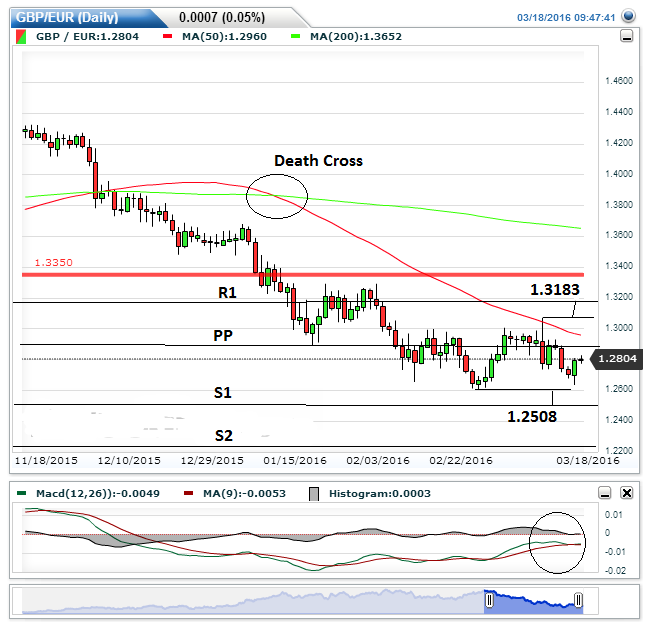
Given the strength of the 2016 down-trend the odds ultimately favour a continuation lower.
An acceleration of the sell-off will come on a break below the Feb lows at 1.2612.
"Macro GBP downtrends are likely to remain intact in any case (with re-emergent strength as/when seen thus regarded as broadly corrective). However to resume the prior negative trend directly an extension through 1.2600 now looks necessary," says Lucy Lillicrap at Associated Foreign Exchange in London.
This break through the support would lead to a probable extension of the move down to a target that equals 61.8% of the width of the current sideways range.
61.8% is the 'golden ratio,' discovered by Mathematician Leonardo Fibonacci.
It is present in many natural phenomena from the ratio of male to female bees in a hive to the spiral shells of sea snails (nautilus).
It also seems to correspond to the length of moves in financial markets.
Our initial target in such an event is therefore located at 1.2377.
A major support level at 1.2508, however, supplied by the S1 Monthly Pivot, which is a level used by traders to buy and sell at, provides a closer initial target.
The 50-day moving average crossed below the 200-day moving average at the start of January, forming a death cross, which is a very negative indicator for the pair in the medium to long-term and casts a bearish shadow over future price action.
Fundamentals to Watch
Brexit fears continue to dog sterling due to fears about the negative economic impact of Britain leaving the EU.
Charles Purdy of Smart Currency Exchange says:
“With concerns around the “Brexit” lingering on, sterling is still lacking the ability to gain meaningful ground against the euro. The downside risk for sterling certainly seems to exceed by a significant margin its upside potential.”
Odds of a Brexit have risen once more according to the Telegraph’s referendum poll tracker and hence we are seeing the exchange rate softer at the start of the week.
Euro Set to Rise Due to Policy Impotence
According to Helaba Economics, the European Central Bank’s (ECB) recent decision to increase quantitative easing (QE), which involves printing money to buy assets from banks - and is normally negative for the currency as it increases the supply of money - appears to have been fully absorbed into the euro’s exchange rate:
“With regard to the euro it is worth mentioning that an appreciation is on the books despite the continuing divergence between monetary policies on either side of the Atlantic.”
The euro surprised traders at the last ECB rate meeting in early March when it rose following ECB President Draghi’s comments that he would not be cutting interest rates any further (when banks cut interest rates it weakens currencies).
In a report from Royal Bank of Canada (RBC), Draghi was reported as saying in a closed door session that he had “no choice” but to cut rates, revealing a marked reluctance for the policy, which highlights how unlikely he is to cut rates further – and is therefore euro positive, as lower rates tend to weaken currencies.
Praet Plays Down Draghi Rate Statement
Not all the ECB seem to agree that a further rate cut is out of the question, however, raising doubts as to the unanimity of Draghi’s ‘no-more-cuts’ view:
For example, RBC also mention the EBC’s chief economist Peter Praet, as downplaying Draghi’s comments arguing a further interest rate cut may well be necessary in the future if conditions warrant:
“ECB’s Praet gave an interview to La Republica newspaper saying ECB does not have a gloomy view of the world, that the deposit rate cut has not reached the lower bound yet and new rate cuts are still an option in case of a shock.”
Praet also discussed ‘Helicopter Money’, which is a policy measure which involves the central bank bypassing banks and lending or giving money directly to businesses and household in the real economy. It is considered controversial and radical. From a currency perspective it would devalue the euro by increasing the gross number of euro’s in circulation.
The euro is also affected by risk sentiment, and tends to gain as a result of a rise in global risk aversion. This is because it is used as a funding currency by investors to buy risky assets, however, when they pull out of those assets the euros are bought back, leading to appreciation. At the end of the previous week we witnessed better-than-expected Chinese data and upbeat Asian markets, which if they are representative of the start of a trend could signal a recovery in risk appetite, which would be negative for the euro.
Economic Data That Matters for Sterling / Euro
Headline UK CPI (year-on-year) is forecast to come out at 0.4% in February from 0.3% previously. The previous three prints were positive.
UK Public Sector Net Borrowing for February is expected to rise to 5.4bn from -11.8bn previously.
ZEW German and Euro-zone Economic Sentiment is forecast to rise on Tuesday March 22, to 5.9 from 1.0 previously.
The IFO sentiment gauge has fallen three months in a row, which is not a very positive sign for sentiment going forward, and could predict further declines to come.
IFO is forecast to come out at 1.06.0 from a current 1.05.7.
On Thursday there are preliminary March PMI’s for The Euro-zone, with Manufacturing expected to rise to 51.3 from 51.2, and Services forecast to remain unchanged at 53.3.
On Friday UK Retail Sales are out and expected to show a -1.0% drop mom in February.
Last month’s result showed an unexpected rise to 2.3%, however, this failed to have a strong impact on sterling.