Those hoping for a stronger British pound to buy euros could be in for some relief as the UK currency appears to be forming a base from which to rise off.

Heading into the mid-week session sterling is holding onto its late January/early-February gains made against the euro.
We have two big events ahead for the British pound - the release of Service PMI data on Wednesday and the Bank of England's super-Thursday. Both could provide fundamental fuel for a move to the upside.
If we look at the charts it is possible to see that the exchange rate is at a key point in its evolution.
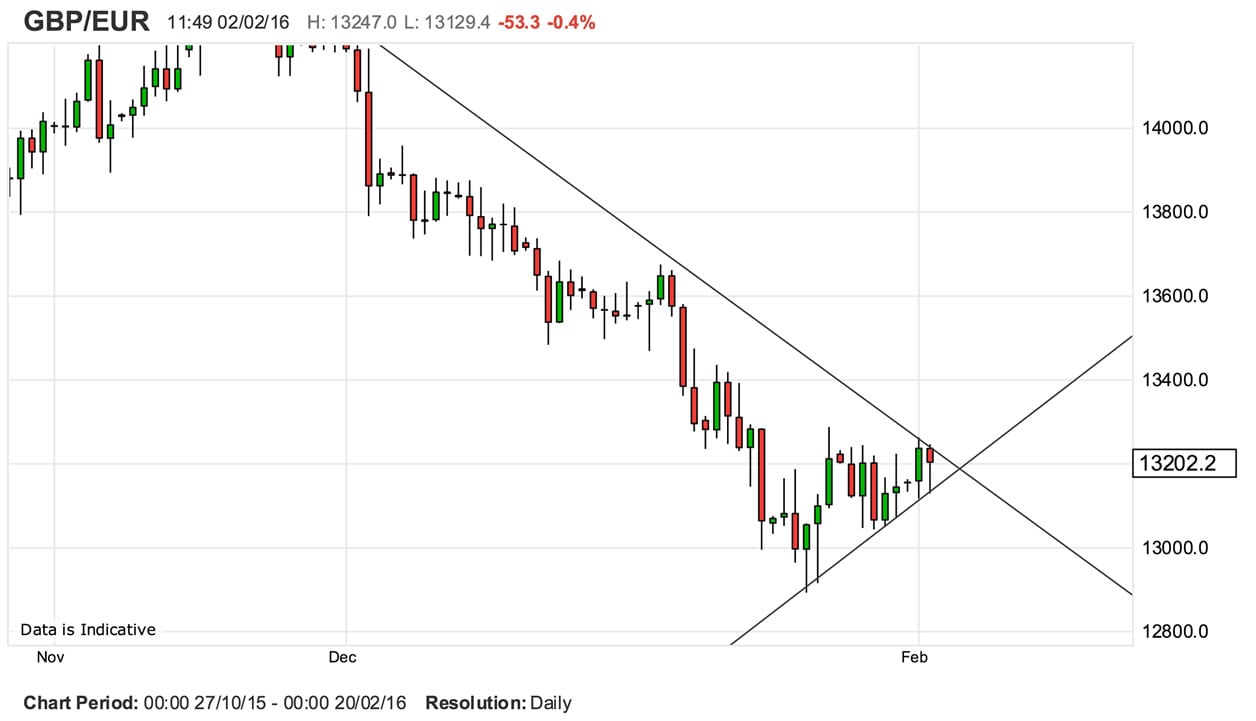
What we are witnessing is the short-term uptrend meeting the longer-term downtrend. If the longer-term trend is to hold sway, as is usually preferred by technical traders, then a turn lower should now happen.
However, if the a base has been formed and a recovery is building then a break of this descending line must now take place. Should it happen then we would be much more confident in calling a stronger pound sterling over the course of February.
Latest Pound/Euro Exchange Rates
  | Live: 1.1886▲ + 0.17%12 Month Best:1.1913 |
*Your Bank's Retail Rate
| 1.1482 - 1.1529 |
**Independent Specialist | 1.172 - 1.1767 Find out why this is a better rate |
* Bank rates according to latest IMTI data.
** RationalFX dealing desk quotation.
Longer-term, Sterling is Struggling
Late 2015 and early 2016 has simply been nasty to those holding out for a better GBP to EUR exchange rate to conduct international payments or holiday on the continent.
January was not a good month for sterling and its 3.8% decline against the euro concluded its worst two-month decline since 2008.
Over the past 365 days we have seen GBP/EUR fall from a best exchange rate at 1.4415 in the summer of 2015 to 1.3134 today - this is a decline of 8.89%.
All the more galling is that the decline flies in the face of the forecasts issued over 2015 that foresaw a stronger pound with some major institutions quoting levels at 1.50 as being possible.
These forecasts are now being lowered as it appears most analysts had failed to account for the prospect of a British exit from the European Union.
“The decline is as much about political uncertainty as anything else (brought on by the looming referendum on EU membership), although market participants are also reacting to the latest musings from members of the MPC, which seem to suggest that rates will not be going up before the end of the year,” says Bill McNamara at brokerage Charles Stanley.
Watch the FTSE 100
When the FTSE 100 sinks sharply, so does the GBP to EUR conversion. It is not all-bad for sterling though as there are other higher-yielding and 'riskier' currencies that tend to lose out more when markets go into sell mode.
For instance the GBPAUD, GBPNZD and GBPZAR rates are all notably higher in this environment.
The euro tends to benefit more in these conditions as it is a funding currency - i.e it is cheap to borrow and use to finance investments in higher-yielding assets. When these assets are sold the euro is purchased as this borrowed money is returned.
Hence why we are seeing as stronger euro exchange rate complex today. Risk therefore matters for the pound to euro rate.
Could February be Better for the British Pound?
There are signs that February could be kinder to sterling.
According to technical analyst Axel Rudolph at Commerzbank in London, the euro is looking increasingly shy in its attempts to take more ground from the British pound.
“EUR/GBP remains nervous of the topside, having most recently failed just ahead of the .7762 2012 low,” says Rudolph.
EUR/GBP at 0.7762 equates to 1.2883 in GBP/EUR terms. What this suggests that while sterling has found strength of late there is still some way to go before real support levels kick in - something to keep in mind.
“This is quite a pivot point and is regarded as formidable resistance near term,” says Rudolph (note that tech analysts approach the pair from the EUR/GBP angle, so readers should simply reverse the message when approaching from the GBP/EUR angle).
However, Charles Stanley's McNamara urges caution:
“In the near-term the UK currency appears to have found a degree of support in the region of 1.30 but that is somewhat tenuous and confidence in a significant bounce from current levels remains fairly low,” says McNamara.
That said, McNamara believes that a close above 1.33 would lift sterling through the top of its recent range and would imply that the selling pressures are drying up.
Lucy Lillicrap at AFEX remains sceptical on sterling:
"The response of Sterling prices to local supports continues to look more obviously corrective than base forming and thus while additional sideways action may well prove necessary over coming sessions an eventual downside resolution is nonetheless still anticipated."
We are faced with a busy week of data so keep an eye on our reporting of upcoming events.
The week concludes with the Bank of England’s ‘Super Thursday’ in which the latest thinking of policy makers is spelled out - currency markets are entering the event in a dour mood, therefore the risks for a positive outcome have grown in our opinion.