Euro forecast: The shared currency is poised to advance yet further against the British pound ensuring the possibility that the exchange rate moves sub-1.30.

A bearish chart pattern combined with potentially historic fundamental event-risk on the horizon in the form of a possible earlier-than-previously-thought summer referendum, are weighing on the outlook for sterling.
The current vogue for positive data releases about the Eurozone is meanwhile supporting the single currency; whilst the opposite seems to be the case for the U.K.
In fact, sterling has been severly punished following the release of January's industrial and manufacturing data from the UK's official statistics body which showed manufacturing slumped an alarming -0.7% in November.
The data has seen more analysts rushing to wind-back their forecasts for when the BOE is expected to raise rates.
"Weaker growth in Europe, the slowdown in China and unseasonably warmer weather weighed on energy output. The Bank of England won't be happy with the latest report as it gives them even less reason to consider raising interest rates this year," says Kathy Lien at BK Asset Management.
Lloyds: Recovery to 1.40 Possible
Is the sell-off in sterling-euro now overdone? According to Lloyds, in their latest FX forecast note, this could indeed be the case.
We cite Lloyds because they have proven over recent months to be on the more pessimistic side when it comes to forecasting this exchange rate. So when they say the pair has overshot, we listen.
That said, momentum remains pitted against sterling and the charts are screaming out for more declines.
Latest Pound/Euro Exchange Rates
  | Live: 1.1663▲ + 0.02%12 Month Best:1.1828 |
*Your Bank's Retail Rate
| 1.1266 - 1.1313 |
**Independent Specialist | 1.15 - 1.1546 Find out why this is a better rate |
* Bank rates according to latest IMTI data.
** RationalFX dealing desk quotation.
Technical Studies Warn of Decline Below 1.30
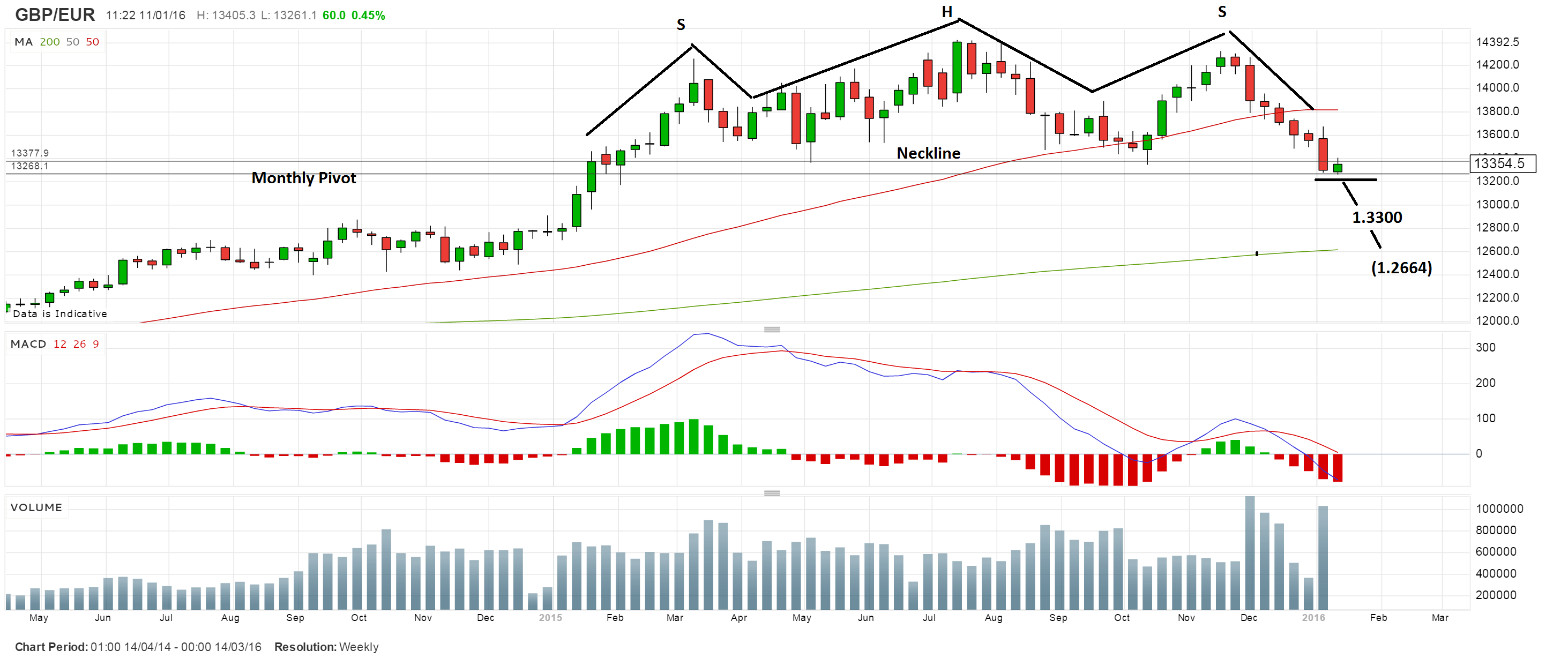
However, perhaps the most convincing indication that the pound is about to weaken comes from the charts where we can see that after a particularly weak December, GBP/EUR has now fallen to the neckline of a large head-and-shoulders pattern at 1.3377, threatening to break even lower.
If the exchange rate breaks below the neckline, it will probably fall rapidly to below the 1.3000s.
However, the existence of the S1 Monthly Pivot at 1.3268 presents a formidable obstacle against such a break lower, and Ideally I would want to see the rate break below it order to open the path lower.
In addition, the high volume on the right shoulder of the H&S should ideally be lower, although the weak momentum is in line with expectations.
Nevertheless, a clear 20-point move below the pivot – so below 1.3248 - might be enough to confirm a break.
Such a move could see a dramatic devaluation as head and shoulders triggers lower.
First stop would be psychological 1.3000 level followed by 1.2664, near the 200-week MA.
Green Shoots in Housing Supporting the Euro
The fundamental picture behind the shared currency meanwhile continues to improve.
In a characteristically pro-euro note today, HSBC reports a rise in Eurozone housing:
“Housing markets are firming in much of the eurozone. The combination of record low mortgage interest rates and better employment prospects are tempting prospective buyers to take the leap.”
Prices in Germany have now reached pre-crisis levels; whilst those in Spain are on the rise.
More buying interest is expected from investors taking advantage of low interest rates, in line with what happened in Scandinavia:
“Moreover, as the ECB takes deposit rates more deeply into negative territory, we may see more speculative interest as investorslook for a store of value."
"This is certainly what we've seen in Scandinavian countries that have taken interest rates well below zero.”
The recovery in housing is also likely to have a strong positive feedback effect on employment, according to HSBC:
“the really positive element of the story comes from the prospects for a revival in construction.”
“Job losses in the construction industry accounted for half of the 6m jobs shed in the crisis and are still holding back the labour market."
"If the situation turns around, it could mop up unemployment in the eurozone, particularly in the low-skilled sector.”
Oil Boost to the Eurozone
Deutsche Bank analyst, Micheal Lermer, argues the euro-area is “well placed in 2016” due to lower oil prices boosting growth:
“We argue that the euro area is well positioned in early 2016. Oil prices are about USD20/pb below what is assumed in our baseline scenario. If maintained, this could add several tenths to GDP growth.”
The flipside, however, is that low oil prices will also weigh on inflation, nevertheless Deutsche’s base-line scenario sees the ECB as “done” with QE:
“The flipside of lower oil prices is lower headline inflation. Our baseline view is that the ECB is done. Nevertheless, the risk of further ECB policy easing will help maintain expansionary financial conditions – and despite this week's events, euro area financial conditions remain easy.”
As far as UK inflation goes, however, Deutsche’s Hall says there is little sign of growth:
“Our latest analysis of the "swathe" of various measures of underlying prices and wages suggests that there is presently very little 'core' inflation in the system.”