Pound sterling is suffering following data showing a steep decline in Industrial and Manufacturing Production which confirms the economy is starting to slow down.

Data out on Wednesday shows U.K Industrial Production missed analyst’s estimates in November, contracting by -0.7% on a month-by-month comparison - truly awful when we consider that economists had expected the number to come out at 0.0%, from 0.1% previously.
The 5-year chart of Industrial Production (IP) mom data shows November's contraction as the steepest since 2012.
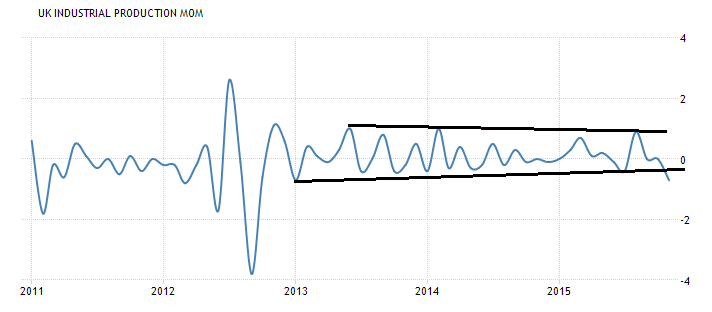
The -0.7% print represents a critical break out of a stable range which has seen IP oscillate between a -0.4% floor and 1.0% ceiling for over 3 years.
The most recent result, however, represents a significant break out from the range and therefore, possibly, herald even lower results to come.
"Weaker growth in Europe, the slowdown in China and unseasonably warmer weather weighed on energy output. The Bank of England won't be happy with the latest report as it gives them even less reason to consider raising interest rates this year," says Kathy Lien at BK Asset Management.
Bank of England ‘Panic’
Commenting on the figures, Senior Sales trader at Foenix Partners, Alex Lydall, said the data would raise “anxious sighs” amongst Bank of England (BoE) decision makers.
In short the data spells woe for sterling going ahead:
“Both figures printing such large misses against analyst forecasts this morning will add to further woes for Sterling,"
Indeed, GBP/USD moved below the critical 1.45 handle after the release – a clear indication of how seriously traders were taking the miss.
IP year-on-year also missed expectations, by coming out at 0.9% when it had been expected to remain at 1.7% - an almost halving of the consensus.
Latest Pound/Euro Exchange Rates
  | Live: 1.1663▲ + 0.03%12 Month Best:1.1828 |
*Your Bank's Retail Rate
| 1.1266 - 1.1313 |
**Independent Specialist | 1.15 - 1.1546 Find out why this is a better rate |
* Bank rates according to latest IMTI data.
** RationalFX dealing desk quotation.
Manufacturing Production in November remained at a -0.4% slump when it had been optimistically expected to rise to 0.0%.
Year-on-year, it had been forecast to drop -0.8%, but even these negative forecasts were surpassed when the result was actually even lower at -1.2%.
The below-expectations data appeared to back-up the recent decision by analysts at TD Securities to delay their forecasts, from May to November, of when the BOE is likely to make its first hike.
RBC cuts GDP forecast to 0.4%
In response to the low data RBC Capital Market’s Sam Hill decided to cut his Q4 GDP forecast to 0.4% qoq from 0.5% qoq.
“Our expectation had been for IP to remain flat at its October level through November and December.
“That would have seen IP make a 0.05ppt contribution to Q4 GDP growth.
"A contraction in November and limited prospects for a significant reversal in December, plus our previously stated downside risks (as a result of December’s floods) mean we now revise our forecast for Q4 2015 GDP to 0.4% q/q from 0.5% q/q previously.”
BofA joins 'Novemberists'
Bank of America issued a note after the figures were released announcing they had pushed back their BOE rate hike expectations to November, in line with a growing number of other Banks and independent market-watchers, including PoundSterlingLive.com’s own team.
The rationale for their delay was not the low IP result, however, but the growing divergence between rising emplyment and falling wages, elegantly illustrated in the chart below.
“We recently pushed back our BoE rate hike call to November 2016 from May 2016.
"Despite continued strong jobs gains, wage data have softened (Chart of the Day)."
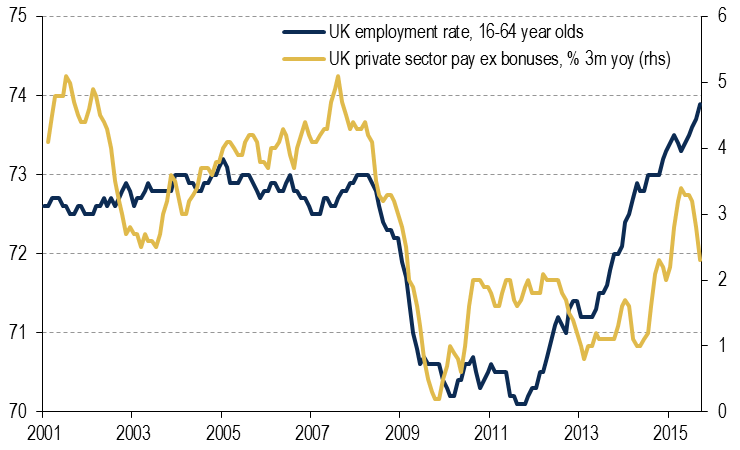
BofA's other reasons for expecting 'folded hands' in Threadneedle Street, include slowing growth, Brexit fears and recent falls in the price of oil weighing on inflation.
“So, we expect no change from the BoE at Thursday's meeting and no signals that a change is imminent either.”
BofA’s team see the possibility of the release of dovish minutes, which would almost certainly weigh on the pound:
“If anything, the minutes of the meeting could veer further into dovish territory.”