EUR/USD fell at the weekly open after the Spanish election produced no clear winner; the pair recovered, but uncertainty remains.

The euro weakened on Monday morning after an ambiguous result in the Spanish general election led to fears about a possible Spanish exit from the Euro.
The potential for minor Catalan and Basque parties to act as 'king-makers' in a new coalition, also raised concerns about a possible break-up of Spain, with destablising knock-on effects on the European ‘project’, as Madrid has said it will not allow a soverign Catalonia in the E.U.
The election results showed that neither of the major two parties, the Conservative PP or Socialist PSOE won enough seats for an overall majority. PP, the incumbent government, won the most with 123, but this fell short of the 176 required to form a majority. PSOE won only 90. The parliament has 350 seats.
Coalition on the Cards
The two major parties must now try to find coalition partners if they wish to form a government. PP will most probably try to form a coalition with Ciudadanos, which is its natural ally on the right side of the political spectrum, however, they only have 40 seats, so together they would still fall short of a majority.
In order to make up the numbers they may have to make a deal with the Basque nationalists (EAJ-PNV) or the Catalan nationalists (Dil), both of whom are right of centre, but, have fundamentally different views on nationhood to PP.
For PSOE to form a majority, it would have to untie with several anti-European parties, such as Podemos, who reject continued austerity, which they see as imposed from Brussels.
In addition, they would have to form a larger coalition with the left wing Catalan Republican party, who want an independent Catalonia.
The two major parties PSOE and PP are both pro-European, but have rejected the idea of forming a grand coalition.
Under the constitution the next step is for King Felipe VI to name a nominee, who will be given the opportunity to form a coalition government; which must then win a vote of confidence in parliament, in order to be sworn in.
The euro weakened temporarily as a result of fears of instability following the result.
EUR/USD gapped down at the week’s open, reaching 1.0850, however, it soon recovered and rallied above 1.0900 again, although since then it has once again weakened and fallen back down to its current trading level, which at the time of writing is at 1.0855
Technical outlook: 1.0530 lows back on radar?
The technical picture continues to indicate a strong bias to the downside.
For example, technical analysts at Swissquote, recently noted that:
“In the longer term, the technical structure favours a bearish bias as long as resistance holds.”
There is now also arguably a bearish head-and-shoulders on the 4-hr chart, which is likely to break to the downside, and potentially reach the 1.0530 early December lows.
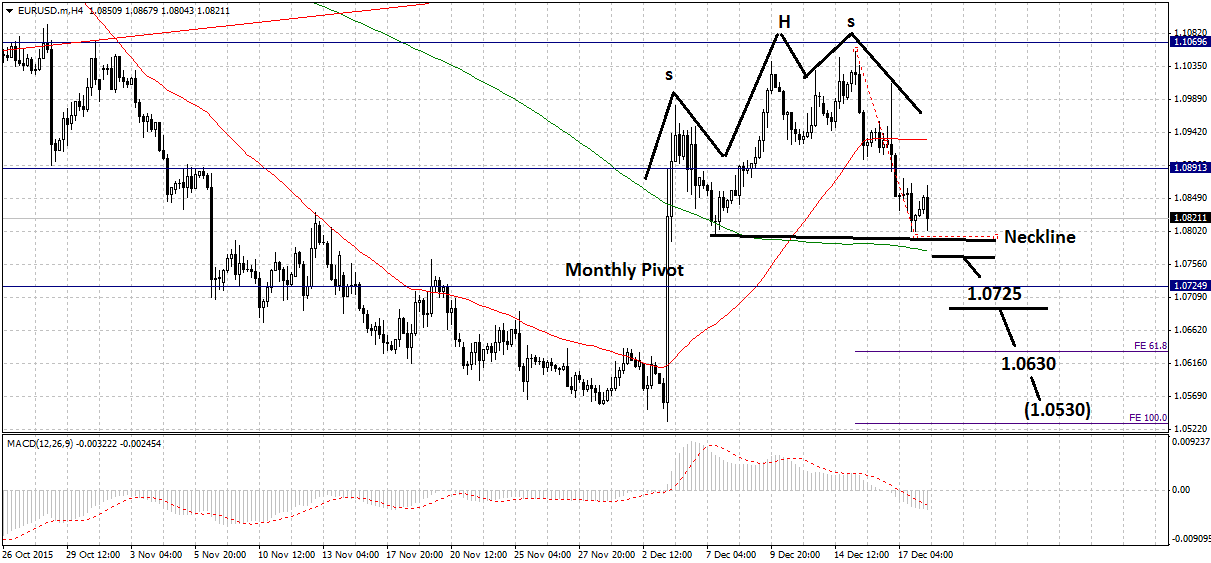
Possible Step Decline Lower
The 1.0800 lows are also key as a break below them would signal both a break of the H&S's neckline.
Such a decline would also reverse peak and trough progression from up to down in the short-term, indicating a probable reversal of the short-term trend.
The next target down from there would be the 200-4hr MA at 1.0775, however, this is not a major support level so we would expect further declines to the monthly pivot, at 1.0725.
A break clearly below the pivot, signalled by a move below 1.0690, would probably signal a continuation of the down-trend towards the next target at the 61.8% Fibonacci extension of the H&S's height, at 1.0630.
That level could be the focus of much buying interest so a bounce or consolidation is possible, however, eventually there is a possibility of a move even lower to the 100% extension of the H&S and the early December lows at about 1.0530.