The pound to euro exchange rate has advanced following news that UK inflation has risen.

UK inflation was higher than expected for the month of July - the release of the data has pushed the pound to euro exchange rate higher to 1.4151 confirming a base to recent weakness may have finally formed.
The pound to euro exchange rate suffered earlier in the month with the most recent labour market data playing its part in undermining the GBP’s attractiveness.
The ONS reported the second successive month of an increase in unemployment.
The underwhelming data, when combined with the Chinese Yuan devaluations, could prompt the Bank of England into avoiding an interest rate rise in the coming 6 months.
Much of the pounds 6% gains have come on the back of expectations for higher interest rates, so such a shift in perception really does matter for sterling valuations.
Hence we have seen the pound to euro exchange rate conversion decline from the 1.43’s in August back towards the 1.40’s.
Latest Pound/Euro Exchange Rates
  | Live: 1.1656▼ -0.04%12 Month Best:1.1828 |
*Your Bank's Retail Rate
| 1.126 - 1.1306 |
**Independent Specialist | 1.1493 - 1.1539 Find out why this is a better rate |
* Bank rates according to latest IMTI data.
** RationalFX dealing desk quotation.
Markets had expected annual inflation to read at 0%. The ONS reported a figure of 0.1% in the end confirming we may have seen the effects of low oil prices starting to fade.
The trajectory from here is higher say the Bank of England who expect inflation to rise back to their 2% target in the medium term.
Such a move higher will inevitably attract higher interest rates which will in turn feed into a stronger British pound.
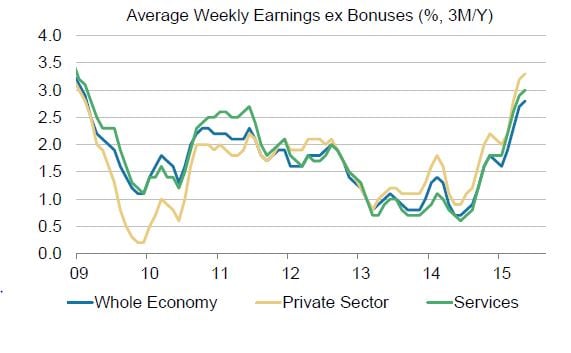
British Wages Are Shooting Higher
The pound sterling fell sharply in August following a less than impressive jobs report in which it was shown UK employment contracted for the second month in a row.
Bank of America Merrill Lynch caution against taking an unnecessarily negative view on the UK economy and its currency on the back of the date.
“There is little cause for serious worry on the labour market, or indeed wider economic front, in our view. The UK data have been more mixed of late, but they continue to point to a trend-like pace of expansion, a tightening labour market and robust upturn in wages,” says BofA’s Robert Wood.
Wood acknowledges that while jobs gains have lost some of their ‘zip’ the June employment fall looks more like a ‘blip’ than anything else.
Indeed, surveys point to solid jobs gains to come and importantly underlying wage growth remains around 3% yoy.
The Euro: Will Germany Fall Victim to Chinese Slow Down?
The message to take away from the UK is that growth is strong and people are earning more – something that will fundamentally underpin the pound.
But what of the Eurozone’s outlook and therefore what is the bigger picture for the GBP/EUR exchange rate from a EUR perspective?
Interesting observations have been made by Commerzbank who have warned clients that Germany could take a knock to its economic growth profile over coming months due to slowing global economic activity.
We see this as having implications for the euro longer-term.
Commerzbank note that Germany’s exposure to China has been counter-balanced by an uptick in demand from the USA and the recovering Eurozone.
“That said, this does not mean that China’s problems will leave the German economy completely unscathed,” says Dr Jörg Krämer at Commerzbank.
It is argued that many companies will respond to poorer business conditions in China by reducing domestic investment.
"In addition, the weaker renminbi is likely to reduce profit margins further. Moreover, in key industries such as engineering or the automotive sector, at least 10% of gross value added depends on final demand from Southeast Asia," says Krämer.
The analyst says the problems in China have for some time led Commerzbank to position below consensus with their 2016 German growth forecast of 1.8%.
“And the downside risks have increased recently, especially for 2016,” says Krämer.
For now the underlying fundamentals continue to support the pound sterling against the euro and the longer-term drive to 1.50 remains alive.
The most obvious risk to the pro-Sterling thesis will of course be a stronger-than-expected uptick in Eurozone economic data.
Indeed, the underlying trend remains healthy and economic growth is expected to accelerate to a 2% annualized pace in 2H15.
Anything more could have a profound positive impact on the euro exchange rate complex.
In short – dips should be followed by strength until such a time the Eurozone starts firing on all cylinders.