Consensus projections for the next four quarters, compiled from leading investment banks.
Access the full forecast →

Image © Adobe Images
Pound sterling finds its feet against the euro ahead of the weekend.
The pound to euro exchange rate (GBP/EUR) rises to 1.1450 ahead of the weekend, setting up a potential advance in the coming week.
GBP/EUR gains are consistent with support at 1.1435 being tested but holding firm, confirming that this is an important structural level in the near-term.
As our chart shows, we see near-term risks of a rise as support at 1.1435 is reinforced, before the broader trend lower commences.
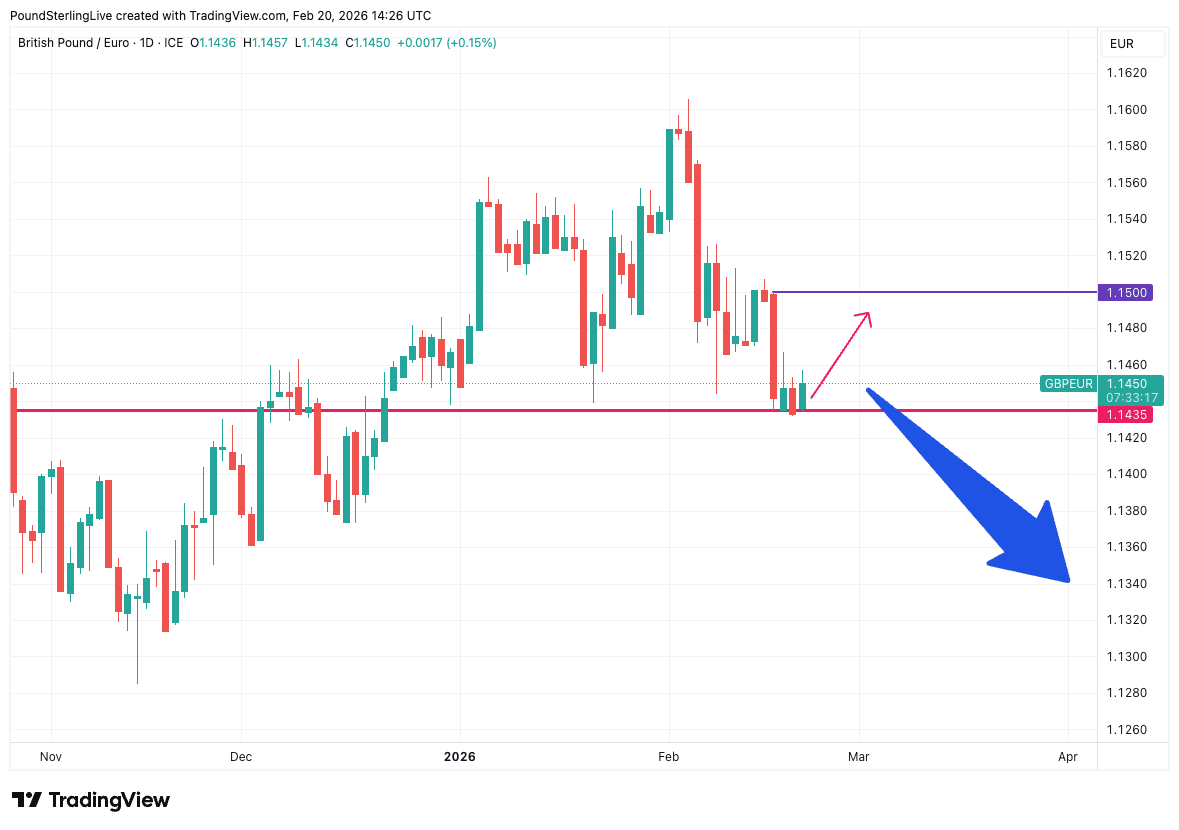
So, it's a case of near-term upside risks ahead of a resumption lower, which should provide those with GBP into EUR transfer requirements the backbone structure for their payments strategy over the coming days and weeks.
The technical recovery is reinforced (or triggered) by three separate sets of good news that came out of the economy Friday:
📈 Retail sales showed a strong start to the year for the all-important UK consumer. In January, they rose 1.8% y/y, which beat estimates for 0.2%, and marked a significant uplift on December's 0.4%.
Government finances start the year on a solid footing: The government reported a £30N surplus in January, exceeding the 23BN figure expected.
📉 Although income tax receipts drove the surplus, it was actually an unexpectedly large undershoot in borrowing that caught the eyes of economists: thus far for 2025-26, the government cash requirement (amount needed to be borrowed) is now reported as being £21.8BN less than expected.
📈 February, meanwhile, saw the broader economy expand at a decent clip, according to PMI data. S&P Global's Composite PMI read at 53.9 in February, up from 53.7 in January, and ahead of expectations at 53.4.
"The economy has held on to the momentum seen at the start of the year, with private sector activity expanding at a solid pace for a second consecutive month. That marks a clear improvement on much of last year," says Jake Finney, Senior Economist at PwC.
These good news data come after a dour employment report released Tuesday and a below-consensus inflation print out Wednesday.
It was the news that the UK unemployment rate rose to 5.2% in December that sent the pound hurtling lower on Tuesday as it raised the odds of a Bank of England rate cut in March and cemented a second cut, while raising the odds of a third reduction.
This makes the Bank of England an outlier in terms of the speed and depth of cuts to come. In a world where FX is highly sensitive to interest rate changes, that is a distinct disadvantage for the pound.
For the currency to break its downtrend we will need to see upcoming official data confirm the economic renaissance hinted at in the survey data (PMIs) is very much real.
In this case, the market would need to row back on rate cut bets, which would support sterling.
Clearly, there's some time to fill between now and the next sets of inflation and labour market data, which leaves the UK currency vulnerable to further decline.