Image © Adobe Images
Pound sterling rises to a significant resistance point against the euro, temporarily stalling the rally.
The pound to euro exchange rate's advance took it to a high of 1.1560 on Tuesday, where it promptly butted heads with the 200-day exponential moving average (EMA) and halted.
The 200-day EMA is a significant technical barrier where traders will have laid sell orders to automatically trigger and get them out of the market. This is why developments on the charts are worth keeping an eye on, as they can have real-world impacts on an exchange rate.
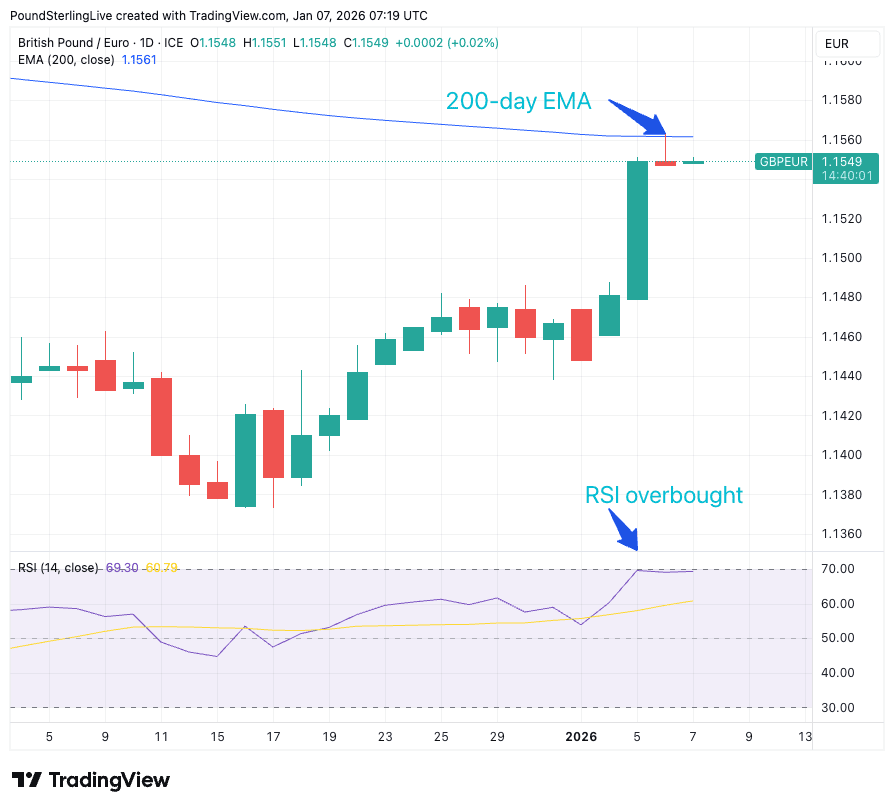
While below this technical level, GBP remains vulnerable to another relapse that could ultimately result in fresh multi-month lows being tested against the EUR in the coming weeks and months.
Those wanting a stronger pound will therefore need buying momentum to return with enough vigour to break through the sell orders littered in the neighbourhood, which would expose it to clear air and allow it to enter a more durable uptrend.
"The 200 day moving averages can be key pivot points over long horizons and currencies along with other assets tend to get 'trapped' above or below their moving averages for months at a time," explains W. Brad Bechtel, an analyst at Jefferies.
"So when you see something making a move one way or the other through the 200dma, you want to try to assess whether we are in for a new period of structural strength (weakness) above (or below) the 200dma moving average," he adds.
✳️ Secure today's exchange rate for a future payment. You may also book an order to trigger your purchase when your ideal rate is achieved. Learn more.
GBP/EUR has risen through December and January, but this has widely been considered a short-term recovery move that unwound some of the persistent weakness that we saw throughout 2025.
If this is the case, then the current resistance layer at 1.1560 could be the ceiling.
Also note that the recent rally pushed the Relative Strength Index (RSI) - visible in the lower panel of the chart - into overbought territory at 70.
The RSI is a mean-reverting indicator that tends to anchor around 50. There's a strong calling signal for it to revert to more comfortable levels, which means the exchange rate must enter a consolidative phase or pullback.
✳️ Secure today's exchange rate for a future payment. You may also book an order to trigger your purchase when your ideal rate is achieved. Learn more.
There's a strong emphasis on technical signals for GBP/EUR at this time owing to the lack of domestic data that would normally provide the signals for GBP/EUR to trade off.
It won't be until next week when we receive some UK GDP numbers that the market gets to act on some data. But it won't be until the releases of labour market, inflation and PMI data the following week that the real 'red meat' is thrown down.
These are two data prints that will impinge on Bank of England policy and determine whether it delivers another rate cut in February.
If the data is soft enough, pound-euro will likely retreat. However, a stubborn set of inflation numbers would ensure the recovery endures into February.