
Image © Adobe Images
A slowing economy is weighing on jobs, wages and growth, which is finally crushing inflation.
"Breaking the back of inflation is as painful as it sounds," says Nicholas Kennedy, FX Strategist at Lloyds Bank.
The UK recorded a sharp drop in annual inflation from 3.6% y/y in October to 3.2% in November, following a -0.2 m/m reading.
The decline was widespread, with the vast majority of components in the inflation basket seeing a decline.
✳️ Secure today's exchange rate for a future payment. You may also book an order to trigger your purchase when your ideal rate is achieved. Learn more.
It comes after months of the UK being an outlier with inflation running well ahead of rates seen in other developed economies.
"Inflation persistence has been a long-standing problem for the UK. While more recent CPI prints had shown some improvement, that had not looked sufficient to suggest that the price tide had turned comprehensively," says Kennedy.
However, "the November report looks different, showing a broad deceleration across nearly all of the price components," he adds.
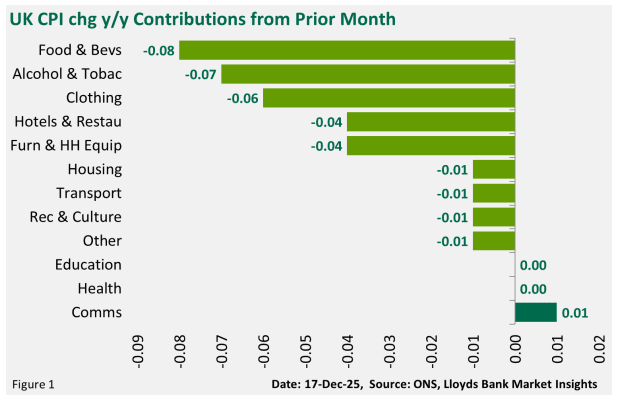
Image courtesy of Lloyds Bank Market Insights.
Economists have roundly pointed out that November's report was driven by a broad-based drop, which suggests the disinflationary trend is more durable than in instances where one-offs drove improvements.
The news will be welcomed by the Chancellor of the Exchequer, Rachel Reeves, and the Governor of the Bank of England, Andrew Bailey, who is mandated to get inflation back to 2.0%.
However, the cost of breaking inflation will come at a cost, as the disinflation we are seeing is the result of a stalling economy.
Kennedy explains the "pincer of slowing nominal wage rates" is crunching up "against the decline of those in work."
✳️ Secure today's exchange rate for a future payment. You may also book an order to trigger your purchase when your ideal rate is achieved. Learn more.
It was reported on Tuesday that aggregate pay growth in the UK has dropped to just 2.5% y/y, which is below the levels we saw during the pre-COVID period.
"But where the real hurt shows up is translating this to real wages, those are now -1% y/y on the same basis," says Kennedy.
Real wages are what we get when inflation is subtracted from the headline wage rate.
As wages go into reverse, demand in the economy will fade, hence the cooling inflation rates we have seen over recent months.
"The pace of the drop suggests weakening demand is also a key factor in the level of
discounting, and some of the footfall data suggests that those price drops still might not have been enough to tempt buyers," says Kennedy.
In response to the falling inflationary pressures, markets now see three further interest rate cuts coming from the Bank of England as it tries to help the economy.