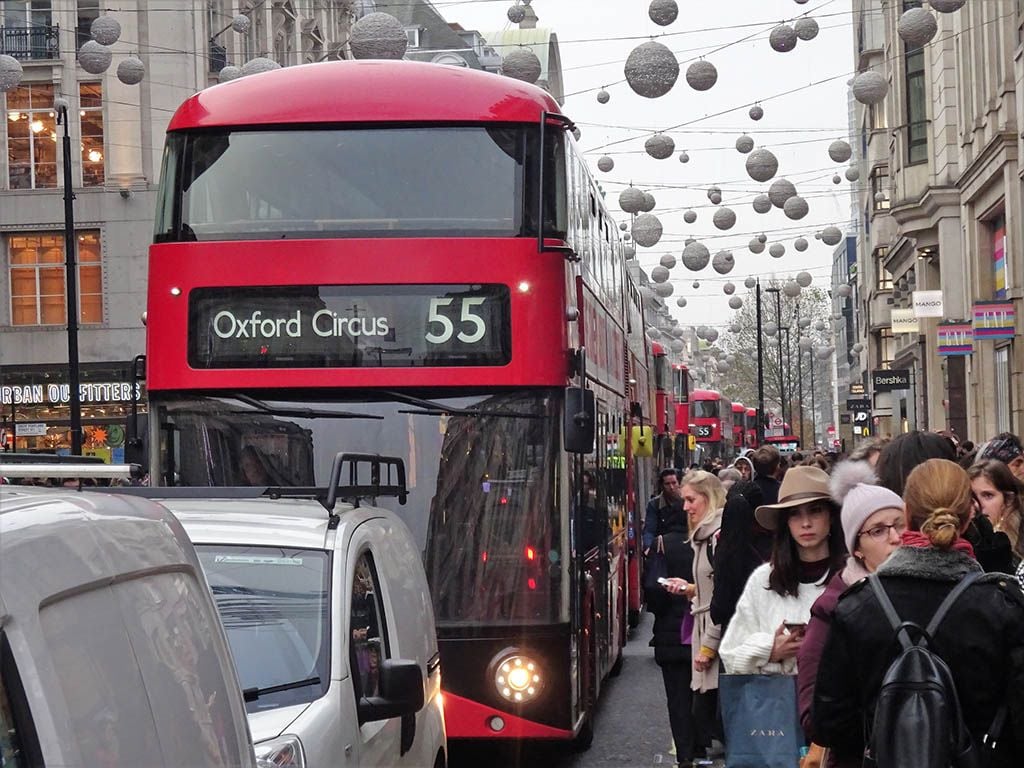
Image © David Holt, Accessed: Flikr, Licensing Conditions: Creative Commons
Nielsen, a global consumer intelligence company, says the data shows UK households are under pressure.
UK retailers suffered one of their weakest Black Friday performances on record this year as squeezed households cut back on non-essentials despite broader and deeper discounting.
NielsenIQ (NIQ) reported that sales fell across almost every major Tech & Durables category, describing the outcome as a clear sign of the financial strain facing consumers.
"For the first time in a Black Friday event, we have seen sales declines across nearly all categories within Tech & Durables, with only Personal Care showing growth (+4%), despite retailers increasing the number of discounts," says Kelly Creaby, Head of Retail Customer Success at NIQ.
✳️ Secure today's exchange rate for a future payment. You may also book an order to trigger your purchase when your ideal rate is achieved. Learn more.
The proportion of items carrying discounts of 15% or more rose from 45% in 2024 to 50% this year, but Creaby said even that was not enough to "stimulate demand" as households prioritised essentials.
She added that "economic uncertainty and low consumer confidence mean UK households are prioritising essentials over discretionary purchases - and we've seen the impact of that caution during this subdued and disappointing Black Friday period."
The Tech sector saw one of the steepest pullbacks, with values down 4.5% and volumes falling 3.3% year-on-year.
NIQ attributed this to weaker demand for big-ticket appliances and limited product innovation, both of which typically underpin Black Friday traffic.
The data aligns with broader confidence readings: GfK’s UK Consumer Confidence Index fell to –19 in November, with all components weakening.
Its Major Purchase Index, a measure closely linked to Black Friday categories, slid to –15. NIQ said this reading underscored the reluctance of households to commit to large purchases even in the face of substantial promotions.
In previous years, the event has often been buoyed by a "hero product" that sparks demand across categories.
But in 2025 no such catalyst emerged. Instead, a handful of niche or home-focused items provided the only bright spots.
Wellbeing products such as LED facemasks boosted Personal Care and contributed to a 90% jump in the broader Wellbeing category.
Coffee machines also performed strongly, rising 43%, while hobbies and crafts saw a resurgence, with knitting and crocheting up 35%. Large-screen TVs posted a 23% increase, and within Homewares, bedding linen rose 5.6% and sofas gained 4.3%, with corner sofas singled out as a notable area of investment.
Creaby said the pattern reflected a clear pullback in discretionary spending.
"We will remember this year’s Black Friday for consumers’ withdrawal of discretionary spend," she said.
Looking into 2026, she warned that the challenge for both manufacturers and retailers would be navigating a market defined by financial caution and a lack of standout products capable of driving excitement.
Categories linked to comfort, hobbies, and home improvement may continue to fare relatively better, NIQ said, but across Tech & Durables the backdrop remains "tough and deeply value-driven".