
Image © Adobe Images
JP Morgan sheds light on why the yen is failing to strengthen despite the Bank of Japan's recent commitment to delivering higher interest rates.
In a new report, the investment bank says the currency’s muted reaction to the Bank of Japan's recent overtures to recent overtures to a December rate cut reflects a structural shift in what drives yen performance, with domestic interest-rate changes exerting far less influence than in previous cycles.
The findings are significant as 'long' yen is a consensus position amongst institutional strategists heading into 2025, driven primarily by the assumption that rising interest rates in Japan will confer support to the now undervalued currency.
✳️ Secure today's exchange rate for a future payment. You may also book an order to trigger your purchase when your ideal rate is achieved. Learn more.
However, JP Morgan says the Bank of Japan simply lacks the vigour to drive such a rates-led move.
It says Japan's exit from a zero interest rate policy looks to be more symbolic than any show of intent to drive down the gaping rate differential between Japan and its peer nations.
After all, the research shows that April's historic exit from negative rates produced only a brief yen bounce before the currency resumed weakening as U.S. yields rose again.
JP Morgan says the ultra-cautious approach to raising interest rates does not meaningfully alter Japan’s relative rate position, leaving the yen at a persistent carry disadvantage against higher-yielding currencies.
And what's more, the yen is now more than a simple interest rates story. "The yen’s sensitivity to the domestic short-rate cycle has fallen sharply during 2024," as JP Morgan points out.
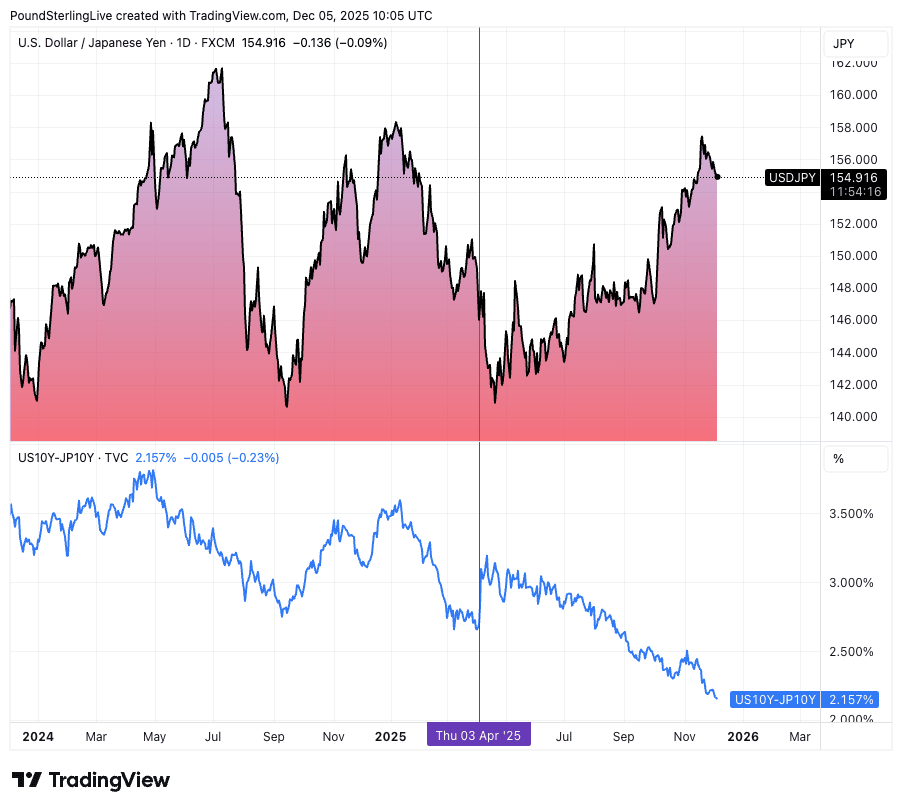
The above chart shows the correlation in USDJPY to the rate differential has broken. It should in fact be stronger if this was the key driver.
"USDJPY has become structurally more sensitive to foreign developments than domestic ones," it adds.
The analysts argue that this flow dynamic makes the currency increasingly responsive to global risk sentiment rather than to domestic monetary settings.
"The yen has increasingly traded on global risk sentiment and foreign fixed-income flows, not domestic policy expectations," says JP Morgan. "The domestic rate channel has weakened significantly."
✳️ Secure today's exchange rate for a future payment. You may also book an order to trigger your purchase when your ideal rate is achieved. Learn more.
The report warns that even a December rate hike at the BoJ would not fundamentally change these drivers because Japanese rates would remain low by international standards as the BoJ is judged unlikely to embark on an aggressive tightening cycle, limiting the scope for policy-led currency support.
JP Morgan continues to expect a gradual narrowing of U.S.–Japan yield spreads in 2025, but says the adjustment will be slow and insufficient on its own to generate a near-term yen reversal.
The bank maintains a neutral stance on USDJPY for the coming month, with a gradual move lower expected only in the middle of 2025 as U.S. yields decline and equity inflows stabilise.