
Above: File image of SNB Governor Martin Schlegel. Copyright: World Economic Forum / Greg Beadle. Source and licensing.
The pound to franc exchange rate is at the bottom of a multi-year range and looks set to weaken further.
Expect ongoing support for the Franc to pressure the pound after the Swiss National Bank (SNB) left its base interest rate unchanged at 0% and signalled it would keep it here for the foreseeable future.
The decision confirms the central bank won't seek to fight ongoing Franc strength via the interest rate channel, as further reductions would have signalled such intentions.
"We think the SNB will leave its policy rate unchanged at 0.00% for the foreseeable future," says Josie Anderson, an economist at Nomura.
On the subject of active FX market activism, the SNB said it "remains willing to be active."
However, Switzerland is on the U.S. Treasury's currency manipulator monitoring list, which should limit activity that would seek to weaken the currency.
"We believe the central bank may be cautious on FX intervention, as Swiss officials are in the process of negotiating with their US counterparts over high tariffs," says Anderson.
"The Swiss National Bank did not dare to openly break the CHF growth trend," says Alex Kuptsikevich, chief market analyst at FXPro.
The U.S. slapped a 39% import tariff on U.S. imports, but SNB Governor Martin Schlegel pointed out that the hit to GDP would be relatively limited as only 4% of exports would be affected.
The decision comes amidst ongoing CHF strength, with the currency proving particularly attractive to investors looking for inflation hedges.
The outlook for the Franc remains constructive with investors seeking Swiss assets to hedge against inflation.
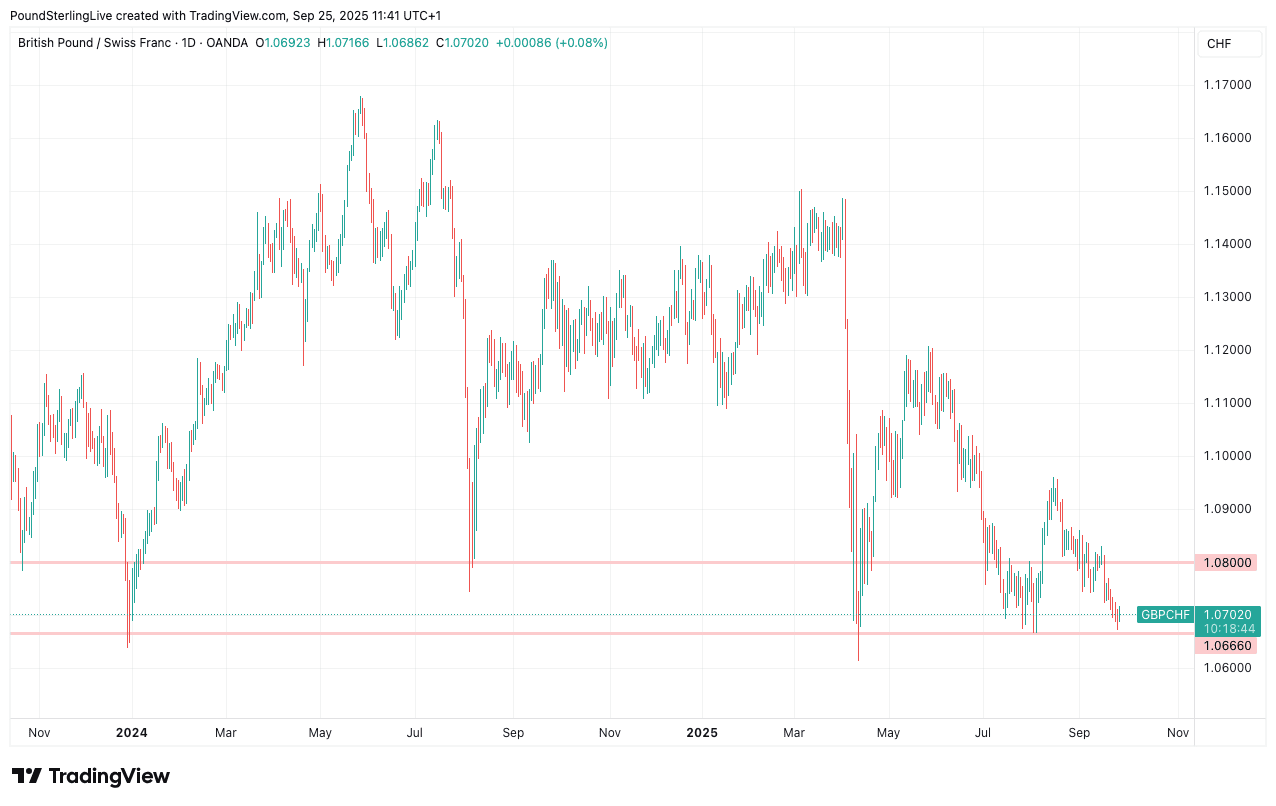
Above: GBPCHF is close to a major support level.
The surge in gold and bitcoin are two other financial market indicators that show investors are concerned about the stubbornly high inflation levels they are seeing around the world, and the apparent reluctance by central banks to tighten policy to the extent needed to bring it down again.
Prime examples are Federal Reserve and Bank of England, which are engaged in rate cutting cycles despite inflation rates pointing higher in the UK and U.S.
Switzerland is one country where inflation is under control, owing to its credible monetary and fiscal policy stances.
The Franc should continue to shine bright as a result.
✳️ Secure today's exchange rate for a future payment. You may also book an order to trigger your purchase when your ideal rate is achieved. Learn more.