The GBP/CAD pair is consolidating in a range which will probably extend through next week until it breaks to the upside.

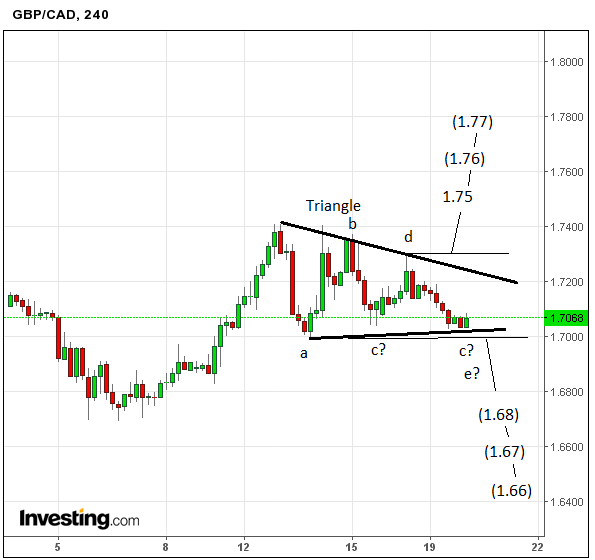
The pound to Canadian dollar exchange rate continues to move sideways in a range, visible on the four-hour chart below.
The range looks like a triangle pattern since the component waves are narrowing with each turn.
The triangle will probably breakout to the upside, with a move above the 1July 18 highs at 1.7300, would probably signal a move to a maximum target at 1.7700 - although 1.75 or 1.76 provide safer targets for the more risk averse; breakouts from triangles normally extend between 61.8% and 100% of the height of the tirnagle at its tallest.
It is not clear whether we are in component wave C or E of the triangle - either interpretation is possible.
Triangles have a minimum of five waves A,B,C,D and E, so there is a possibility that if E has just completed then the triangle is also complete.
Not all analysts are buillish, for example, Scotiabank's FX Strategist, Shaun Osborne is bearish the pair, citing the tough layer of resistance at 1.7300 as reason:
"Despite intermittent signs of strength last week, the GBP attracted steady selling interest above 1.73 and closed poorly on the week overall (“shooting star” signal). We remain bearish overall and continue to think that near - term risks favour 1.65 trading before 1.75." Says Osborne.
Indeed the triangle is a symetrical type which can break in eithe direction so a move below the July 13 lows at 1.6995 would confirm more downside to a minimum target at 1.68, then 1.67 and a maximum of 1.66.
Outlook for Oil and Impact on CAD
Oil is a major contributing factor in the value of the Canadian dollar (loonie) which has averaged a 78% correlation (vs USD) with the commodity over the last ten years.
Whilst we do not have research showing the correlation between oil and GBP/CAD, we can estimate it will be similarly close given the general importance of oil to the Canadian economy and the not vast disimilarlity between GBP and USD.
Recently crude has slumped to $45 a dollar from $50 and this has weighed on CAD, and been a significant part of the reason for sterling’s recent recovery from off of the post-Brexit 1.67 lows.
Yet despite this pull-back analysts remain bullish oil expecting it to resume its medium-term up-trend eventually – although in the week ahead the down-trend may still push lower.
Bank of America Merrill Lynch’s Head of Research, Tomos Rhys Edwards, for example sees the commodity recovering after what he describes as the “summer sell-off”:
“We have repeatedly warned in recent months about the risks of a summer sell-off in global oil prices to $39/bbl. After all, we have not changed our outlook for Brent or WTI since the first week of January. And so far, WTI crude oil prices have tracked a path that is surprisingly similar to 2016. Even then, the key difference to last year is that crude oil supply around the world is now falling at a pretty fast rate, with global output set to contract by 300 thousand b/d YoY in 3Q16 and set to grow by only 230 thousand b/d on average in 2017. While we acknowledge that inventory levels are very high, we still see the oil market moving into deficit, with Brent prices rebounding to $55/bbl by year end.”
Latest Pound / Canadian Dollar Exchange Rates
  | Live: 1.882▼ -0.14%12 Month Best:1.9044 |
*Your Bank's Retail Rate
| 1.818 - 1.8255 |
**Independent Specialist | 1.8556 - 1.8632 Find out why this is a better rate |
* Bank rates according to latest IMTI data.
** RationalFX dealing desk quotation.
Current Account Deficit to Narrow - CAD Positive
The recent dramatic worldwide fall in yields has led invetsors to seek yield-bearing bonds in ever more remote places, one such place being Canada.
This has led to massive surge in demand for Canadian soverign and coporate bonds which has led to a surplus in the trade balance of financial instruments.
The surplus, which NBF's Warren Lovely estimates at 10bn in May is likely to significnatly reduce the country's current account deficit - which currently stands at 16.77bn in Q1 2016.
If the performance seen in May continues and Q2 and Q3 also produce simiar surpluses this should close the Current Account deficit, which will be highly supportive of the Canadian dollar.
Q2 is likely to alos show a surplus as Brexit in june further dragged international bond yields lower into negative territory.
Data out in the remainder of the week
We have to wait till the end of the trading week for significant data from either of the currencies in GBP/CAD.
The Canadian dollar has Core Retail Sales in May, which are forecast to rise more slowly at 0.3% compared to 1.3% in April.
Core CPI data on Friday is expected to show price growth slowing to 0.0% in June.
The UK sees important data in the form of July Services, Manufacturing and Construction PMI on Friday.
These will provide one of the first snapshots of how the economy is coping after Brexit, and will be a highly influential factor in shaping market sentiment.
General Macro Concerns
Recent central bank commentary saw the inflation outlook as ‘evenly balanced’ but it trimmed growth expectations.
The Alberta Wildfires had a major negative impact on growth, but this is expected to be made back up in 2016.
The government’s generous fiscal stimulus programme will also provide a crutch for growth over the next few years.