The Canadian Dollar (CAD) has relinquished its advantage over the US dollar but maintains gains against a striken British pound.

News out of Canada ahead of the weekend is that employment fell by 5.7K people in January, worse than expectations for 5.5K jobs to be added to the payrolls.
The news has seen recent gains made against the US dollar be relinquished.
In the 12 months to January, employment increased by 0.7% (+126,000). Over the same period, the unemployment rate rose from 6.6% to 7.2%, as the labour force grew at a faster pace than employment report Statistics Canada.
Despite the negative headline the Candian dollar has advanceda against sterling which is firmly back in sell territory after fresh polling data was released on membership of the European Union.
As our below analysis shows, this will aid the negative projections contained within the charts.
Latest Pound / Canadian Dollar Exchange Rates
  | Live: 1.8766▼ + 0.19%12 Month Best:1.9044 |
*Your Bank's Retail Rate
| 1.8128 - 1.8203 |
**Independent Specialist | 1.8503 - 1.8578 Find out why this is a better rate |
* Bank rates according to latest IMTI data.
** RationalFX dealing desk quotation.
GBP to CAD Forecast to Head Lower
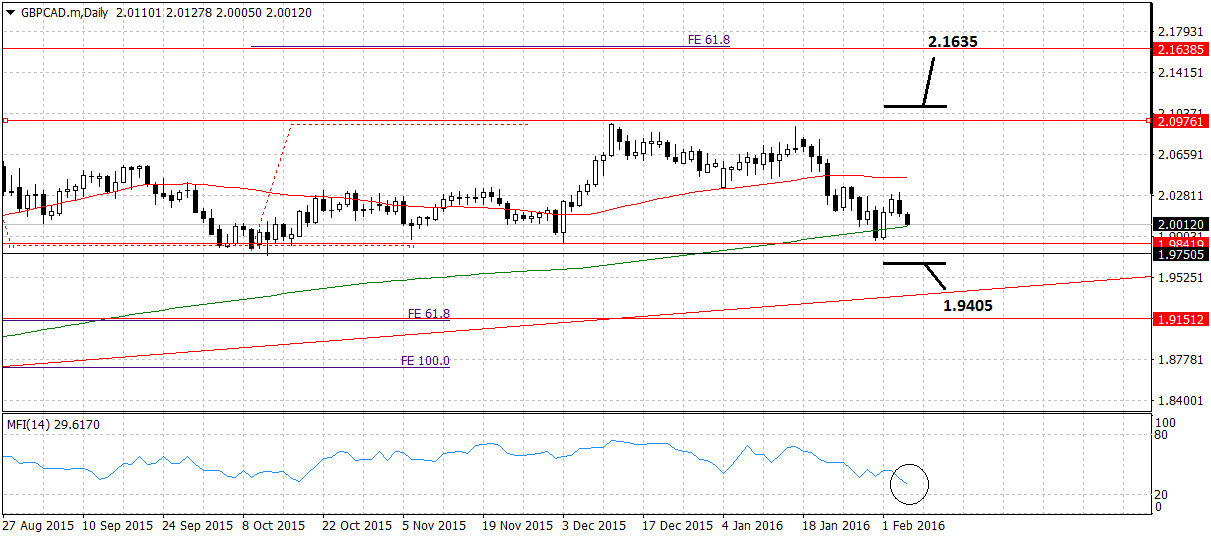
This pair is at the floor of a long sideways consolidation, or box pattern.
There is an equal possibility of a breakout higher or lower, however, the pair is currently pushing against the floor of the box and it is supported by the lowest Money Flow since April 2015 – a very bearish sign in a sideways market.
Therefore, there is a possibility of a breakdown, however several strata of support lie below, including the 200-week MA at 1.9750 and then the trend-line at around 1.9400.
However, a clean break below the 200-week, registered by a move below 1.9600, would open the way down to a target at the trend-line at 1.9405, and then potentially even lower as the minimum expectation using the box height is at 1.91 – even further down.
A Good Week for the Canadian Dollar
The dollar has declined steeply this week on a mixture of dovish commentary from voting US Federal Reserve member, a surprise fall in Non-Manufacturing PMI in January and a surprise rally in oil.
New York Fed President William Dudley said economic conditions had “tightened” since the December decision to hike rates and that if the phenomenon persisted policy makers would have to take it into consideration at the next rate meeting in March.
The dollar then steepened its decline further following the surprise fall in Non-Manufacturing PMI from 55.8 to 53.5 when it had only been expected to shed seven basis points.
“Global financial markets went for another rollercoaster ride on Wednesday as the US dollar got slammed across the board, helping crude oil to erase its losses from the previous two sessions," says a note from strategists at ING.
The combined effect of a sell-off in the greenback and a recovery in crude oil prices was beneficial for commodity currencies.
The Canadian dollar was the second best G10 performer, after the New Zealand dollar, with a climb of 2.20% against the greenback.
Can the Oil Rebound be Sustained?
Oil’s rebound was aided after Russia reiterated its willingness to talk to OPEC about output cuts.
Russian Foreign Minister, Sergie Lavarov, said that if there was a consensus amongst OPEC and non-OPEC petroleum exporting countries to meet then “we will meet.”
Hantec Market’s Richard Perry warns though that the recovery was “unsustainable”, because it was built on the "dodgy" grounds of “..a weakening US economy,” and, “for me this does not sound like conditions set up for a sustained recovery, just more volatility.”
US and Canadian Payrolls Ahead
The immediate outlook for the Canadian dollar will be determined by employment figures out of both the US and Canada.
Given the dovish Fed back-drop to current events any surprise weakness in US Payrolls will probably have an adverse effect on the dollar, as it will solidify dovish market expectations that the Fed will abandon its tightening programme altogether.
Futures markets are already pricing this scenario as a 50% probability.
US non-farm payrolls are forecast to read at 190K.
Forecasters are meanwhile looking for the Canadian economy to have added 5K jobs in January.
Where is Oil Headed?
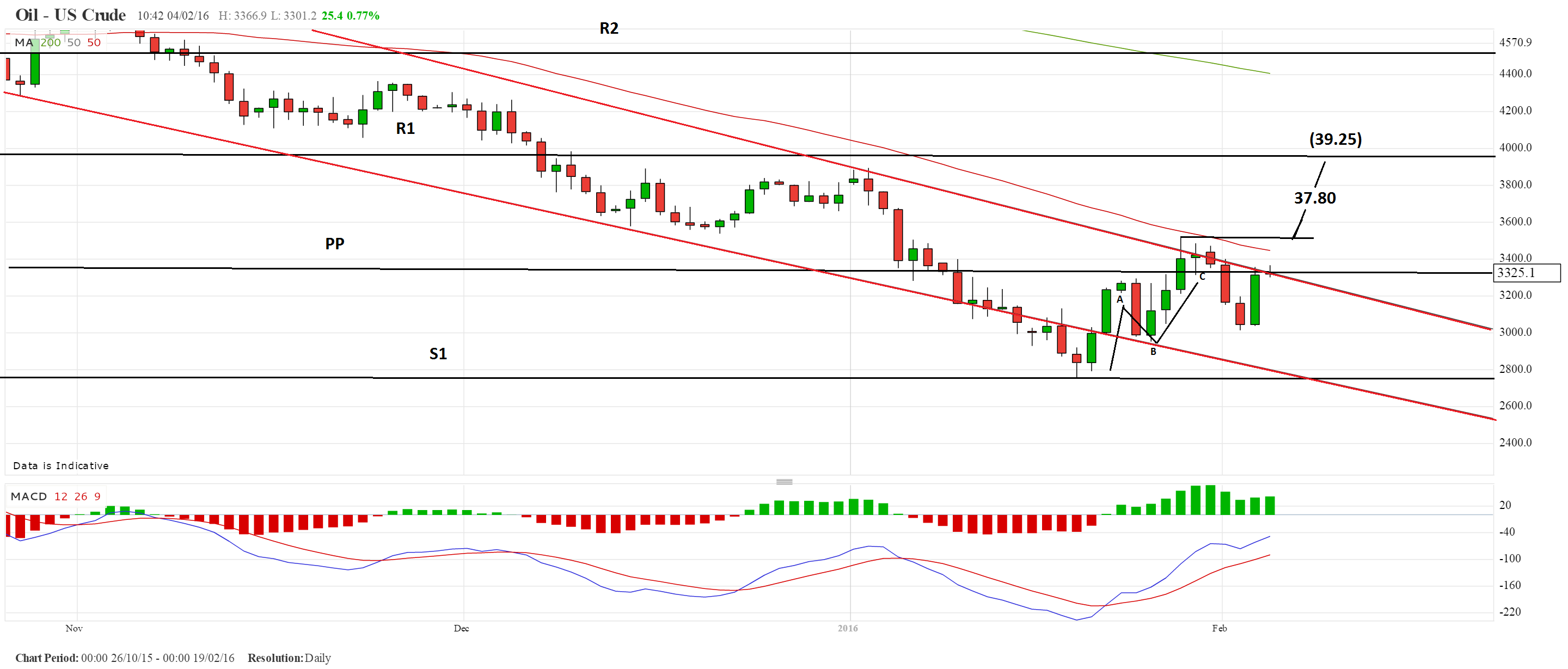
Oil continues to trade within a descending channel, although currently it is pushing against the upper border line.
I actually see more upside as the more likely path, with a breakout from the channel signalling a stronger move higher.
The 50-day MA lies in the way, but a break above the failed breakout 35.20 highs would probably be enough to confirm a new bullish phase higher, with the 61.8% projection of the height of the channel providing a minimum target of 37.80.
Other analysts, are more cautious, however, such as Hantec’s Perry, who sides more with the dominant down-trend:
“Even though yesterday’s candle was a bullish engulfing, the technical indicators suggest the bulls are still under real pressure.
“Furthermore, the move has simply brought the price back to the resistance of a 3 month downtrend.
“The deteriorating momentum indicators suggest that rallies are still a chance to sell with the RSI around 50 and the Stochastics having turned lower again.
“The hourly chart shows there is a pivot around $32.75 which could limit the gains today and if this coincides with a sell signal the bears could return quickly.
“Expect further pressure back on $30 again with a test of the key $29.25 support still likely.”
Nevertheless, he fails to mention the exhaustion break from the channel on the 19th-20th which initially set-up the recovery bounce and indicates more sustained upside potential, rather than a fleeting 3 wave correction as it is present.
Nor do I agree with his comment about “deteriorating momentum” as my MACD is following the trend higher and reinforcing it.
USD to CAD Forecast
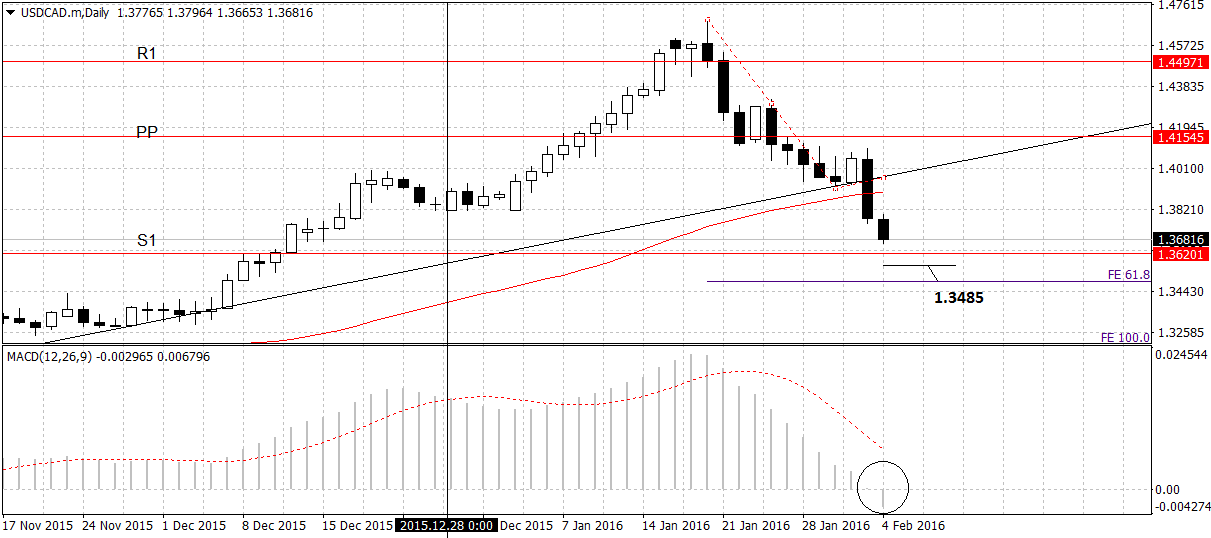
USD/CAD has impressively over-come negative -expectations and exceeded its grasp, by breaking cleanly below the multi-year major trend-line at 1.3950 and the 50-day MA, and breaking down all the way to lows of 1.3638.
Now that we have had this significant trend-line break it has generated a new target at the extrapolated height of the previous wave down 61.8%, at 1.3490.
However, the S1 Monthly Pivot first needs to be breached in order to get there at 1.3620, and ideally I’d want to see the exchange rate move below 1.3580 for confirmation such a break had happened and it was on its way lower.
The chart is looking much more dovish, now MACD has also given a bearish trend-change signal by moving below the zero-line.