The Reserve Bank of Australia will keep interest rates unchanged for the rest of 2016 argue Credit Suisse, something that should ensure the Aussie Dollar maintains a positive tone going forward.

The Australian Dollar has recorded a fresh 2016 best against the British Pound thanks to the ongoing shift in monetary policy settings at the Bank of England and Reserve Bank of Australia.
At the time of writing the GBP/AUD exchange rate is seen at 1.6881, confirming a tentative break of the psychological level of 1.70 is in progress.
However, those with GBP into AUD payments will know that the retail market broke below 1.70 a while ago now and they will be seeing bank transfers as low as 1.6320 at present, with more competitive quotes being seen towards 1.67.
The big driver for this currency pair remains central bank policy.
The Bank of England has cut rates to a record low, something that should encourage the flow of borrowed funds from the UK into Australia, where interest rates are set higher.
Lower interest rates tend to devalue currencies as they lessen inflows of capital from international investors seeking yield.
The dynamic has been reinforced by views that the yield advantage held by Australia is likely to remain at current levels for the foreseeable future.
The AUD should retain a strong upside bias should the RBA not cut interest rates again in 2016, a scenario envisaged by Honglin Jiang, a strategist at Credit Suisse.
Jiang’s analysis suggests the Australian dollar may have a relatively strong second half in comparison with most other currencies where rate cuts or other central bank stimulus measures are likely to keep those currencies under pressure.
Latest Pound / Australian Dollar Exchange Rates
  | Live: 1.88▲ + 0.07%12 Month Best:2.0851 |
*Your Bank's Retail Rate
| 1.8161 - 1.8236 |
**Independent Specialist | 1.8537 - 1.8612 Find out why this is a better rate |
* Bank rates according to latest IMTI data.
** RationalFX dealing desk quotation.
This probably includes the pound which recently say a lot of volatility after the Bank of England cut interest rates to 0.25% and cranked up QE by 70bn.
Indeed, according to Aussie lender Westpac the GBP/AUD pair is likely to continue its down-trend towards the 1.66-1.67 level over the next few weeks, as fundamental pressures weigh more heavily on sterling than the Aussie.
Despite the RBA enacting two interest rate cuts already in 2016, in May and August, which have seen rates fall from 2.0% to 1.50% in the space of six months, the current 1.5% rate is still offers investors a much higher return compared to the BOE’s paltry 0.25%, giving those who sell their pounds for Australian dollars a 1.25% (1.50-0.25) return on their money.
This interest rate differential is likely to maintain the Aussie's advantage over sterling in the forseeable future.
RBA Reluctant to Unfold Arms
Adopting a typically Australian stance, the RBA is unlikely to want to change its stance for the remainder of 2016 argues Credit Suisse’s Honglin Jian - a view which runs contrary to the consensus that there will be a further rate cut at the November meeting.
“The lack of dovish guidance and enhanced rhetoric around the currency in the RBA statement, in conjunction with the reasons cited above, leads us to believe that the RBA is biased to hold rates steady in the meetings leading up to and including November (barring a further significant deceleration in inflation or global shock),” said Jiang in a recent research note.
The Credit Suisse strategist cites the RBA’s own admission that there is an increasingly “marginal return” from cutting rates, as one reason for the RBA to resist taking further measures.
He argues the RBA will not cut any more if they can possibly help it, claiming the central bank would probably have preferred to “preserve their monetary ammunition,” in August but were forced into making a cut due to the challenge to their mandate brought on by low inflation figures.
“They undoubtedly would have preferred to preserve their monetary ammunition if their mandate was not in as much risk as it is. Indeed, the lack of any meaningful forward guidance itself indicates to us that there may have been disagreement around the decision, and that further action this year is unlikely to materialise without exceptional circumstances.”
Jiang points to market-based inflation expectations which remain robustly high as further evidence for not expecting the RBA to make further cuts this year:
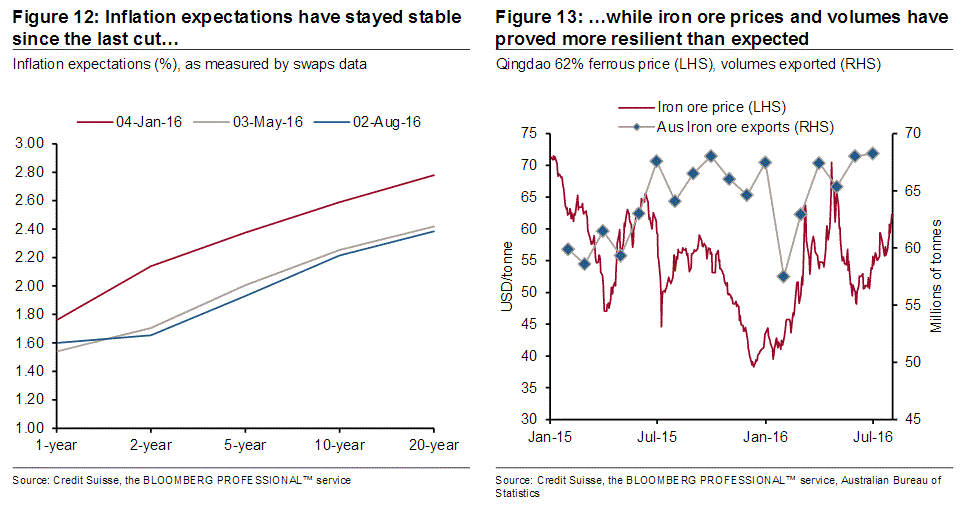
“Inflation expectations, particularly as measured by longer dated swaps in Figure 12, remain well anchored around the RBA’s 2-3% target.
Finally, Jiang points to the steady recovery in Iron Ore prices as another factor against the likelihood of further RBA stimulus, although he accepts the RBA’s own caution in relation to the rally as also valid, given one quarters worth of price growth does not an up-trend make in such a volatile commodity.
Governor Stevens Questions RBA Effectiveness Going Forward
The RBA's outgoing Governor, Glenn Stevens, told an audience at the Anika Foundation Luncheon in Sydney that he believes the RBA can only do so much when it comes to stimulating economic growth.
Stevens noted: 1) lower growth is here to stay; 2) the flexible inflation target provides the best framework; 3) there are limits to what policy can achieve; and 4) the government should invest more in infrastructure.
If the board of the RBA are to share this stance then there are clearly limits to just how much cutting they are prepared to do noting diminishing returns.
Nevertheless, analyst Felicity Emmett takes a different approach saying that while she sees rates on hold at 1.5%, there are clear risk of further cuts given:
1) inflation is expected to remain subpar through to the end of 2018;
2) the banks passed on only half the latest rate cut, suggesting we may be nearing the point where the RBA considers unconventional policies; and
3) the exchange rate remains uncomfortably high.
Clearly ANZ believe further rate cuts can devalue the Aussie dollar if necessary, and we await incoming governor Philip Lowe's views on the matter.
Lowe takes over on 17 September.