A fall in demand for credit keeps the inflation outlook subdued and a rate cut from Reserve Bank of Australia (RBA) a distinct possibility.
- Australian to US Dollar exchange rate = 0.7510
- Pound to Australian dollar exchange rate = 1.7579
The Australian dollar remains under pressure after recent data showed a fall in credit growth.
Data for June showed Private Credit rising at a slower 0.2% pace - the weakest monthly increase in nearly three years.
Annual Credit growth slowed marginally to 6.2%, an 11-month low, and below the long run average of 6.5%.
Housing Credit was steady at 0.5%.
Analysts at St George Economics Advisory Service in Sydney said that the figures continued to show a weak inflation outlook, and that a rate cut from the RBA was still "on the cards", but that nevertheless, overall they expected the RBA to hold fire in August.
In contrast markets are now almost 100% certain the Bank of England (BOE) will cut rates next week and possible even ratchet up QE, and this has widened the expected difference between the two central bank's rates, with UK looking likely to be on 0.25% and Australia at 1.75%.
This is likely to further support the Aussie going forward as international capital tends to flow to yield-rich countries.
CPI sent AUD on rollercoaster ride
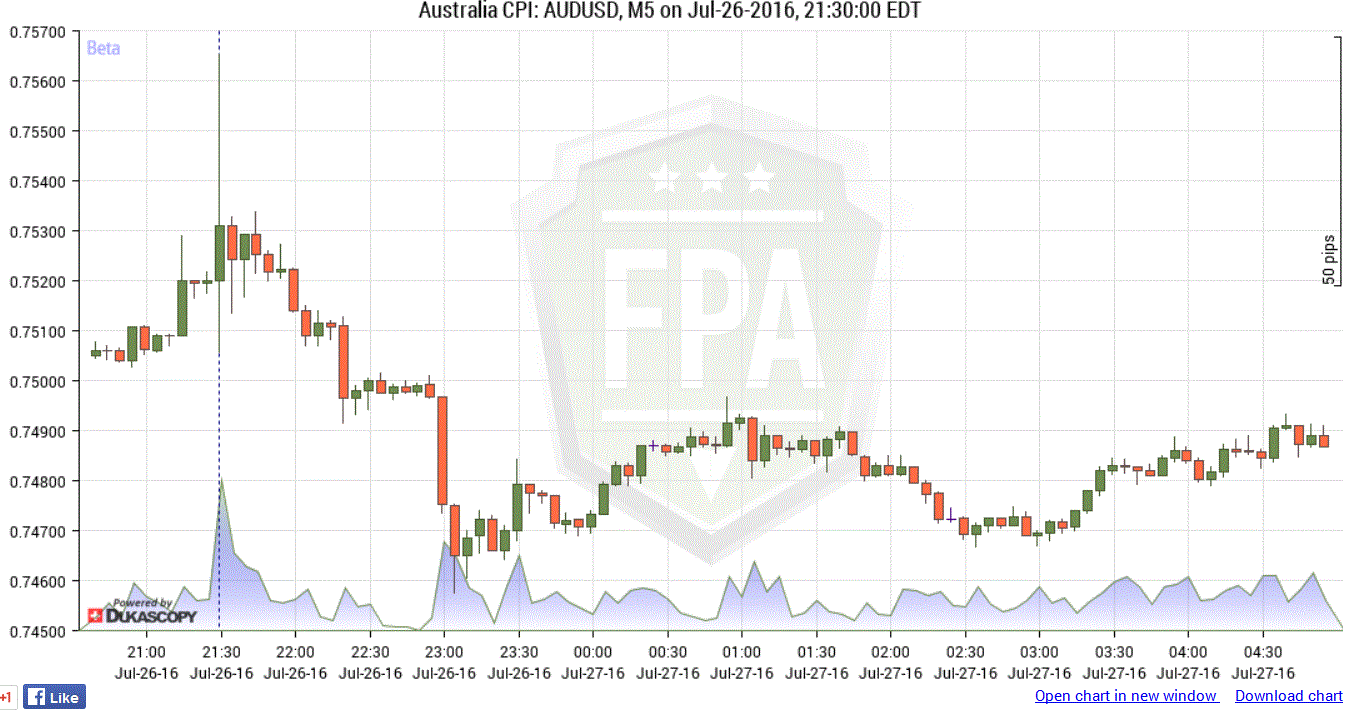
The Australian Dollar rose in the aftermath of Q2 Consumer Price data, spiking over half a cent higher against the US Dollar from 0.7505 to 0.7565, in the minutes which followed the release of inflation data.
Q2 CPI showed a 0.4% rise in inflation in Q2 from -0.2% in Q1, in line with expectations.
Year-on-year prices rose 1.0% from 1.3% previously when a rise of 1.1% had been expected.
The result was a 17-year low for the metric.
The Trimmed Mean of the CPI beat expectations both on a quarterly and yearly basis.
The Aussie soon gave up its gains and fell back down well below the pre-release exchange rate level as the dust settled and it soon became clear that the data had failed to radically alter perceptions about whether the RBA would lower interest rates at their next meeting or not.
ANZ Research commented that if anything the data has reinforced their view that the RBA would push the button and cut rates on August 2:
“Q2 CPI data were broadly in line with market expectations and confirm a weak inflationary pulse. Weak price pressures were broadly based across both tradable and non-tradable items. Low wage growth continues to impact, while tradable inflation is being weighed down by competitive pressures and margin compression. These trends have further to run, suggesting a weak inflation profile over the coming 12-18 months. On balance, we continue to favour a rate cut at the 2 August RBA policy meeting.”
International Foreign Exchange’s dealing desk also see a cut in interest rates as likely given the slight 1.0% undershoot year-on-year.
“The Reserve Bank of Australia is currently priced with a 52% probability of monetary easing in next week’s central bank meeting. Overnight at 02:00 this morning the RBA announced that inflation had remained subdued at 1.0% in the second quarter of the year and adds weight to theory of a policy change in the short-term to stimulate domestic demand.”
Latest Pound / Australian Dollar Exchange Rates
  | Live: 1.8892▲ + 0.03%12 Month Best:2.0851 |
*Your Bank's Retail Rate
| 1.825 - 1.8326 |
**Independent Specialist | 1.8628 - 1.8703 Find out why this is a better rate |
* Bank rates according to latest IMTI data.
** RationalFX dealing desk quotation.
No Rate Cut
Not all analysts were of the view that the CPI release had reinforced expectations of a cut.
Broker TD securities said the result was in line with forecasts and therefore made it less likely the Reserve Bank of Australia would cut interest rates at their meeting on August 2.
“Q2 underlying CPI was spot-on the RBA’s expectations so we don’t think this will be a trigger for the Bank to cut. While the RBA in the recent July Board meeting Minutes noted that the economy was looking a little more mixed (employment, credit), overall, GDP is on track to reach at least 3% this year and next.
“A lack of a GDP outlook downgrade—combined with a likely unchanged inflation profile—is unlikely to sway the Board members to cut next week. Recall the May Minutes revealed that some members saw a case for waiting to cut 'They could see cases both for moving at this meeting or at the subsequent meeting'. With a lack of a shock in either inflation or key activity indicators, there really isn’t a clear trigger for a cut next week.”
Analysts at Bank of Tokyo Mitsubishi agree saying they believe the chance of a RBA interest rate have decreased slightly following the inflation data.
"We just about lean in favour of a 25bp cut given the data will not alleviate low inflation concerns within the RBA.
"The 2-year yield and the 3-month OIS both increased by a few basis points but still imply a greater than 50-50 chance of a rate cut next week. That perhaps is one factor undermining AUD/USD – the data has certainly not shifted expectations greatly that the RBA will ease."
BTMU note that on a relative basis, like with EUR/USD – the 2-year spread with the US has seen the premium in favour of Australia falling to a new low this month as yields in the US pick up again and the spread is consistent with AUD/USD closer to 0.7000 rather than 0.7500.
Technical Updates
AUD/USD
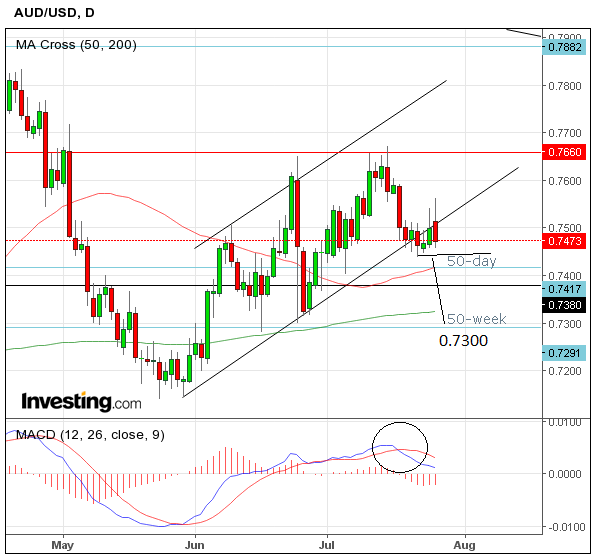
The pair is correcting in the midst of a longer-term downtrend.
The correction has formed a short-term rising channel clearly visible on the daily chart below.
This correction appears to be waning as the pair has broken below the lower channel line of a rising channel.
It is now likely to continue falling in line with the longer-term downtrend.
There are several layers of support, however, which will likely obstruct more downside.
The first such layer is the 50-day MA at 0.7418.
The next is a longer-term support line at 0.7380.
This is followed by the 200-day MA at 0.7324 and then the 50-week MA (not shown) at 0.7293.
Nevertheless, the final target for downside, based on the height of the channel extrapolated lower, is at 0.7300, and the exchange is expected to reach that level eventually.
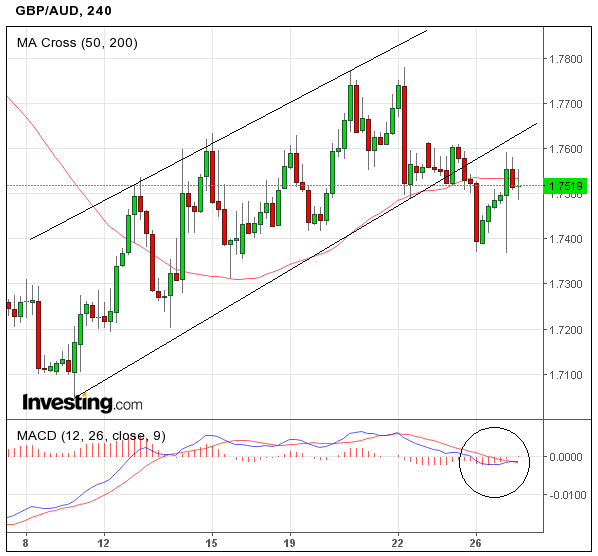
GBP/AUD
The pair is in a concerted medium-term down-trend on the daily chart (see below).
The correction over the last few weeks looks very much like a ‘flag’ continuation pattern, which if true, would forecast substantially more downside for the pair into the 1.60s.
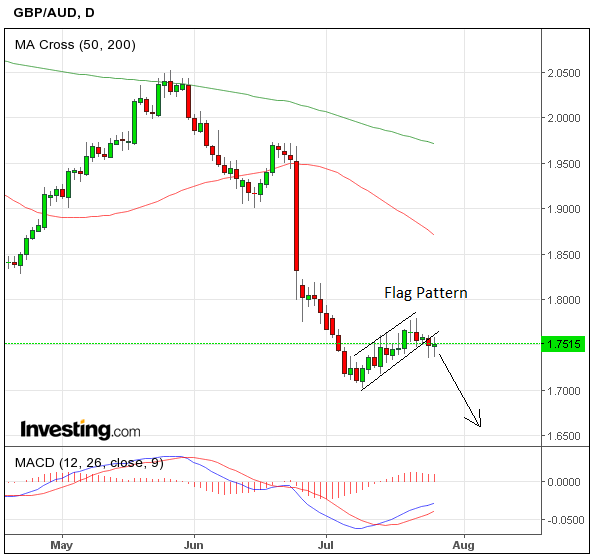
Zooming in now to the four-hour chart and we can see that the pair has broken down below its rising channel.
After almost falling down to the 1.7350 target, the pair has recovered and is currently trading at 1.7534.
The strong up-bar on the four-hour chart, indicates the likelihood of more upside.
It is less likely now that the pair will resume its descent and reach the 1.7350 level.
From a technical perspective the pair seems roughly balanced at this juncture.