RBS analysts say despite the falls seen over 2015 the Australian dollar is still overvalued on a long-term basis.
RBS have released their latest Australian dollar forecasts which suggest the currency will trend lower against the pound and US dollar in 2016.
This will be welcomed by those in Australian industry who are hoping for a more competitive AUD on the global arena as well as those using international buyers who have seen sterling fall back over recent weeks.
Indeed, the pound to Australian dollar exchange rate is still caught within an incredibly reliable technical channel.
Downside momentum, in place since mid-2015, still advocates for further losses from a technical perspective. Recently though sterling has managed to advance.
The fundamental backdrop to the recovery lies with the renewed slide in all commodity currencies. In fact the Australian dollar has fared particularly badly.
For the GBP to AUD conversion, the levels around 2.09 form the upper limit of a declining channel and the exchange rate is telling us it is not yet ready to break out of this level.
From a technical perspective we would suggest a decline towards below 2.0 is possible. 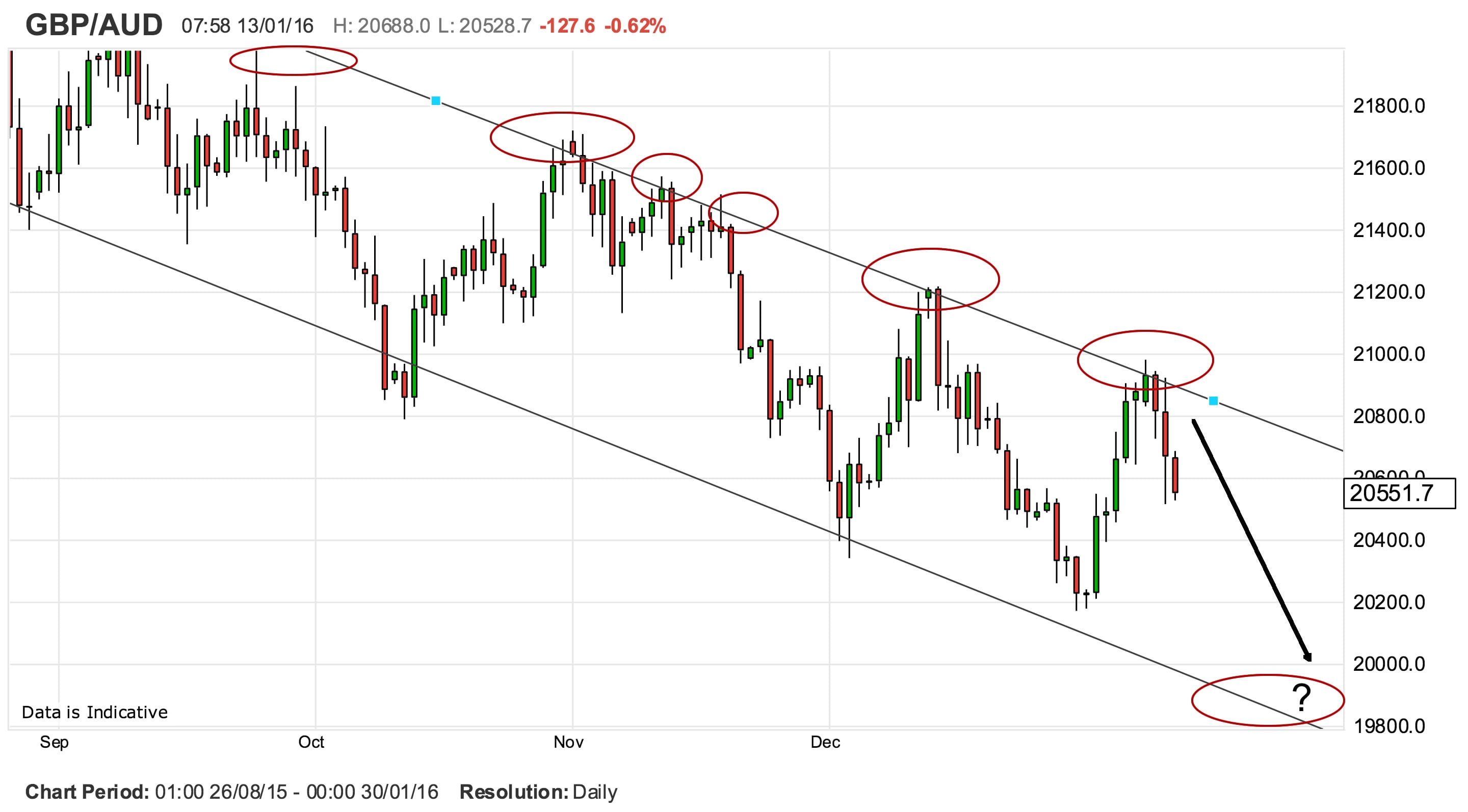
What those hoping for a stronger GBP/AUD exchange rate need is a game-changer on the fundamental front, something that will break the stranglehold of the strengthening Australian dollar.
With this in mind, the latest currency predictions from RBS catch our attention.
2016 Forecasts from RBS
The British bank has been in the news recently with their call to ‘sell everything’ over the coming year. We are of course interested to hear what they have to say about the prospect for the major currencies over the course of 2016.
RBS are negative on the broader commodity currency complex as a whole - i.e those currencies that derive a good portion of value from the export of raw materials to China. This basket includes the Aussie dollar, New Zealand dollar, Canadian dollar and the SA rand.
With China’s economic growth profile slowing the impact on commodity exporters has been notable.
Latest Pound / Australian Dollar Exchange Rates
  | Live: 1.8891▲ + 0.02%12 Month Best:2.0851 |
*Your Bank's Retail Rate
| 1.8248 - 1.8324 |
**Independent Specialist | 1.8626 - 1.8702 Find out why this is a better rate |
* Bank rates according to latest IMTI data.
** RationalFX dealing desk quotation.
But for RBS what is important when looking at the AUD is valuation.
“We’re particularly negative still towards the Australian dollar: the AUD is the most expensive currency we look at in terms of RBS long term drivers. Yes, it’s fallen quite far already but only enough to take the AUD from very expensive to less expensive,” says David Simmons, Head of Currency Research at RBS in London.
Simmons says the Aus dollar needs to be cheaper and is sceptical about how easily Australia can transform itself from commodity-investment led to consumption-led growth as China slows.
“The AUD has fallen hard over the last two years, both against the USD and in trade weighted terms. But just because something is a lot cheaper than it used to be doesn’t mean that it is cheap,” points out Simmons.
RBS’ studies confirm that when the Australian currency is measured against a range of long term currency drivers (current account balance, real effective exchange rate relative to long run averages, relative shifts in terms of trade, and so on) they observe that the AUD is still the most expensive of all G10 currencies.
“That looks most inconsistent with the fundamental landscape and we anticipate further significant declines for the AUD in 2016, both against the globally strong USD and in Aussie trade weighted terms,” says Simmonds.
The Chinese story matters says Simmonds:
"Generally put, the proceeds of Australia’s prolonged commodity super cycle have been consumed, or rather overconsumed.
"Now, as China growth slows and Australia’s terms of trade falls, the value of the AUD needs to fall to demonstrably cheap levels, in our view."
Lloyds: Chances for an Aussie Rebound
Questioning RBS’ all-out negative theme on the Australian dollar for 2016 are Lloyds Bank who say there is a good case for at least a modest rebound in the AUD this year.
“Growth in the economy outside the resource sector has shown some signs of life on the back of stronger consumer spending and the housing market. As a result, the RBA as of late last year was showing little inclination to initiate further monetary policy stimulus, although this position may change when policymakers meet next in early February,” say Lloyds in a recent exchange rate forecast note.
No doubt, the Reserve Bank of Australia’s monetary policy ‘read’ will be a very important influence on the currency, of course.
In suggesting no immediate need to consider further policy easing, the RBA had given FX markets some legitimate cause for pause in selling the AUD.
Over the last three or four months the central bank has declined numerous opportunities to talk the AUD down further - so while RBS see the Aussie as remaining historically overvalued, the same is not necessarily true at the RBA.
Analysts at Lloyds do concede that a further fall cannot be ruled out given ongoing uncertainty about the outlook for commodity prices and the Australian economy’s close links to China.
(We note here that Chinese authorities will have to devalue their Yuan by as much as 20% if they are to stabilise private capital outflows).
RBS sense that the RBA will change tack in 2016 as the relationship between Australia’s terms of trade and the value of the currency is most important and has featured more prominently in recent RBA policy pronouncements.
“While iron ore prices have rallied modestly from mid-December lows, the dichotomy between the terms of trade (weaker) and the AUD (resilient) over the last couple of months is unlikely, in our view, to endure,” says Simmonds.
RBS Australian Dollar Forecasts 2016
The pound to Australian dollar is forecast to end March 2016 at 2.15 ahead of a climb towards 2.23 by the end of June. Forecasts for end of September price in 2.27 and the year should end at 2.30.
For the US to Australian dollar exchange rate analysts forecast 0.69 at end of March, 0.66 mid-year, 0.64 in September and the year will end at 0.62.
Euro to Australian dollar forecasts see the exchange rate at 1.10 by March, 1.08 by end of June where it will stay until a fall to 1.07 at the end of the year.