Forecasts for the Aus dollar against both the pound and USD based on technical and fundamental observations.

What maters for the Aussie dollar this week?
As always we believe a study of both the technical structure of the market and the fundamental economic picture will give the best picture.
Looking at the pound to Australian dollar exchange rate’s charts, a clear move above 2.1100 would confirm a breakout from the descending channel and signal a probable move up to an initial target at 2.1200 where the R2 Monthly Pivot is situated.
At the time of writing the Aussie has staged a strong comeback and has pushed the exchange rate back to 2.0588, but this move does not yet invalidate the pair's technical picture at this stage.
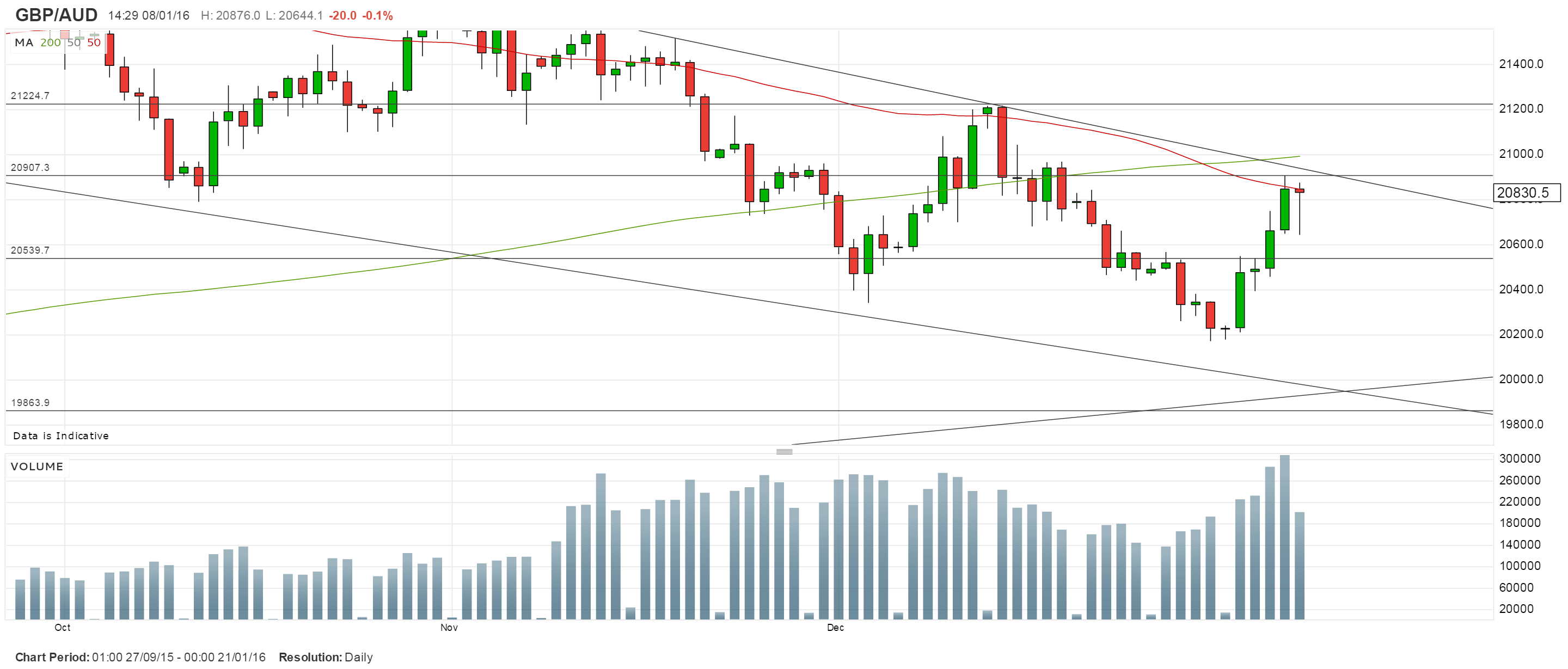
Above that there might even be further gains to an eventual target at 2.1750.
For more down-side I would want to see a break below 2.0490, which would signal a move down to the lows of the channel at 2.0200.
"GBPAUD has been in a choppy but coordinated decline since August 2015. Recent strength, more due obviously to AUD underperformance on China worries, has seen the cross move back to the 2.10/2.11 pivot and channel resistance region," say Lloyds Bank in a client briefing.
It is noted by analysts at the bank that this channel has capped the last four rally attempts, "support lies at 2.0670 and then 2.0550/40, a break of which would suggest a return to channel lows and key support region around 2.00."
Latest Pound / Australian Dollar Exchange Rates
  | Live: 1.877▼ -0.16%12 Month Best:2.0851 |
*Your Bank's Retail Rate
| 1.8131 - 1.8206 |
**Independent Specialist | 1.8507 - 1.8582 Find out why this is a better rate |
* Bank rates according to latest IMTI data.
** RationalFX dealing desk quotation.
AUD to USD
Against the dollar, the aussie has just reached a major support level from the S2 Monthly Pivot at 0.6966.
It has broken out of a triangle and moved down but has just hit support.
The target for the breakdown is the 61.8% extrapolation of the height of the triangle at 0.6905, which also happens to be the same level as the September ’15 multi-year lows.
To reach this, however, it will first have to break down through the pivot, and this will be tough. There is likely to be a bounce form the pivot higher – perhaps back up to the key 0.7000 level.
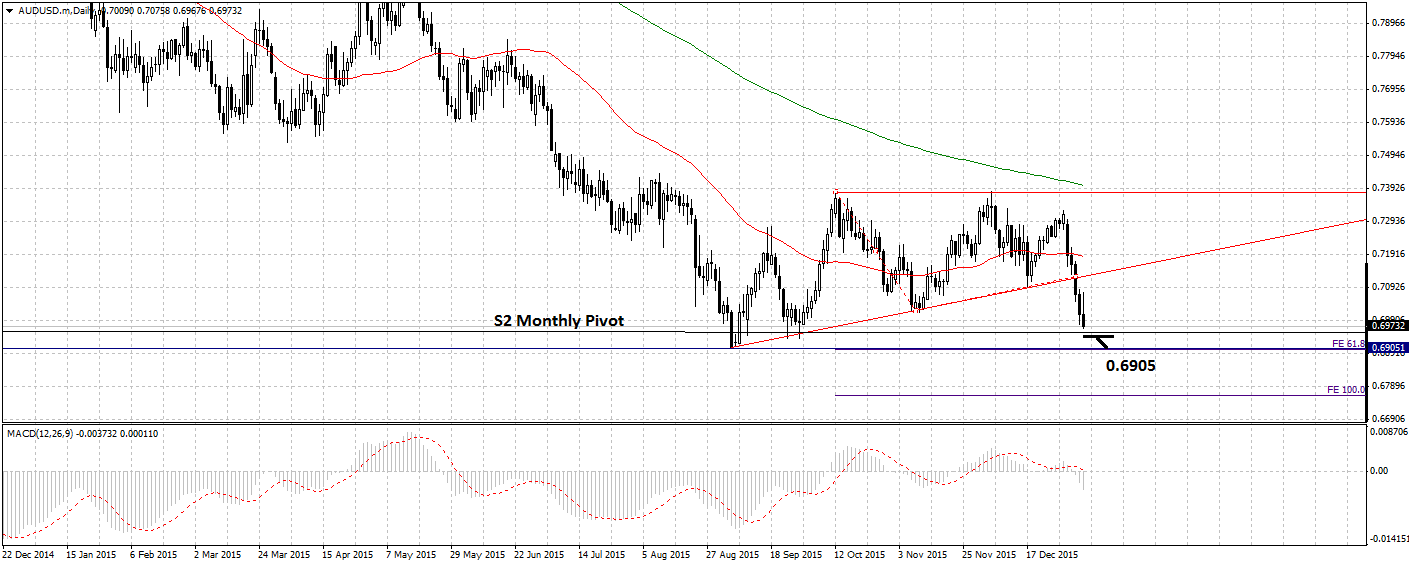
To see a definitive break I would want the exchange rate to penetrate below 0.6946 at the least, with a target if did, at the 0.6905 lows.
MACD backs up the possibility of further downside as it has made a particularly bearish thrust below the zero-line.
The Fundamental Backdrop: What to Watch
From a data perspective, the big release for the aussie in the week ahead, will be the Australian Unemployment Rate due out on Thursday, which has been performing well recently, having fallen to 5.8% in December, a 19-month low.
Economists are forecasting a reading of -12K to be released, anything either side will likely cause movement in the exchange rate.
From a risk perspective, however, the most influential factor is Chinese data and slowdown concerns, particularly around the daily yuan fixings and the Chinese Trade data, scheduled for release on Wednesday.
Obviously any weakness in exports – or Imports for that matter, since they are gauged for economic rebalancing – would cause pain to the aussie.
In fact so sensitive is the aussie to China, that analysts at Bank of America are recommending using the aussie as a proxy for trading the yuan:
“Quant models recommend selling AUD/JPY as a proxy for China risks.”
And:
“G10 correlation to USDCNH has increased as the importance of China on global markets comes into focus.
“We favour owning downside AUDUSD digital puts as a leveraged play on further CNH depreciation.”
According to TD Securities there is a considerable risk of decline to Chinese trade figures, due on Wednesday, which could put pressure on the Australian Dollar:
“The risk lies with exports registering another decline from the -6.8% prior.
“The market is more likely to look at imports to gauge internal demand.
“Here too we pencil in another decline from the prior -8.7%, but part of this is due to the CNY depreciation over Dec.”