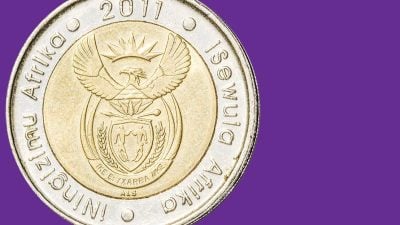
“If, as we believe, the start of the US tightening cycle passes by without significant disruption to EM FX, then the MXN and the ZAR are best placed to capitalise.” – HSBC Global Research

Unlike the governor of Bank of England, Mark Carney, who has insisted that the upcoming possibility of a US Federal Reserve rate hike is “not decisive” for his bank, there are some central bank heads who will be more inclined to act following the rise.
According to HSBC Global Research, amongst these are the central banks of Mexico and South Africa (above), “where prospective interest rate hikes in the US are a consideration in the pace of tightening at home in order to prevent inflation accelerating through currency weakness and financial instability.”
It is argued that monetary tightening on their parts could act as a buffer against any ill effects of a Fed rate hike, particularly as large sums of money are repatriated to the United States where they will earn higher returns at a lower risk premium.
In the Mexico and South Africa economies, there is high foreign ownership of local bonds, which leaves the respective economies and currencies extremely vulnerable to capital flight if foreign investor sentiment were to change in favour of increasing yields in the US.
Wrong Type of Depreciation
When a currency is weakened as a result of capital flights, the ensuing risks are very different from currency weakness induced by trade and other economic factors.
South African Reserve Bank (SARB) Governor Kganyago was quoted as saying, “[If] a currency declines because of a terms of trade shift, for example, there is an associated ‘hit’ to demand that helps cap the inflation effect of the weaker currency.
“But when the currency declines because of capital flight, there is no offsetting restraint on demand. As a result, the need for offsetting monetary tightening is greater.”
HSBC notes that it is the same with Bank of Mexico (Banxico) as “similar considerations have created the strategy of synchronicity between the central bank and the Fed. The narrative is that an effort should be made to protect the yield premium over the US which is offered to holders of Mexican assets.”
Thus, the encompassing monetary policy concern is what might happen if the Fed raised interest rates in December.
Latest Pound / SA Rand Exchange Rates
  | Live: 21.8703▲ + 0.06%12 Month Best:23.3448 |
*Your Bank's Retail Rate
| 21.1267 - 21.2142 |
**Independent Specialist | 21.5641 - 21.6516 Find out why this is a better rate |
* Bank rates according to latest IMTI data.
** RationalFX dealing desk quotation.
HSBC: MXN and ZAR to Outperform if Markets Shrug Off US Rate Hike
While the synchronisation of interest rate strategy of SARB and Banxico may hold weight in an environment where EM FX were destabilised after a Fed rate hike, it may be much ado about nothing if the markets absorb a lift off without fuss.
In “traditional” market occurrences, the former scenario may have been the case but the Fed’s monetary course has been anything but traditional.
HSBC Global Research notes, “[This] has been an unconventional easing cycle in the
US, and the repercussions of the normalisation could be equally unconventional.
“In addition, this is a tightening cycle that the markets have been contemplating for a long time, and the rising probability of a December ‘lift-off’ by the Fed has not delivered a devastating blow to emerging markets.”
“...This reaction to the FOMC minutes may prove akin to a “movie trailer” for the main event in December.
“The markets simply shrug after a long-anticipated hike, and take solace that the path for rates remains dovish.
“Some emerging markets could still face pressures because of local frailties, but this threat from ‘global’ factors would recede. The Fed ‘fear factor’ would virtually disappear.”
So in essence, rather than a “risk off”, the scenario can become a “risk on”, where the MXN and ZAR will greatly benefit.
HSBC explains, “The lack of currency fall-out in the wake of the Fed move would mean one of the key requirements for a succession of rate hikes currently priced in for Mexico and South Africa would recede.
“After all, the magnitude of these hikes was anticipated because of financial stability considerations, not because of traditional macro-economic considerations.”
Thus, if the Fed liftoff is a non-shocking event and the pressure for Banxico and SARB to raise rates fades, a “virtuous cycle” will occur permitting MXN and ZAR to outperform; “pricing out the hikes could be bond positive, and thereby support the currency” and “a stronger currency could, in turn, support bond inflows.”
Another advantageous facet is that this “virtuous cycle” would be spurred on by the fact that the MXN and ZAR are among the more undervalued of the EM FX, according to HSBC Little Mac valuation estimates.
HSBC Global Research concludes, “Monetary policy in Mexico and South Africa is being operated largely on the basis of a ‘fear factor’ that Fed tightening will induce local currency weakness unless interest rates are increased to act as a buffer.
“This is justifiable as both the MXN and ZAR would most likely be hardest hit were global markets to experience a fresh bout of turmoil in the wake of Fed ‘lift off’.
“However, these two currencies are also now in the best place to capitalise if the normalisation of US monetary policy proves not to be destabilising.
“Bond markets would likely rally as future rate hikes were priced out, helping to strengthen the currencies and potentially creating a virtuous circle.
“For those wondering how to trade the Fed ‘fear factor’, the MXN and ZAR should be your focus.”
What if a US Rate Hike Destabilises Emerging Market Currencies?
In the event that HSBC Global Research team in incorrect, they state, “Of course, this more positive view of the MXN and the ZAR is predicated on a calm market back-drop in the aftermath of a Fed rate hike.
“Should we be proved incorrect, with the USD surging and the US yield curve steepening dramatically following a US rate hike, then the MXN and the ZAR would be in the firing line to underperform, such is their higher-beta nature.
“So however the Fed story plays out, ZAR and MXN are the best way to express an EM FX view around this event.”