Image © Adobe Images
Politics is weighing on the Bank of Japan's thinking and the JPY's performance.
The Bank of Japan's policy makers unanimously opted to keep the base interest rate at 0.5% at its July policy update, while confirming that it remains dependent on data when shaping future policy decisions.
Referencing the value of the currency, which conyinues to lose value, it said "the yen isn't deviating much from BoJ's view".
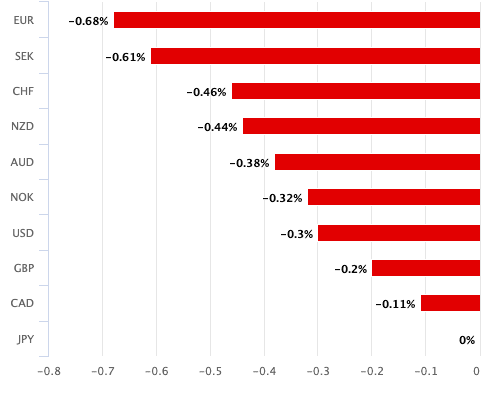
According to analysts at TD Bank, this admission was particularly hurtful to the Yen as it shows the BoJ and government officials are happy for it to trade on the weak side. The currency's post-decision slide shows traders are more than happy to oblige the Bank's assesment:
The yen has lost ground against all its G10 peers over the course of the past 24 hours, building on increasingly chronic underperformance, with the currency also losing ground to all peers over the course of the past month.
The currency's month-long underperformance reflects growing uncertainty as to whether the central bank will be willing to cut interest rates while domestic politics remain in a state of flux.
"We still think it will hike rates in October 2025 and April 2026, based on our assessment of the underlying fundamentals. The risk to our view is that those hikes get pushed back owing to lingering political uncertainty," says Tom Kenny, Senior International Economist at ANZ.
Politics have been an unhelpful headwind to Japanese assets and central bankers ever since polls started to show the ruling LDP-K coalition would lose its Upper House majority, which it duly did in the July 20 elections.
To pass legislation, the government will now need to make deals that include the priorities of the major opposition parties, which risks populist decisions that aren't necessarily helpful to Japan's financial market profile.
"Despite the U.S.-Japan trade deal, the BoJ remains cautious as the Bank emphasised that it wants to assess the impact from tariffs in the hard data. We suspect politics is the larger factor at play for the dovishness as Japan is in a tricky political period after the ruling coalition lost the Upper House election," says TD Bank in a note following the Bank's decision.
TD says to watch the LDP's plenary session of its Parliament members on August 8; once the political situation settles, the BoJ can always voice its opinion for an October hike through media leaks.
Prime Minister Shigeru Ishiba was put on resignation watch following the election which saw his Liberal Democratic Party, in power for most of the past 70 years, lose its coalition majority in elections to Japan’s upper house.
It lost its majority in the more powerful lower house, the House of Representatives, last year.
Nevertheless, ING Bank thinks inflation will reemerge as a primary concern for the BoJ, and prompt the delivery of further rate hikes.
"A notable upward revision to the inflation outlook increases the likelihood of a rate hike in October," says Min Joo Kang, Senior Economist for South Korea and Japan at ING Bank.
"In our view, the BoJ has eased its concerns about trade uncertainty and will now focus on the inflation mandate instead of risk management," adds Kang.
The Bank of Japan is expected to be the lone hiker amongst major peer central banks in the coming months, which if borne out, would help the Yen.
The yen has been kneecapped for years by Japan's ultra-low interest rates, but the BoJ has a window to reduce the JPY's interest rate advantage by raising rates as other central banks cut their.
However, this support won't materialise if the Bank is itself kneecapped by crippling political uncertainty.