
The Pound to Dollar exchange rate has shot higher at the start of the new week, however a mix of technical signals and fundamental risks should keep the rate contained within familiar territory
A strong start to the week for Pound Sterling sees it bounce to 1.2688 against the US Dollar.
The US Dollar is struggling against a host of major currencies as markets pare recent gains against the much-anticipated US Federal Reserve meeting due mid-week.
In fact, the USD is the worst-performing G10 currency at the start of the week while the New Zealand Dollar is the best and Pound Sterling the second-best.
No doubt this is profit-taking adjustment by the markets as there is no fundamental reason why the USD should be lower other than traders are expressing caution ahead of the Fed meeting and are nervous of being caught over-exposed.
“The Dollar fell prey to cautious profit-taking,” says Piet Lammens at KBC Markets in Brussels. “Investors apparently are turning a bit more cautious on the Dollar ahead of the Fed policy decision.”
In times such as this technical levels should be respected moreso than would normally be the case.
We are therefore cautious of suggesting the GBP/USD is at the start of a fresh push higher and only once the Fed has passed would we be confident in calling a direction.
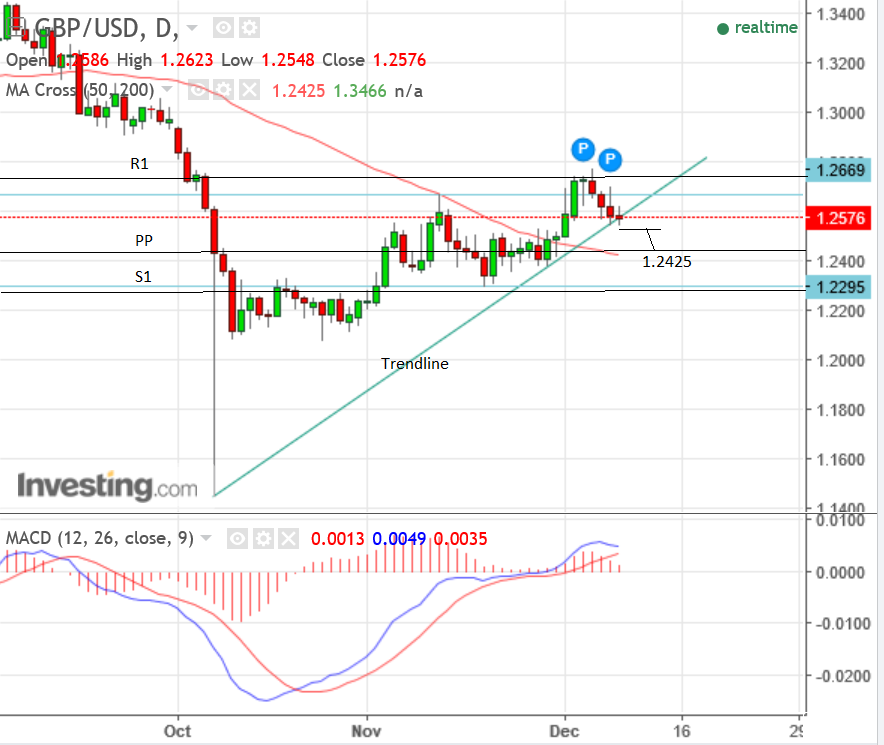
Indeed, we must respect the fact that GBP/USD has recently rolled-over from its 1.2730 highs and we suspect the capitulation could lead to further weakness.
The top was followed by two quite potent bearish Japanese candlestick patterns – the Doji Star and Three Black Crows patterns (see chart below with the two blue dots marked ‘P’ indicating the candlesticks).
Japanese candlestick patterns are an especially graphical way of representing asset prices.
They were developed in the 18th century by a rice trader called Munehisa Homma, and are still used by traders today.
When two or more candlestick patterns occur close to each other it tends to increase their effect, experience has shown.
To confirm a change of the short-term trend, however, we would be looking for a break of the trendline drawn from the October lows as well.
Such a break would be confirmed by a move below 1.2525, with a target at 1.2425.
These targets should provide good guidance for those with payments to layer their stop and limit orders which should ensure they get the maximum purchasing power out of forthcoming movements.
Latest Pound / US Dollar Exchange Rates
  | Live: 1.3237▼ -0.29%12 Month Best:1.3867 |
*Your Bank's Retail Rate
| 1.2787 - 1.284 |
**Independent Specialist | 1.3052 - 1.3105 Find out why this is a better rate |
* Bank rates according to latest IMTI data.
** RationalFX dealing desk quotation.
Data to Watch this Week for the Dollar
The main event for the Dollar in the week ahead is the meeting of the Federal Reserve Open Market Committee on Wednesday, December 13 at 19.00 (GMT).
Markets expect the Fed to raise rates by 0.25% so if they do it is unlikely to move exchange rates by very much.
Instead, it is guidance about potential moves in 2017 and 2018 that will drive the Dollar.
Analysts will be interested in the expectations of individual members as to what rates should look like over coming years.
This is illustrated on the Fed website’s dot plot diagram:
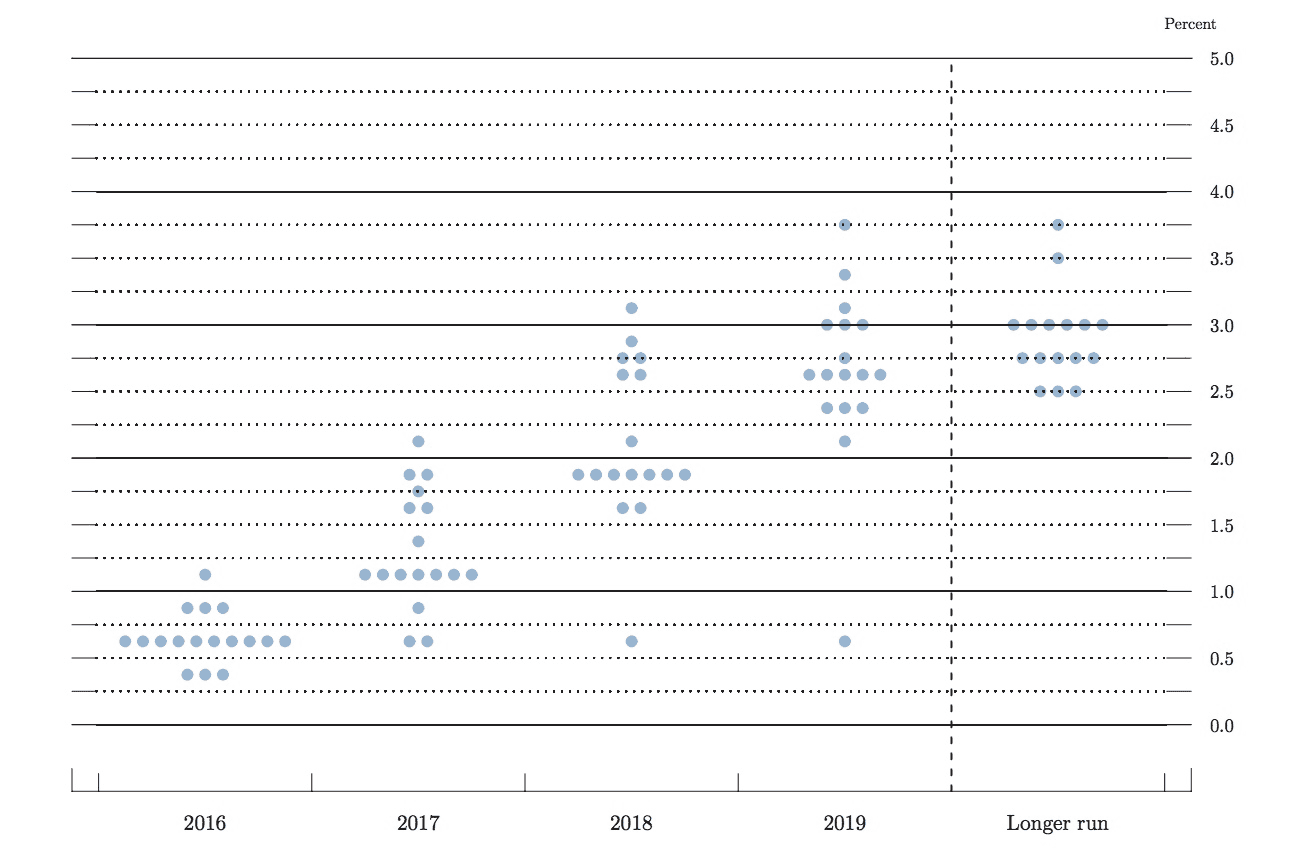
The consensus is that there will be no change to dot plot which currently shows two hikes expected in 2017 and three in 2018.
But, if there is either for more or less hikes it will impact on the Dollar.
The wording of the statement will also provide clues as to how many rate hikes the Fed is expecting in the next two years.
There is a possibility of the word “roughly” being removed in the phrase “risks are roughly balanced” to produce a less ambivalent and more positive statement, according to Strategist Athanasios Vamvakidis at Bank of America Merrill Lynch.
Janet Yellen’s press conference will also be the focus of much attention as investors seek confirmation for the current positive ‘reflationary’ outlook.
She is expected to be “cautiously optimistic” by Vamvakidis.

Other Data...
Retail Sales is released before the Fed meeting on the same day at 13.30 and therefore may only garner a subdued market reaction.
Headline Sales is expected to show a 0.3% rise in November, and Core Retail Sales a 0.4% increase.
Data has already shown a fall in auto sales in November due to tightening credit standards so this may weigh on November Retail Sales figures, says BBVA’s Amanda Augustine in London.
Nevertheless, she still expects November Retail Sales to be strong due to Consumer Confidence hitting a 12-year high in the month.
The non-seasonally adjusted figures are also expected to get a boost from e-commerce shopping – nevertheless, the reaction should be “short-lived” say TD Securities due to the “proximity of the Fed.”
Factory Gate Prices (PPP), released at the same time, are expected to show a 0.1% rise for the month of November.
On Thursday, December 14, Core CPI is estimated to rise 0.2% in November.
Referring to the inflation data Augustine commented that: “We are likely to get a lower headline gain in November but a stronger Core result.”
The closes with Building Permits at 13.30 on Friday, December 15, which are forecast to decline slightly to 1.24m in November.
And the Pound
The Bank of England (BOE) interest rate meeting on Thursday, December 14 at 12.00 (GMT) is the main economic data event in the week ahead, and although no change of policy is expected the minutes, released immediately afterward, could be instructive in showing members thinking on future policy.
Inflation will be absolutely key as to what the Bank does to interest rates in the future.
Therefore, this week's inflation data which preceeds the BoE decision by a day will be important for Sterling.
On Tuesday, December 13 November CPI is released at 09.30.
The annualised figure is forecast to read at 1.1%, up from the previous month's 0.9%.
A beat on this figure would prove beneficial to the Pound in that it would imply the Bank of England may have to raise interest rates at some point in the future in an attempt to keep inflation settled.
However, if the figure underwhelms then Sterling could struggle.
On Wednesday, December 14 at 09.30 the ONS release unemployment data, which is forecast to show a 4.8% unemployment rate (Oct), a 5k rise in the Claimant Count (Nov) and Average Earnings Including Bonuses (Oct) rising by 2.3%.
On Thursday, December 14 at 09.30 Retail Sales in November is released and expected to come out at 0.2% month-on-month.
If these data remain robust then Sterling should be able to enjoy the fundamental support required to keep its recent recovery move in place.