The pound to dollar exchange rate's recovery could extend further argue analysts at Societe Generale.
- Still to early to call a reversal in longer-term downtrend in GBP/USD
- A clean break above the 'c wave' highs at 1.4436 would solidify the pound’s foothold higher
- Bank of England and US Federal Reserve to provide focus of fundamental guidance for pair this week
The pound's rebound against the US dollar could run further and we could even witness the UK currency recapture the lion's share of losses suffered in February it is suggested.
The March recovery in the conversion rate has been impressive with GBP/USD advancing in 10 of 13 trading days.
“1.46 should cap the short term rebound,” says Stéphanie Aymes, technical analyst at Societe Generale.
However, Aymes is not bullish on the GBP's medium-term prospects noting the exchange rate has breached a multi-year upward channel support at 1.46.
Hence, what was once support is now seen as resistance to major advances.
The pair, "looks headed towards graphical levels at 1.36/1.35 (lows of 1986, 2001, 2009). Long dated indicators are close hitting a floor pointing towards possibility of consolidation once these levels are achieved," says Aymes.
Latest Pound / US Dollar Exchange Rates
  | Live: 1.3341▲ + 0.27%12 Month Best:1.3867 |
*Your Bank's Retail Rate
| 1.2887 - 1.294 |
**Independent Specialist | 1.3154 - 1.3207 Find out why this is a better rate |
* Bank rates according to latest IMTI data.
** RationalFX dealing desk quotation.
Central Banks to Stir the Market
But beware, the GBP/USD exchange rate could see notable volatility in the week ahead, especially if there are any surprises from either of the two central bank rate meetings which form the focus of FX market attention this week.
The BoE is least likely to surprise, but it could impact on the pound if there is any more commentary from the MPC about Brexit.
The pound rose last week after BoE governor Mark Carney and Deputy Governor Sir Jon Cunliffe expressed mildly pro-European Union views, while warning of the hazards of the UK leaving the European Union.
If there is more fervent pro-stay commentary expressed within the BoE minutes, which are released right after the decision, this could further support pound sterling as it will signal a well-respected financial establishment is backing the ‘stay’ campaign, which could well sway some of the undecideds.
"A more dovish BOE tone this week, especially in light of mounting Brexit worries and the impact that those worries are having on the U.K. economy, could send the pound lower against the greenback," say Commonwealth FX in a currency brief to clients.
According to newspaper reports betting agencies are comfortably odds-on more for the referendum to support a stay vote.
If the trend towards the stay campaign prevailing in June continues we would expect to see the pound continue to move higher against the dollar.
Analysts continue to argue a substantial amount of the pound’s decline has been Brexit-inspired and therefore is reclaimable upon a win for the stay campaign.
"Ahead of the BOE MPC (and Osborne’s budget speech) this week and tapering Brexit concerns, at this juncture, the GBP-USD may attempt to inch higher into and post-FOMC if Yellen fails to surprise significantly on the upside. With a spot ref at 1.4380, we target 1.4770 and place a stop at 1.4180," says Emmanuel Ng at OCBC Bank.
The US Federal Reserve Could Surprise
An upside risk for the US dollar is that the Fed decided to make a surprise rate hike.
Whilst this is unlikely there is an outside possibility which traders should be cognisant of.
As suggested by a note from Commerzbank, the U.S maintains broadly robust fundamentals, sporting low unemployment and strong economic growth, which they argue will almost certainly eventually translate into higher inflation:
“The Fed, on the other hand, at its meeting next week is unlikely to hike rates further – but only for now. In the US, in contrast to the euro zone, full employment has been reached, with inflation pressure gradually increasing, particularly in services.
“Hence the Fed seems set to hike rates more strongly (i.e. twice) than expected by the markets, which will lend support to the US dollar and cause yields to rise. “
For Commerzbank the real bell-weather for inflation is not any goods-based index but services prices, which are more sensitive to wage inflation since wages are a major cost for service companies, unlike manufacturers whose costs are split between goods and labour.
The core inflation rate for services has already risen from 2.4% to 3.0% since May 2015 and more inflation pressure is in the pipeline given that the unemployment rate has kept falling (and is likely to fall further).
The prices for services should therefore rise at a sharper rate in future.
As services account for 75% of the core index, rising inflation in this area carries more weight than the barely existent inflation pressure in goods prices, which is unlikely to change very much initially given the firm dollar and spare global capacity.
The core inflation rate for consumer prices already rose to 2.2% in January; the consumption expenditure deflator (PCE), which is preferred by the Fed, showed a rate of 1.7%. Consequently, the Fed’s 2% target is slowly coming within reach.
Technical GBP to USD Forecast
The pound to US dollar rate remains in a down-trend, but is showing early signs of reversal potential, nevertheless these remain inadequate to call a reversal yet.
The pair has completed a three wave a-b-c correction higher to reach a critical ‘make-or-break’ scenario with a possibility the down-trend could reassert, whilst at the same time a clean break above the c wave highs at 1.4436 would solidify the pound’s foothold higher by reversing the direction of peaks and troughs from down to up.
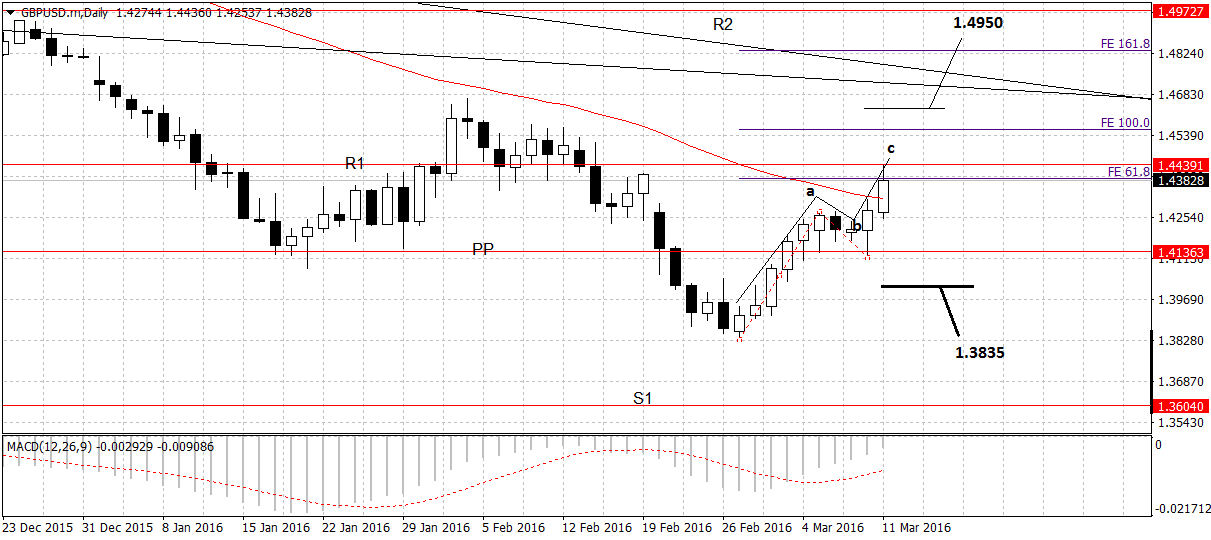
MACD, which measures momentum, is still in bearish territory supporting a resumption of the down-trend.
Therefore, if the pair started to move lower, a break below the March 3 lows of 1.4032 would probably confirm more downside to the 1.3835 February 29 lows.
On the weekly chart there is a two-bar reversal pattern signalling the likelihood of more upside. This gained further confirmation by the bullish finish this week.
A break above the 1.4436 highs and the R1 monthly pivot at the same level, including a confirmation gap would probably indicate a continuation of the youthful bull trend.
As such a break above the 1.4667 highs would probably confirm a move up to 1.4950 just below the R2 monthly pivot.