
The RBNZ is back in focus this week but we don't believe anything the central bank does or says will prevent the NZ Dollar from strengthening.
The GBP/NZD rate starts the new week from 1.7870, near its lowest point since 2013.
GBP/NZD continues to trade near the lows hit following the Brexit vote.
The range resembles a triangle with a vaguely ‘right-angled’ resemblance, and therefore a bearish bias.
Right-angled triangles have a flat side which is the side the breakout most often occurs.
The flat side is on the bottom of this triangle indicating it is therefore probable that a downside breakout will eventually follow the completion of the pattern.
Triangles normally have a minimum of five component waves – a,b,c,d and e.
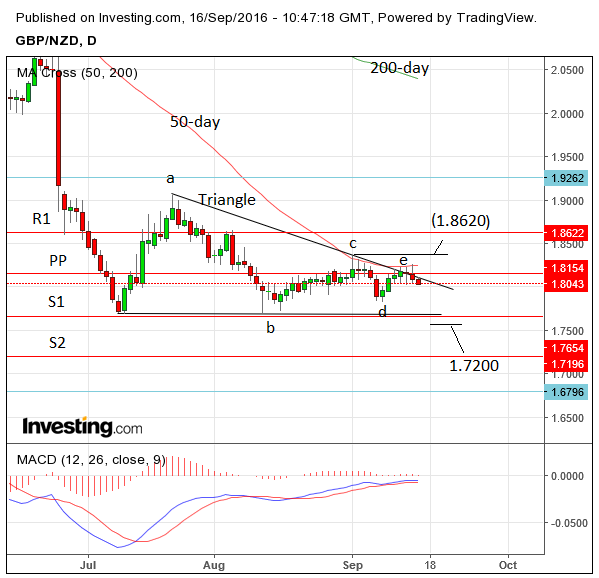
The GBP/NZD triangle may already have formed all 5 component waves, which could mean it may be at risk of breaking out.
A move below the lows, confirmed by a clearance of 1.7600 would signal a breakout had probably occurred and the pair was likely to continue lower down to a target at the S2 monthly pivot at 1.7200 .
Monthly pivots are levels of support and resistance where the exchange rate often stalls in its tracks. Traders often home in on pivots to trade counter to the prevailing trend or add to positions once they have been breached.
Alternatively a break out above the C wave highs at 1.8362 would mark a probable upside breakout with a target at 1.8620.
Latest Pound / New Zealand Dollar Exchange Rates
  | Live: 2.3468▼ -0.47%12 Month Best:2.4815 |
*Your Bank's Retail Rate
| 2.267 - 2.2763 |
**Independent Specialist | 2.3139 - 2.3233 Find out why this is a better rate |
* Bank rates according to latest IMTI data.
** RationalFX dealing desk quotation.
Will the RBNZ Target the NZD's Strength This Week?
The main event for New Zealand Dollar in the week ahead is the Reserve Bank of New Zealand (RBNZ) rate meeting on Thursday September 22.
Markets are not expecting any changes to be announced by the Bank but the wording in the accompanying statement could indicate a strong likelihood of a cut in November.
Indeed, many economists expect such a move to come despite the NZ economy continuing to steam ahead.
“We wonder if the Bank might say something to stop market pricing drifting too far off the idea of a cut in November, the way it is currently swaying on global tides,” says BNZ’s head of research Stephen Toplis.
Any cut to interest rates may help stem further strength in the domestic currency which remains bouyed by a robust economy as confirmed by last week's GDP release.
However, this is not an economy that warrants lower interest rates. Markets know this.
"We remain wary on a few fronts: the housing market and household debt, global developments, and the endgame associated with cutting rates in the face of a strong and expanding economy," say ANZ Research in a briefing to clients.
With the Official Cash Rate (OCR) sitting at 2.0% the RBNZ would have to slash at an unprecendented rate to make any fundamental impact on the domestic currency.
As a result, were the RBNZ to talk the NZD lower, we believe it won't stay down for long.
"Even if the RBNZ cuts rates, it is difficult for the central bank to weaken the currency in a time when markets are looking for anything high yield," say Morgan Stanley in a foreign exchange briefing to clients.
However, analysts caution that NZD remains vulnerable to a risk-off period on global markets and from aggressive OCR cuts at the RBNZ in response to a too-high New Zealand Dollar.
Staying Bullish on the NZD
Stronger-than expected growth of around 3.6% on an annualised basis will ensure the RBNZ doesn't rush into an interest rate cut this month which should keep NZD elevated.
The stand-out growth sector in the recent GDP data was in consumption, which bodes well for inflation, and could see the kiwi rise further.
"There are many reasons to be bullish on the NZD. The first one is technical, as the NZD is the highest beta currency in G10 so when the USD weakens, the NZD strengthens. Fundamentally, dairy prices continue to rise, the housing markets remains supported and consumption data is coming in strong," say Morgan Stanley.
Quite how the RBNZ will battle the appreciation in their currency given the strong economic fundamentals, above average growth and the booming housing market is the ‘60,000 dollar’ question for the erstwhile members of the RBNZ governing council.
As it stands the kiwi is likely to strengthen further as it is also supported by the dynamics of the carry trade, which is a type of investment becoming ever more popular in a world of diminishing investment avenues.
The carry trade is an investment strategy in which an investor borrows money in a funding or low interest rate currency, such as the Yen (-0.1%), the Euro (0.0%) or the Pound (0.25%), and uses that money to buy a high interest rate currency such as the Aussie (1.5%) or New Zealand Dollar (2.0%), profiting from the resulting difference.
The fundamentals are therefore biased to further losses for the GBP/NZD. What's more, further strong economic outperformance can be expected according to ANZ Research:
"It’s largely a case of business as usual across the New Zealand economy, with Q2 GDP data confirming solid overall momentum and ANZ job ads showing ongoing growth in labour demand.
"We’re not convinced that this is as good as it gets for the economy, with a lack of excess on the consumer side (ex-housing) and reduced risks for the dairy sector suggesting the expansion has legs."