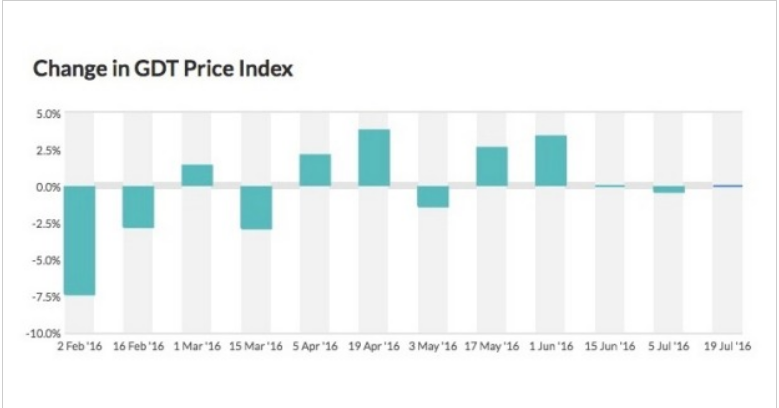
The pound to New Zealand dollar stalled after NZD possibly gained support from a 1.9% rise in Whole Milk Powder at the Global Dairy Trade auction on Tuesday.

The New Zealand dollar (kiwi) may have gained a small boost from the results of the Global Dairy Trade (GDT) auction on Tuesday as they showed a 1.9% rise in the country's single biggest export Whole Milk Powder (WMP).
Nevertheless, there was a negligible change in the Global Dairy Trade Index which averages the prices of a basket of dairy porducts, since several of the constituents such as butter fell in value.
The GDT data is an important influencer in the decisions of the Reserve Bank of New Zealand (RBNZ) when it decides on interest rates.
The result makes it marginally less likely the RBNZ will feel it is necessary to cut interest rates in August as is currently widely expected, however, given the GDT index as a whole has failed to show signs of concerted growth the impact is probably negligible.
GBP/NZD rises after NZ inflation miss
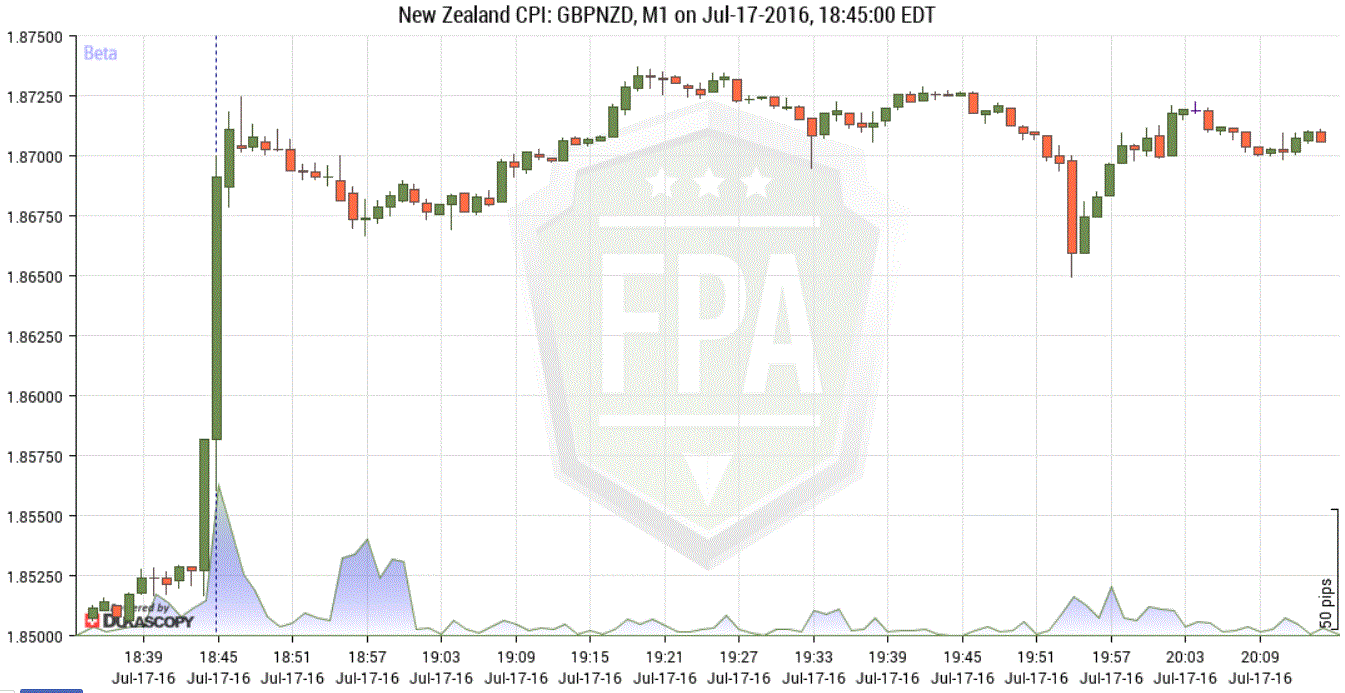
The pound rose almost two cents against the New Zealand dollar (kiwi) on Monday after New Zealand CPI in the second quarter came out lower-than-expected at 0.4% qoq, when investors had been anticipating a rise of 0.5%.
The GBP/NZD exchange rate rose from roughly 1.8540 to 1.8725 in the minutes following the release.
What little inflation there was, was driven mostly by house price inflation and household utilities, according to Capital Economics' chief economist for Australia and New Zealand Paul Dales.
Dales was quoted in the Sydney Herald as saying:
"After excluding housing and household utilities, price inflation is negative 0.5 per cent, and has been below zero for almost two years."
The slow-down in inflation means it is now much more likely the RBNZ will cut interest rates at their August meeting.
The base lending rate is currently the highest in the G10 at 2.25%, however, a 0.25% cut is expected at the next meeting.
The kiwi lost ground recently after the RBNZ ordered an ‘economic update’ scheduled for release on Thursday.
Many analysts think the update is being used to pave the way for another interest rate cut.
The main impediment to cutting interest rates in New Zealand has been the excessive rise in house prices, especially in Auckland.
If the central bank cut rates again that would risk making the housing bubble even larger.
Some think the RBNZ may try to solve the problem by introducing lending restrictions to cool the housing market whilst at the same time cutting rates.
“Our hunch is that at Thursday's economic update, the RBNZ will hint that it's going to use lending restrictions to take the heat out of housing but continue to use lower interest rates to boost inflation," said Dales.
Technical Outlook
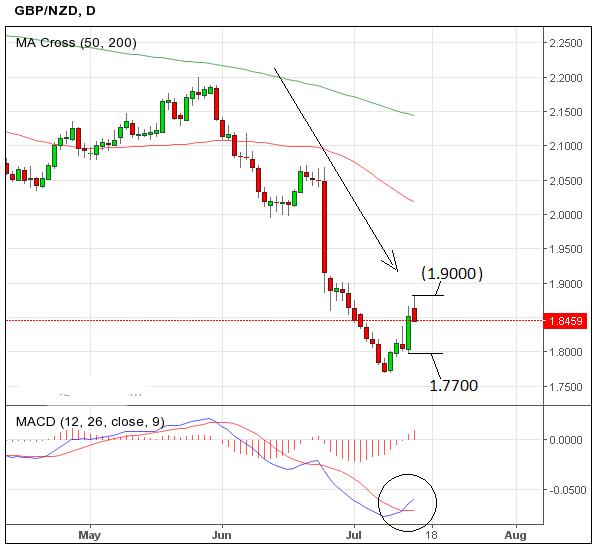
The GBP/NZD had been steadily recovering but then negative news about the London property market as well as pessimistic commentary from Bank of England (BOE) official Andrew Haldane weighed on sterling, sending it lower.
Looking at the structure of the market, a move below the 1.7990 lows would probably confirm a continuation down to the 1.7700 market lows.
Alternatively, a break above the recent correction’s peak at 1.88421 would probably lead to an extension higher as it would show a reversal of peaks and troughs from down to up.
The New Zealand dollar could also weaken if rate hike expectations rise
Currently most analysts expect the RBNZ to raise interest rates in August, mainly because of the RBNZ’s recent announcement of an interim economic assessment (for July 21).
According to Besa Deda, Chief Economist at St George Economics:
“NZD/USD underperformed after the Reserve Bank of New Zealand unexpectedly announced an interim economic assessment (for 21 July). The market interpreted the assessment will pave the way for an August rate cut.”
Latest Pound / New Zealand Dollar Exchange Rates
  | Live: 2.3468▼ -0.47%12 Month Best:2.4815 |
*Your Bank's Retail Rate
| 2.267 - 2.2763 |
**Independent Specialist | 2.3139 - 2.3233 Find out why this is a better rate |
* Bank rates according to latest IMTI data.
** RationalFX dealing desk quotation.
Nevertheless, econometric data continues to be positive for the economy as a whole:
“The Business NZ manufacturing PMI rose from a revised 57.2 in May to 57.7 in June. It is the strongest reading in five months. This morning, the REINZ reported that home sales rose by 6% from a year earlier in June.”
Commenting on the inflation data out at the start of next week, Hans Redeker, Director of Research at Morgan Stanley said:
“A weaker CPI indicates a need for further monetary easing while a strong CPI could push the exchange rate to even more uncomfortable levels (though not necessarily inducing rate cuts like the former scenario). However, housing remains an issue and deputy Governor Wheeler reiterated his stance on macro prudential measures, suggesting that investors will likely have tighter rules by the end of the year. We continue to expect strong migration to support housing and local consumption.”