Dairy prices finally increased in December ensuring the NZ dollar rallies sharply. But, don't expect a sustained recovery warn analysts at Barclays who see downside risks to the NZD outlook.
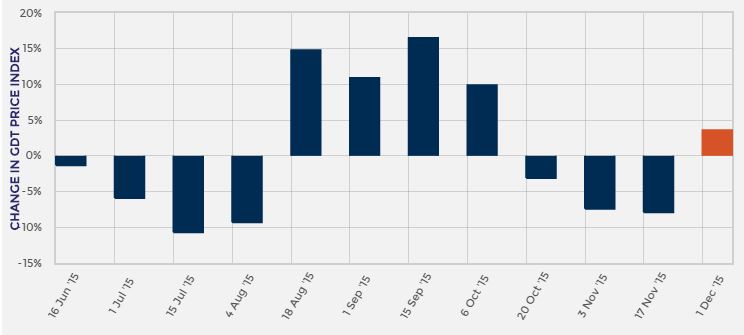
The New Zealand dollar exchange rate complex enters December on the front-foot having found support from improved global dairy prices.
The December 1st auction shows prices recovered 3.6% on the previous auction held on 17th November to record an average price of 2491 USD/MT.
Dairy makes up about 35% of NZ’s total merchandise exports and therefore play a significant role in propping up demand for the NZ dollar.
As a result of the kiwi’s new-found strength we have warned that we see little prospect of the pound to New Zealand dollar being able to move higher over coming weeks. The GBP to NZD exchange rate could well move from present levels at 2.26 down to October lows at 2.24 once more as the kiwi unit continues to appreciate.
The New Zealand to US dollar meanwhile trades above 0.6600 and is at risk of pushing higher yet.
"After trading in a tight range for more than a week, NZD broke above the major 0.6605/10 just a while ago. The up-move is accompanied by strong and impulsive upward momentum which suggests that the current movement is likely the start of a bullish phase. The immediate target is at 0.6690 and the next significant resistance above this level is closer to 0.6790. Stop-loss is at 0.6550," say Quek Ser Leang at UOB in Singapore.
Dairy Prices: Is This Merely A ‘Dead Cow Bounce?'
Much of the NZ dollar strength, from a fundamental basis, rests with a recovery in dairy prices.
Milk co-operative Fonterra have forecast prices to recover from multi-year lows before long, “we certainly expect it to start moving up over the coming months," says Fonterra’s Chief executive Theo Spierings.
“The recent recovery in dairy prices, and associated NZDUSD rally, has captured much attention but is unsustainable, in our view,” warns Dennis Tan at Barclays in Singapore.
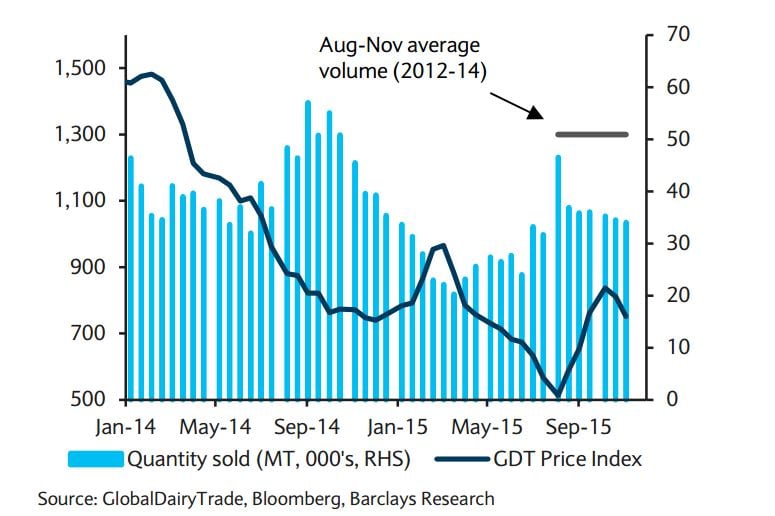
After hitting their lowest level in more than 10 years in early August, dairy prices have increased by more than 40%.
A key driver of this recovery has been a reduction in supply.
For example, average auction supply over August to October was about 30% less than the average for those months in the previous three years.
Tan believes that Fonterra’s forecast payout for NZ farmers – a function of the global milk price and the NZD – remains historically low at NZD4.60 per kg of milk solids, which is below DairyNZ’s breakeven estimate of about NZD5.30.
“With global prices unlikely to rise, a weaker NZD is necessary to push the payout higher,” says Tan
RBNZ Still Wants a Weaker NZD
The RBNZ was exceptionally clear in its latest policy statement: if recent currency strength is sustained, “this would require a lower interest path than would otherwise be the case”.
“This is aggressive language in the context of the September MPS forecasts which already implied a further 25bp rate cut by the middle of next year. The central bank likely continues to see a much weaker currency as important to help stimulate a slowing export sector and achieve its 2% inflation target,” says Tan.
Barclays expect a 25bp cut at its December meeting, returning the policy rate to historical lows of 2.50% and providing additional downward pressure on the currency given market pricing of just a 30% chance of 25bp cut.
Latest Pound / New Zealand Dollar Exchange Rates
  | Live: 2.3468▼ -0.47%12 Month Best:2.4815 |
*Your Bank's Retail Rate
| 2.267 - 2.2763 |
**Independent Specialist | 2.3139 - 2.3233 Find out why this is a better rate |
* Bank rates according to latest IMTI data.
** RationalFX dealing desk quotation.
The Other View: Prices Will Rise say ASB
Not everyone agrees that the dairy price dynamic will continue to lag, and therefore be a weight on the New Zealand dollar.
“With NZ production so far this season confirmed as weak and the outlook for further weakness, we see the current prices as out of whack with dairy fundamentals,” says Nathan Penny at ASB.
ASB do note that the market is factoring in some milk powder scarceness later in the season – prices of later-dated WMP contracts are around $300/MT higher than near-dated ones.
“While we agree with that pattern, the overall price level is still too low,” says Penny.
With that in mind, ASB continue to point out that the market assumption that other producers like the EU will pick up NZ’s slack is misplaced as lost NZ exports are too big to cover.
“As a result, once markets come to this realisation (most likely as stocks run down) prices, particularly for WMP, will correct higher. However, this correction may be a month or more away,” says Penny.
If ASB are right then we could well be facing the prospect of a more robust New Zealand dollar over coming weeks and months.