Today sees the British Pound under notable pressure as the Bank of England starts buying gilts in line with its quantitative easing programme and the move lower reinforces our view that GBP/EUR is on course to test post-Brexit lows towards 1.16.

- Pound to Euro exchange rate today: 1.1724, 5 day best = 1.1984
- Euro to Pound Sterling exchange rate today: 0.8527, 5 day best = 0.8496
- Elliot Wave formation advocates for declines towards 1.16
- AFEX see supportive buying interest at 1.1750, but this support appears to have broken
The GBP/EUR pair trades lower courtesy of the Bank of England's recently-announced stimulus package.
We have heard that the Bank has been active in the market with Reuters reporting that investors have rushed to sell bonds to the Bank of England on Monday after it revived its quantitative easing asset purchase programme for the first time in nearly four years.
The Bank said it received offers to sell nearly four times the £1.17BN of short-dated British government debt it was looking for in the first of what it plans will be six months of buy-backs totalling 60 billion pounds.
The move has forced up the price of gilt futures while pushing yields lower.
Ten-year and five-year yields hit new record lows of 0.603% and 0.152% respectively.
This is important as the lower UK yields go in comparison to those of the US and Eurozone will determine the weakness in the GBP.
With UK yields headed south, so too will support for the Pound.
The pair is however still above the lows registered in the post-referendum sell-off, but we believe these multi-year lows will be tested once again.
The Pound fell by over a percent against its major competitors on Thursday the 4th when the 0.25% rate cut and the £60bn increase in government and corporate bond purchases were announced.
The £10bn in corporate bond buying and new Term Funding Scheme (potentially worth another £100bn) went above and beyond what was expected by analysts.
In short, a huge amount of Sterling is to be released onto the market, which should devalue the currency on a unit basis.
In addition, the commitment of traders (COT) (see chart below) data from US futures exchanges is showing a roughly 60% probability of a move higher in EUR/USD at the start of next week, and this is likely to see the Euro rise even more versus weaker currencies such as Sterling.
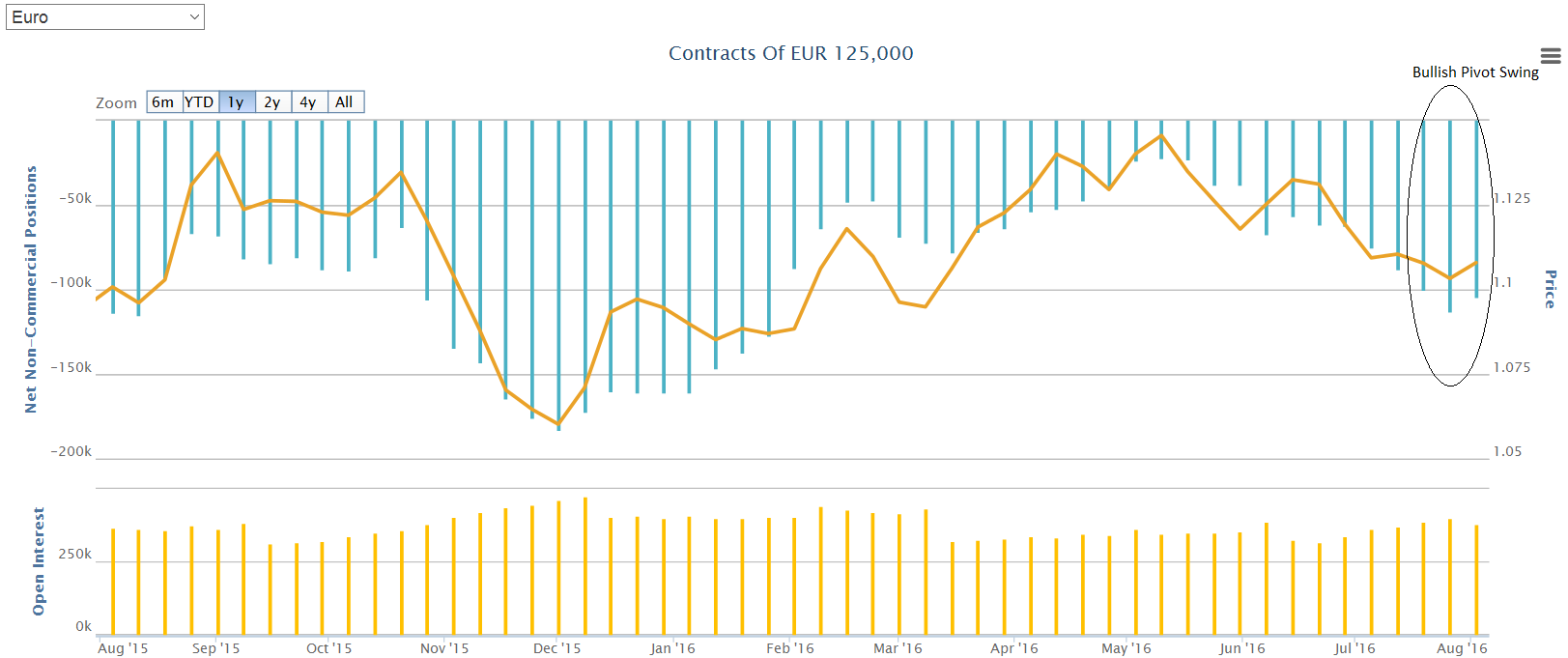
Although there are those arguing that Sterling may now have bottomed, this is still dependent on how good data is for July and the period following Brexit.
The only 'timely' data is that from the CBI on Tuesday – all the rest of the data will be of limited interest as it is for the period preceding the referendum.
Tech Forecasts See 1.1750, Ahead of 1.16
The GBP/EUR pair is in a dominant short-term down-trend but we note some supportive buying interest is around 1.1750 which implies an intermediate floor to GBP weakness.
Sterling values recently failed to hurdle 1.2000, and thereby secure an interim floor.
“Such a positive outcome may yet unfold but in the meantime local supports appear vulnerable to attack again and fresh rebounds now face resistance at 1.1865/75 as well,” says Lillicrap.
More substantial buying interest awaits towards 1.1500 and will probably at least slow further erosion from a daily/weekly standpoint.
“However until 1.1990/00 resistance gives way no obvious/direct path is open back up to 1.2125 or indeed 1.2250,” says Lillicrap.
Our studies have mapped out a text-book Elliot Wave from the May highs.
This wave appears to be unfolding towards completing a final wave lower, which should, at the very least match the last low at 1.1600:

It has just completed a triangle pattern and broken lower in what is probably a final wave down.
This is probably the final thrust of a bearish Elliot Wave formation which began at the May highs.
Elliot waves are composed of 5 smaller waves.
The triangle which just unfolded was probably at the end of wave 4 as it is rule that triangles always occur at the end of wave 4s.
Wave 5 is therefore likely to have already started, and could continue lower from here, reaching at least as far as the 1.1600 lows, potentially even lower.
According to analyst Robin Wilkin at Lloyds Bank, the GBP/EUR pair has respected its technical levels well of late, which gives us confidence that the charts will offer decent predictive powers.
Wilkin favours a consolidation in the GBP/USD which could well translated into consolidation for GBP/EUR. The range of 1.20-1.1745 is forecast to hold.
If a breakout were to occur Wilkin is biased to a move lower with a target at 1.1592 being favoured.
Latest Pound/Euro Exchange Rates
  | Live: 1.1944▼ -0.03%12 Month Best:1.195 |
*Your Bank's Retail Rate
| 1.1538 - 1.1586 |
**Independent Specialist | 1.1777 - 1.1825 Find out why this is a better rate |
* Bank rates according to latest IMTI data.
** RationalFX dealing desk quotation.
The Euro - Risk Appetite to be the Main Driver
August is a slow month for the Euro since most of the Eurozone is on holiday; the hallowed summer break not to be forsaken in the countries of the old world.
BK Asset Management’s co-founder Kathy Lien argues the currency may take its cue from risk trends, to which it responds inversely.
Record low interest rates in the Eurozone have attracted many investors to borrow in euros in order to buy more risky higher returning assets in emerging markets or simply higher yielding commodity currency assets, however, when risk appetite falls the repatriation flows back to euro-land mean a net positive demand for the euro, raising its value.
The other issue for the Euro is politics, but currently there does not yet seem to be a serious threat to the currency from the break up of the EU despite Brexit potentially providing other countries with a template for escape.
According to Deutsche Bank’s Fixed Income team the Spanish economy is weathering the extended delay in forming a coalition government quite well.
They see a 60% probability of the outcome being a minority PP government.
Data is likely to be dominated by Q2 GDP and Industrial Production, which according to Capital Economics’ Stephen Brown, “should show a moderate monthly rise in German industrial production (Monday).
Then the second estimate of euro-zone GDP (Friday) for Q2 should confirm that the economy expanded by 0.3%.
Analysts also expect first estimates for Q2 GDP to show growth of 0.1% in Italy (Friday), 0.4% in the Netherlands (Friday) and 0.2% in Portugal (Friday), but a 0.2% contraction in Greece (Friday).”
The Pound: ‘Data in the Driving Seat’
In relation to the Pound, there are some who think ‘the worst may be behind the currency’, although that does not mean there will necessarily be much upside ahead in the short-term either.
Financial markets sold off heavily after the UK voted to leave the EU, but they have now recovered and made new highs – we maintain that if the fallout was still a major risk factor equity markets for one would not be in such good shape.
The Bank of England also appears averse to lowering interest rates any further, and of the various different forms of monetary stimulus this would be the most negative for sterling; monetary stimulus in general, globally that is, also appears to be losing its impact, the UK included.
Nevertheless, as pointed out by broker TD Securities, the key to the Pound remains data for the period after Brexit, in other words for July.
The problem is that there is still a lack of data for July on which to base a fair assessment of the impact of the referendum on the economy, and in the week ahead this remains a problem as there are only two release for the period.
One is the British Retail Consortium's (BRC) retail sales figures out on Tuesday, and the other is the NIESR GDP Estimate for July on the same day.
Whilst BRC sales is normally a tier three release of little significance, in the week ahead its importance will be temporarily exalted.
Clearly a positive result for July data could help sterling recover; whilst a negative would confirm fears that the economy is declining steeply following the impulsive breakaway from Europe.
Has the Pound hit Bottom Yet?
For BK Asset Management’s Lien, the big question is, has Sterling bottomed?
According to her analysis there is a strong possibility the Pound has reached its nadir since she sees it as unlikely that the BoE will cut interest rates any lower, after BoE governor Carney expressed a clear aversion to negative interest rates at the last press conference:
“Yes, the central bank is ready to lower the bank rate further if needed and increase all elements of Thursday’s package but Carney also made it very clear that the “lower bound in interest rates is above zero” and he is “not a fan of negative interest rates.”
Carney believes that helicopter money is a “flight of fancy” and he doesn’t see a scenario where negative rates is discussed, so if BoE were to ease again, it would be in other ways like additional bond purchases.
"The bank reduced its GDP outlook for 2017 but kept its 2016 forecasts unchanged. It also believes that inflation will rise given the weakness of the pound. Having taken such an aggressive stance, the Bank of England is now in wait-and-see mode, which could actually lift Sterling because of the extreme level of short positioning,” says Lien.