The GBP to EUR exchange rate will start the new week on a firm footing as the Bank of England stress the risks of a Brexit during their June policy meeting.
Those watching the British pound's progress against the euro should be aware that a notable shift in momentum has occured over the course of recent trading sessions.
The chart of the EUR to GBP exchange rate pair has rolled over from its highs, after forming an "evening doji star".
This suggests to us that momentum has turned in favour of the pound and we could well see GBP command better exchange rates heading into the much-anticipated EU referendum.
The EUR/GBP pair has also reached the minimum expected target following the breakout above a major trend-line/out of a channel at 0.7790.

Formidable support at 0.7900 has possibly been broken although the move down has not been sufficiently deep to be sure it has.
0.79 in EUR/GBP is 1.2658 for those approaching the market from the GBP/EUR angle.
A clear break above the 0.8000 resistance level - denoted by a move above 0.8040 - would still probably indicate a continuation up to the 0.8110 level, at just below the 0.8117 peak.
0.80 EUR/GBP is 1.25 in GBP/EUR terms.
Right now there is clearly an inability by the market to find the requisite mass of euro buyers to break above the 0.80 point.
This is understandable if we consider that the market is heavily biased against the pound at present, positioning is said to be stretched.
Therefore, it may be the case that we need significant GBP-negative news to convince even more traders to jump into the market and extend the move.
Latest Pound/Euro Exchange Rates
  | Live: 1.1665▲ + 0.04%12 Month Best:1.1828 |
*Your Bank's Retail Rate
| 1.1268 - 1.1315 |
**Independent Specialist | 1.1502 - 1.1548 Find out why this is a better rate |
* Bank rates according to latest IMTI data.
** RationalFX dealing desk quotation.
Pound to Dollar Rate Breaks Back Above Major Support
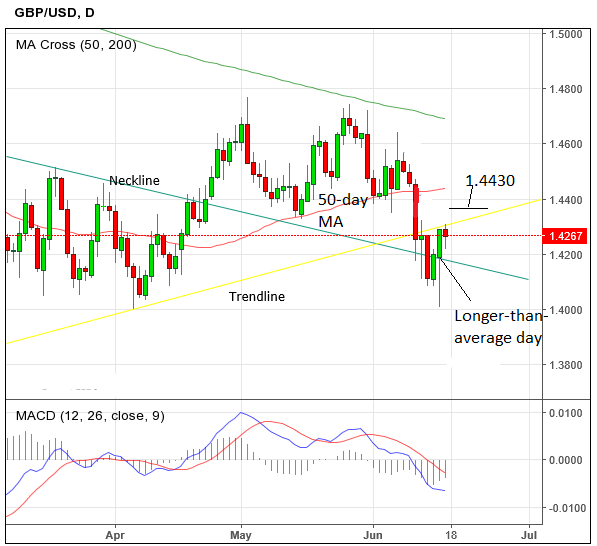
The GBP/USD pair has meanwhile broken back above a major support level reducing the bearishness of the technical outlook.
The exchange rate has now broken back above the 'neck-line' (blue line on chart below) of an inverse head and shoulders bottom pattern.
It also broke back above 1.4089 resistance, which was expected to cap any rebounds.
On Thursday the pair formed an up-day with a longer-than-average range and a close in the top half of the range; this highly bullish day brought the exchange rate
firmly back above the neckline and was itself a sign that there will probably be more bullishness ahead.
The pair is now currently pushing up against resistance from the old trend-line connecting the top of the head and the right shoulder of the inverse head and shoulders (yellow line on chart below).
If it manages to break above that line as well, marked by a move above the 1.4350, it will probably continue higher to a target at the 50-day moving average at just above 1.4430.
the MACD indicator, which measures momentum, has fallen below the zero line indicating the start of a bearish trend.
Sterling weaker after June rate meeting
The Bank of England delivered their June policy decision and statement on Thursday the 16th June.
Comments about the impact of a Brexit were included in the statement and minutes.
They revealed deep concerns about how the economy would be hit by a decision to leave the European Union (EU), saying such a shock would impact not just on the UK economy but also potentially the global economy.
"The outcome of the referendum continues to be the largest immediate risk facing UK financial markets, and possibly also global financial markets," said the BoE.
At the meeting BoE members underlined how growth would be compromised by a vote to leave, saying:
"A vote to leave the EU could materially alter the outlook for output and inflation, and therefore the appropriate setting of monetary policy. Households could defer consumption and firms delay investment, lowering labour demand and causing unemployment to rise.. At the same time, supply growth is likely to be lower over the forecast period, reflecting slower capital accumulation and the need to reallocate resources."
Monetary policy left alone
Investors had not been expecting any change in policy from the BOE due to the closeness of the EU referendum on June 23, and they were right.
The BOE voted unanimously to keep the base lending rate, or Bank Rate, at 0.5% and asset purchases at 375bn pounds.
The minutes of the meeting suggested inflation was still far too low at 0.3% to consider raising rates, given the BOE's target of 2.0%.
The BOE said it still saw inflation rising slowly at the rate outlined in its previous May Inflation report.
Nevertheless, inflation was expected to rise to the target over two years, and at that point Bank Rate was expected to be higher than its current level.
The statement added that further rises in Bank Rate would probably be more gradual than previously expected due to domestic and global "headwinds".
"The MPC judges that it is more likely than not that Bank Rate will need to be higher by the end of the forecast period than at present to ensure inflation returns to the target in a sustainable manner. All members agree that, given the likely persistence of the headwinds weighing on the economy, when Bank Rate does begin to rise, it is expected to do so more gradually and to a lower level than in recent cycles. "
The statement and minutes also alluded to the already tangible impact of the EU referendum on businesses and growth, arguing that the uncertainty caused by the vote was delaying decision making in key business sectors:
"While consumer spending has been solid, there is growing evidence that uncertainty about the referendum is leading to delays to major economic decisions that are costly to reverse, including commercial and residential real estate transactions, car purchases, and business investment."
The minutes also outlined the contingency measures the bank would take in the case of a victory for the leave vote, which broadly involved the provision of sufficient liquidity, including foreign exchange, to banks and other financial institutions, as well the maintenance of foreign credit channels.
Unicredit's Senior UK Economist Daniel Vernazza said the June BOE meeting had not changed their base case scenario that the BOE would raise interest rates in November, following a victory for 'Remain'.
He also suggested an alternative outlook in the case of a Brexit, which was that the BOE would cut the Bank Rate to zero (from the current 0.5%) to help support growth.
This would be the case despite an expected rise in inflation resulting from a sudden sharp drop in the value of sterling, making imports more expensive.
The BOE themselves alluded to the fact in a hypothetical post-brexit world they would have a catch-22 dilemma, familiar to emerging market central banks, of whether to choose between 'growth-friendly' low interest rates or to battle rising inflation at the cost of growth by raising interest rates.
"This combination of influences on demand, supply and the exchange rate could lead to a materially lower path for growth and a notably higher path for inflation than in the central projections set out in the May Inflation Report. In such circumstances, the MPC would face a trade-off between stabilising inflation on the one hand and output and employment on the other." (BOE June Statement).
Polls still too close to call, bookmakers still backing 'Stay'
In a note in response to the BOE meeting the broker TD Securities, included a report on the latest poll results.
"Two new telephone polls released today continue to point to a very tight race. While Leave appears to have pulled ahead in recent days in the majority of both phone and online polls, betting markets still expect that Remain will ultimately win. A few historical facts support this view."
They point out that it appears to be a common phenomenon that the non-status quo vote surges in the three weeks prior to the vote but that on the day people usually vote for the safer status quo option.
"In the 1975, 1979, 1997 (x2), 2011, and 2014 referendums in the UK, support for the "non-status quo" side surged about 1 to 3 weeks prior to the vote, but the status quo prevailed as voters decided to take the less risky option."