The British pound could extend its recovery against the New Zealand dollar over coming days, but we should be aware of where the selling pressure is most likely to resume.
The pound to New Zealand dollar exchange rate has recovered from the lows set at 2.0627 in late February when the EU referendum was fully digested into currency markets.
March has been about recovery and we have seen GBP move higher across the board as markets believe the currency is adequately priced at current levels to reflect the EU vote.
Should we see any swings in the polls in favour of the Leave campaign then markets would likely have to adjust once more and sell the pound.
A Well-Defined Channel Hints at Further Gains Short-Term, Losses Longer-Term
The GBP to NZD conversion has been falling in a descending channel since rolling over after reaching a peak of 2.5209 in August 2015.
The move lower has occured within a reasonably well-defined channel that allows us to more or less predict where recoveries in sterling are likely to fail.
We are currently witnessing such a recovery.
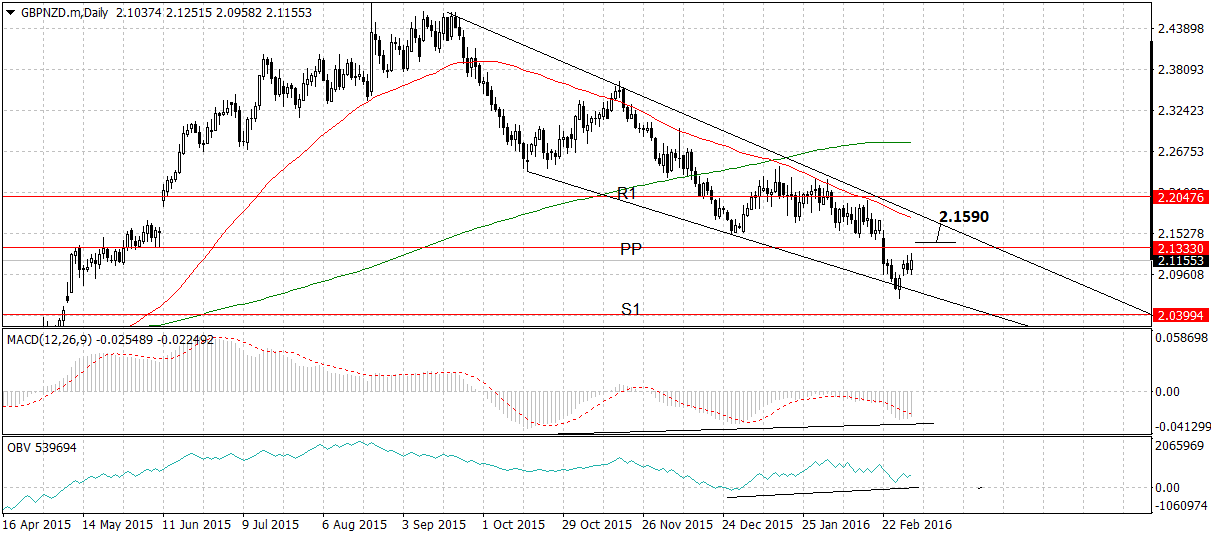
The GBP to NZD conversion has recently touched the lower channel line and rebounded on February 26 at roughly 2.07 – the pair is currently trading at 2.1160.
Whilst the down-trend continues to be dominant and on balance is likely to continue, the current bounce may extend higher in the very short-term, reaching the upper channel line at around the 2.16 mark.
Currently the monthly pivot, an important line traders use as a guide to where price will meet tough support or resistance, and stall, is situated at 2.1333.
Latest Pound / New Zealand Dollar Exchange Rates
  | Live: 2.3529▼ -0.21%12 Month Best:2.4815 |
*Your Bank's Retail Rate
| 2.2729 - 2.2823 |
**Independent Specialist | 2.32 - 2.3294 Find out why this is a better rate |
* Bank rates according to latest IMTI data.
** RationalFX dealing desk quotation.
If the exchange rate manages to make its way up to that level, it will probably encounter resistance there from the monthly pivot, which will either temporarily or permanently prevent it from a going higher.
Only a decisive break above the pivot will probably lead to a move higher, to the next target at the upper channel, at 2.1590 – just shy of 2.1600.
On February 29 the pair gapped higher following the release of weak NZD and relatively strong UK data - a bullish sign, indicating the rally is likely to extend someway further.
Nevertheless, there remains insufficient data to deduce that the medium term dominant down-trend is now in the process of reversing.
New Zealand Interest Rate Cuts Ahead
The pound is unlikely to find much support until markets become convinced the UK will stay in the Eurozone.
Watch polling data for developments here.
This leaves us to look at the New Zealand dollar as a primary variable in the GBP/NZD pair.
The one thing that could halt kiwi strength is the central bank who is notably tetchy on the lack of inflationary pressures in the economy. (Why is low inflation bad? RBNZ's John McDermott explains why stable prices are so important).
Any interest rate cuts aimed at stimulating pay growth will likely burden the New Zealand dollar as lower interest rates mean less foreign demand for NZ assets.
“We expect a lower 90-day rate profile will be needed to offset the impact of weaker inflation expectations and higher NZD. Lower interest rates will boost domestic demand and result in more non-tradable inflation,” says Jane Turner, Senior Economist at ASB in Auckland.
ASB expect the RBNZ will leave the OCR unchanged at 2.5% at the upcoming
OCR announcement and Monetary Policy Statement.
“But we expect the RBNZ to adopt a stronger easing bias, signalling further rate cuts as imminent, albeit conditional on the data,” says Tuner.