Pound sterling has strengthened against the New Zealand dollar in 2016 but our studies suggest it is far too early to call an end of the downtrend.

Fundamental analysts warn the outlook for the New Zealand Dollar is clouded by uncertainty and risk in 2016 while technicians see it as having reached an important cross-roads.
Markets opened the year on the back foot, as the escalation in geo-political tension and “risk-off” environment sparked by yet another slowdown in Chinese manufacturing activity.
As one of New Zealand’s largest trading partners, any weakness in China has a negative knock-on effect on New-Zealand exports and the RBNZ could well be forced into another rate cut. Such a move would hurt the kiwi.
The slowing growth rate in China is most acutely felt in by New Zealand's key export sector - dairy. The first dairy auction of the year was not a good one with the average price of product falling 1.6%, this was the first price fall in three auctions and has reminded investors that 2016 could be a tough one for this relatively small economy.
Latest Pound / New Zealand Dollar Exchange Rates
  | Live: 2.3303▼ -0.37%12 Month Best:2.3553 |
*Your Bank's Retail Rate
| 2.2511 - 2.2604 |
**Independent Specialist | 2.2977 - 2.307 Find out why this is a better rate |
* Bank rates according to latest IMTI data.
** RationalFX dealing desk quotation.
Analysts at Société Génerale argue that the New Zealand Dollar will weaken in 2016 due to negative fundamentals:
“New Zealand is not an oil exporter, but the El Nino weather phenomenon is causing drought as the summer progresses.
"A worsening of the drought would have a negative impact on growth as agricultural production is sharply reduced.
The severe 1997/98 El Nino, for example, shaved off 0.7 percentage points from NZ's GDP growth during the year.
Outlook for sterling. We remain negative on NZD."
Charts showing great correction
From a technical viewpoint GBP/NZD has reached cross-roads: it could either recover and move higher (in line with the negative NZD fundamental outlook), or the current short-term down-trend which began in September ’15 could elongate lower.
The weekly chart below shows the corrective a-b-c pattern in within the longer-term up-trend most clearly:
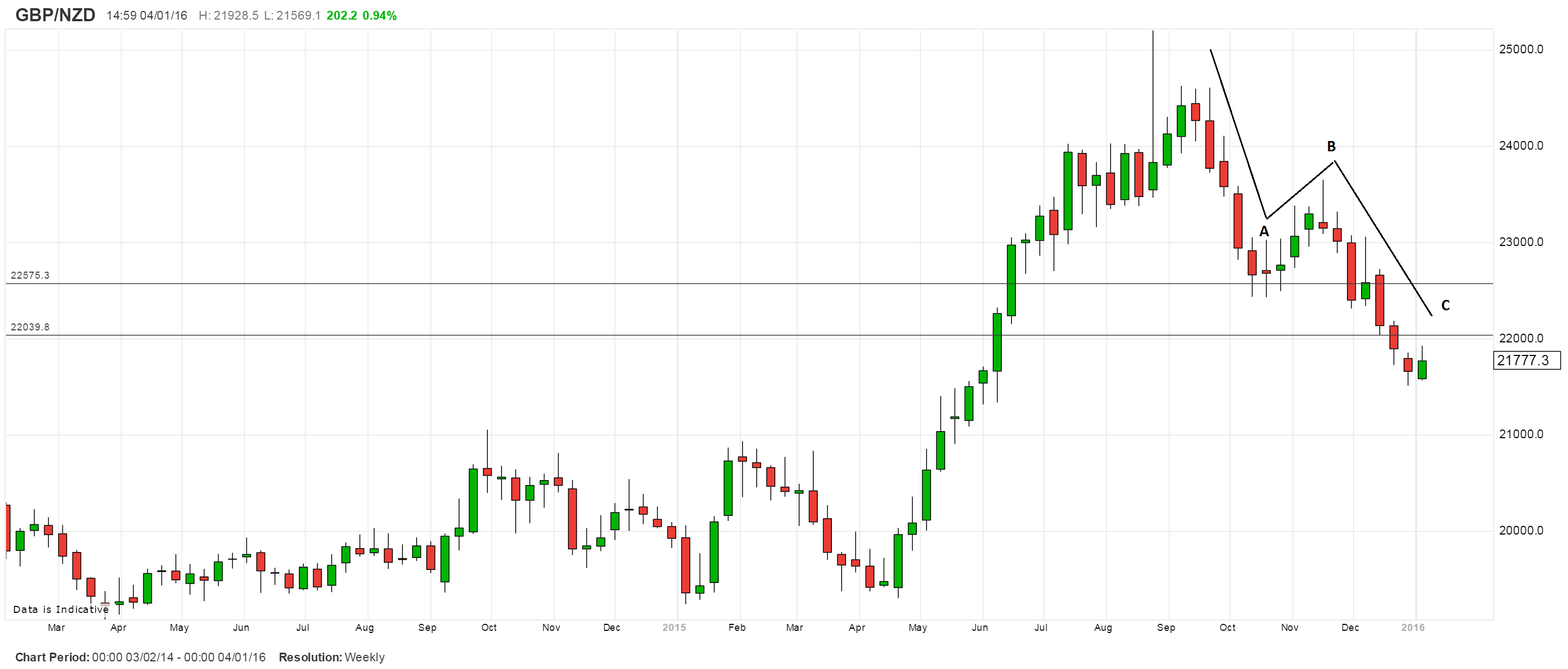
This 3-wave measured move from September’s peak could be a classic a-b-c correction or the start of a down-trend.
Normally I would see this as probably a corrective, however, this pattern is steeper than most, indicating that there is more selling pressure than usual, which could class the move as a reversal.
The monthly chart looks more bearish, and overall I see a slight bias towards more downside, with a break below the 2.1510 December lows confirming a probably continuation lower, towards the next long-term downside target at 2.1014 where the S1 monthly pivot is – followed eventually by a move towards parity, and the 50-month MA at 2.0250.
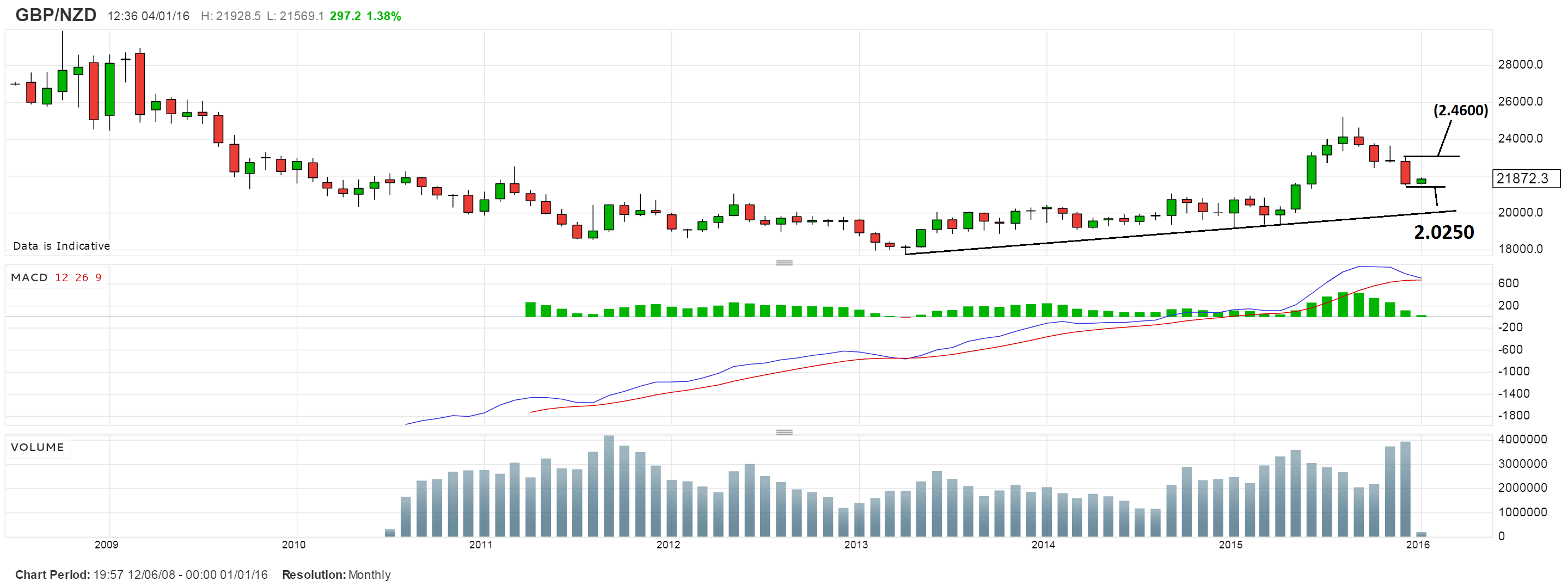
Alternatively, a break above the November highs at 2.3653 would probably confirm a continuation of the broader up-trend, or at least a re-test of the 2.4600 highs.
Daily Chart View
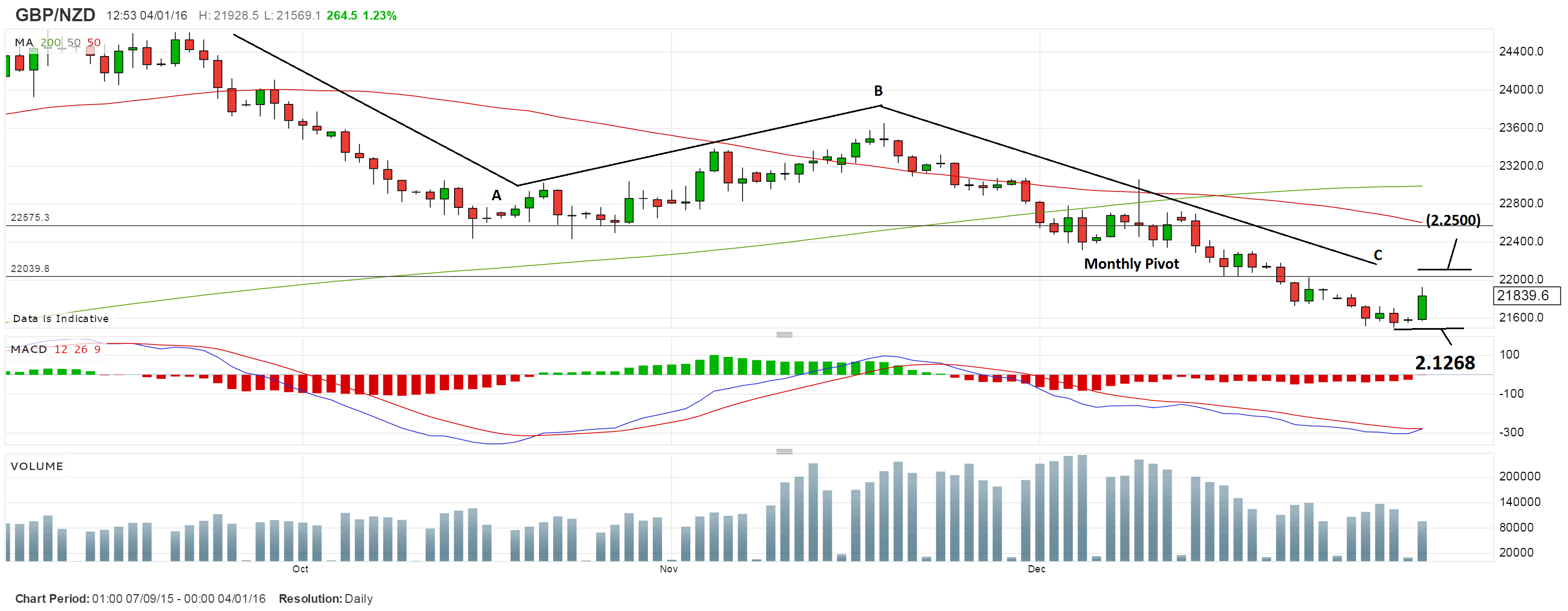
Despite the strong move up at the start of this week, the fact that the pair has completed an a-b-c correction with leg C now over 61.8% of A, and that ADX is ‘oversold’ (over 50), formidable resistance lies above, capping easy gains.
There is still quite a good chance today’s rally could quickly petter out and the down-trend could resume, with a move below 2.1510 leading to a move down to 2.1300, close to where the 100% extrapolation of the a-b-c September move is.
As far as upside goes, the Monthly Pivot, situated at 2.2038 is likely to impede progress higher; as could the 50-week MA at 2.2088, another major resistance level.
Ultimately to see upside solidify and continue, I would want to see a break clearly above these two layers of resistance, signalled by a move above 2.2100, which ought to then open up a target at the R1 monthly pivot at 2.2500.
Pound outlook steadily worsening
Not that the pound has fared much better over recent weeks - most analysts are now bearish the currency as a result of Brexit fears, but also due to lower expectations that the BOE will follow in the Fed’s footsteps in 2016 – or at least not as quickly as had been previously expected.
Nevertheless, there are some who still see a chance of a copycat rate hike from the BOE, such as UniCredit's chief U.K economist Daniel Vernazza, who said he was sticking to their forecast of a May rate hike – albeit with progressively heightened risks of a delay:
“We still forecast May for the first BoE hike, with the risks skewed towards a later hike.
“We think the BoE is behind the curve: spare capacity in the UK economy is close to zero and inflation is currently below target because of the fall in global commodity prices (and its impact on inflation is temporary).
"They should have already hiked.”