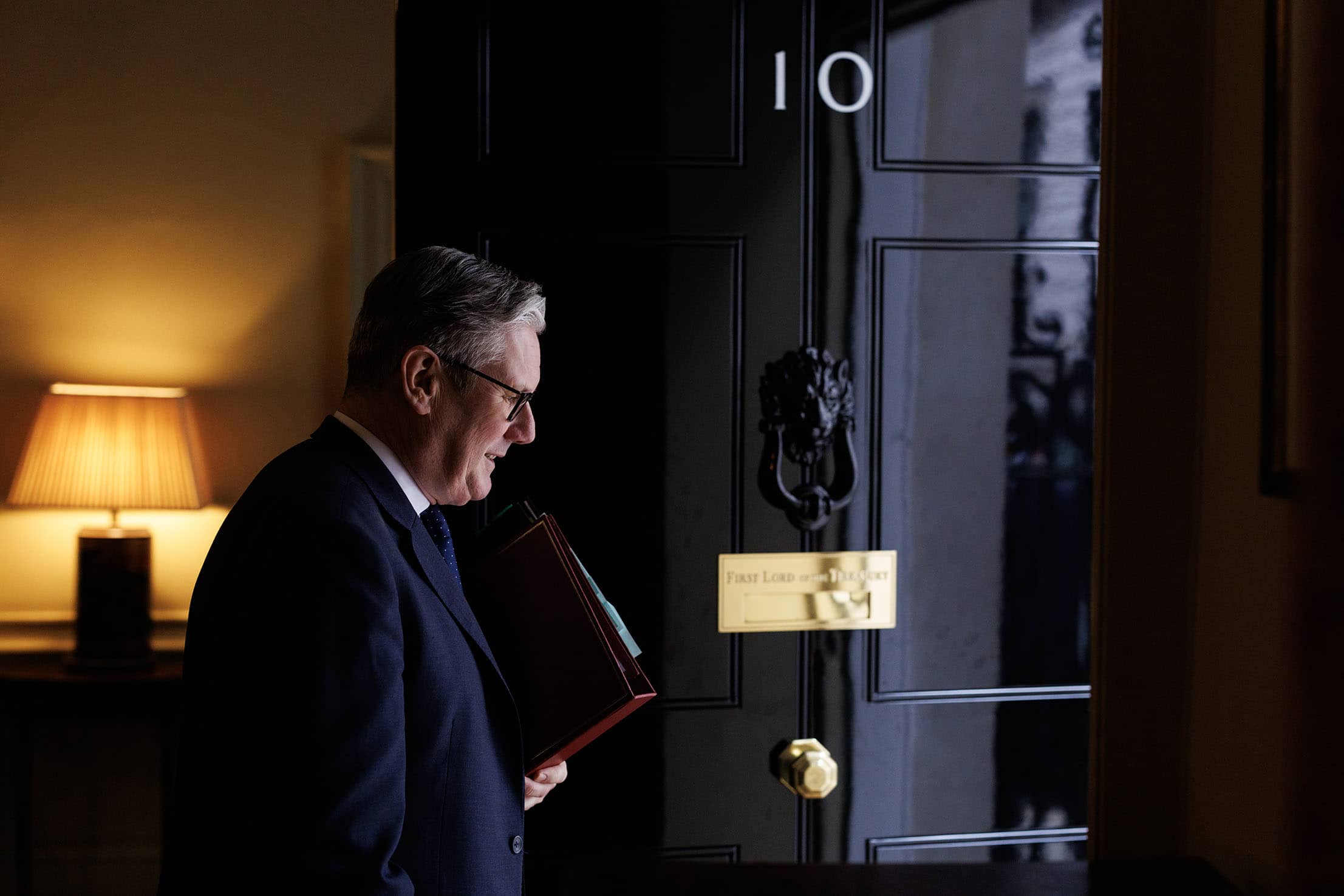
Picture by Simon Dawson / No 10 Downing Street
Allegations of misleading the House come just weeks before ground-moving local elections.
The British pound's outlook has dimmed owing to fresh pressure on Prime Minister Keir Starmer as it is claimed he misled the House of Commons in detailing his appointment of Peter Mandelson as U.S. Ambassador.
The prospect of the pound being plagued by political uncertainty has risen after it was revealed Thursday that Mandelson had failed an internal security vetting process ahead of the appointment owing to his ties to Jeffrey Epstein.
Starmer previously told parliament that "due process" was followed, and overnight his office said he had no knowledge of the security vetting failure. However, opposition parties and political commentators say this is vanishingly unlikely and that he misled Parliament.
The Conservatives, Lib Dems, Greens and Reform have called for his resignation.
"GBP only lost modest ground versus USD following another flare-up of the Mandelson scandal facing the government. That move has not been reversed overnight," says a daily note from Lloyds Bank.
The Prime Minister's latest crisis comes just three weeks before local and devolved elections that are expected to see his Labour Party virtually wiped out. Internal party pressure is expected to build, and challengers are rumoured to be manoeuvring for Starmer's ouster.
"Risks remain skewed to the downside into the May elections," says a recent note covering the pound's outlook from Barclays.
The coming hours and days should see pressure on the PM build, and markets will be tuned into the drama.
"News that Olly Robbins, the head civil servant at the Foreign Office, has been dismissed signals the government see blame laying with officials rather than ministers or Starmer. Nevertheless, prediction markets (Kalshi) now imply a 56% chance Starmer is not PM by the end of the year, up from 47% before yesterday’s news," says Lloyds.
The problem for financial markets is that the new replacement will likely be a left-leaning candidate with inclinations to boost spending at a time when the government's finances are already under pressure.
UK bond yields are the highest amongst G7 peers, confirming markets are already demanding a premium to hold onto UK debt.
The premium was first established when former Prime Minister Liz Truss tried to launch her infamous mini budget that threatened to topple the country's finances.
That premium hasn't gone away and we've reported a number of subsequent episodes where the pound sells off alongside British bonds due to fears that the country's debt dynamics will worsen.
The odds of it happening again are high.
"Risks of a more expansionary fiscal policy have likely risen in the wake of the energy shock and with the upcoming May local elections," says Barclays.
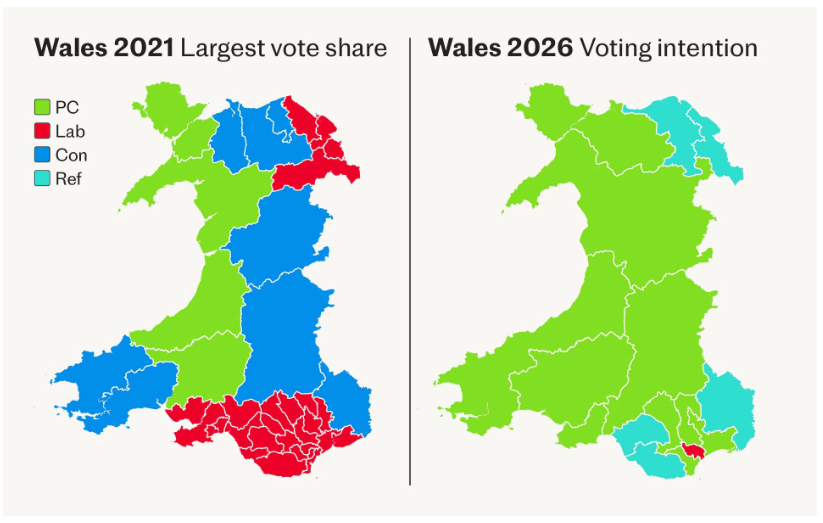
Above: Labour will be wiped out in Wales according to predictions by an extensive MRP poll.
According to a recent MRP poll, Labour could suffer its worst night in local election history, winning just 42 authorities, down from 83.
MRPs are considered the most accurate in the polling industry because they consider local-level voting intentions.
Analysts at Barclays say they now pencil in a modest re-widening of the GBP's fiscal premium in Q2, closer to levels prevailing in November.
The bank's new forecasts reflect this with a 1.1360 target "before a gradual normalisation towards the middle of the post-EU referendum range further out."
The May polls were receding as a risk to the pound ahead of Starmer's latest Mandelson crisis, as it was reported by the Guardian that potential challengers were backing off to allow the PM to navigate the Middle East war.
Polymarket has cut the probability that Mr Starmer will leave office by year-end from over 70% in early March to just 56%.
A recent note from HSBC said this meant "for GBP, UK policy uncertainty remains under wraps, at least for now."
We would expect those Polymarket odds to rise in the coming days, and in due course, political risk premium could start to reflect more meaningfully in sterling.