Consensus projections for the next four quarters, compiled from leading investment banks.
Access the full forecast →

Image © Adobe Images
Pound sterling has turned lower against the euro and dollar on Tuesday in sympathy with weakening stock markets.
Equity markets are back under pressure amidst a renewed push higher in global gas and oil prices as it becomes clearer that Middle East energy exports will be offline for some time.
Iran has targeted energy facilities across the Middle East and the country's Revolutionary Guards announced yesterday that they intend to shell ships crossing the Strait of Hormuz, a crucial pinch point between Iran and the Saudi peninsula through which the region's oil and gas must flow if it is to reach global markets.
"Downbeat sentiment is pervading equity markets as the conflict in the Middle East escalates, with global repercussions. London’s FTSE 100 has fallen deeper into the red as the war widens and companies assess the impact of severe disruption across the region on their operations," says Susannah Streeter, Chief Investment Strategist at Wealth Club.
Surging oil and gas prices tend to stimulate demand for dollars, confirming it as the ultimate petro-currency, pressuring GBP/USD to 1.3310 in the process.
GBP/EUR is meanwhile tracking global equity markets very closely, with the benchmark U.S. S&P 500 proving a useful indicator for what the exchange rate will do. The below chart shows GBP/EUR action mirroring that of the S&P 500: as we can see both put in a decent recovery as Monday wore on:
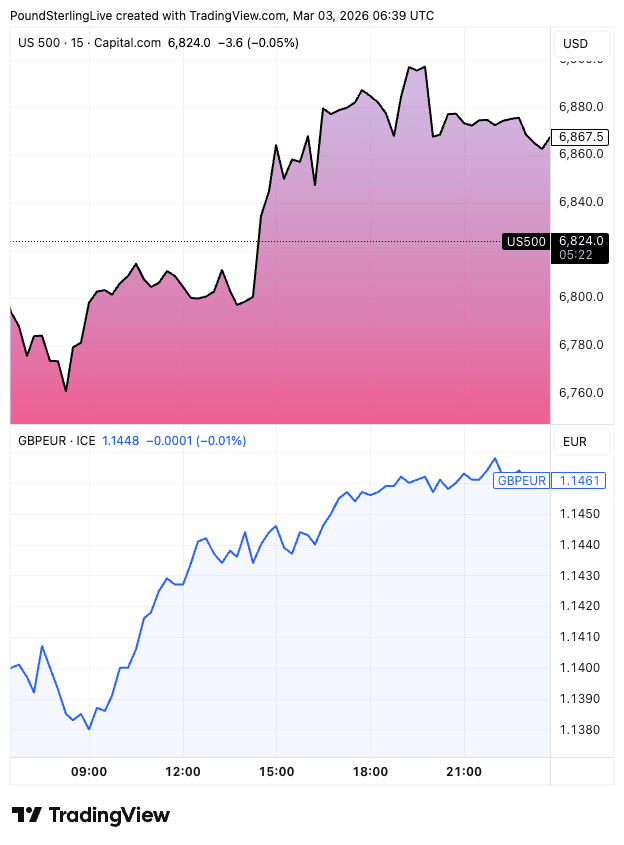
Above: The S&P 500 (top) and GBP/EUR.
The implication of this behaviour is that global sentiment is firmly in charge of the key pound-euro conversion and what the world's benchmark stock market does today will likely determine where GBP/EUR goes.
U.S. stock futures are pointing to a lower open on Tuesday, which is why we are currently seeing GBP/EUR in the red at 1.1446, with the pair having been as high as 1.1466 late Monday. That peak marked an impressive recovery for an exchange rate that had been as low as 1.1379 earlier in the day when the fears surrounding the Middle East conflict were at their most extreme.
It's a skittish market for sure: there are clearly significant negative outcomes for the global economy and markets posed by the war, but investors also know these worries can lift quickly.
There's a sense that U.S. President Donald Trump won't want inflation to get out of hand ahead of crucial mid-term elections, which already promise to be difficult for his Republican Party.
He has said he wants to negotiate with Iran, and he's confident they will do so.
But investors are probably also realising that there's no obvious leadership body left in Iran to do so, following Saturday's surprise decapitation attack by Israel and the U.S. As doubts on a negotiated settlement linger, markets will struggle.
For the pound, that spells further weakness.
GBP/EUR
"Iran is retaliating to attacks from Israel and the US and is now threatening to set fire to ships using the crucial Strait of Hormuz. Given that it’s an essential route for around a fifth of global oil and gas supplies, this has sent energy prices even higher," says Streeter.
UK natural gas prices rose to their highest level since the Russian invasion of Ukraine on Monday after major Liquified Natural Gas facilities in Qatar were shuttered following Iranian drone attacks. As gas becomes more scarce, its price rises.
Britain is a net energy importer, meaning its economy is particularly vulnerable to another spike in oil and gas prices as they would push up inflation and disrupt the consensus expectation amongst economists that inflation was finally close to settling around the Bank of England's 2.0% target.
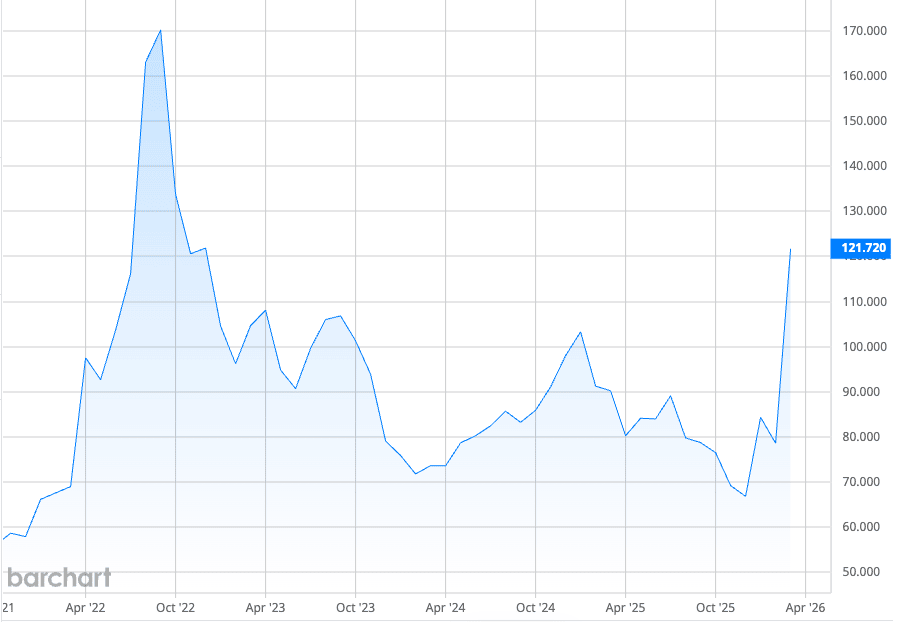
Above: The cost of wholesale gas for April delivery rises back to levels that followed Russia's invasion of Ukraine.
"If sustained, the resulting increases in oil and gas prices will raise inflation in Europe substantially. Were oil and gas prices to hold steady at their current level, UK CPI inflation would likely be 0.7ppt higher than our 2.1% forecast in Q4," says Andrew Wishart, Senior UK Economist at Berenberg Bank.
Wishart joins other economists in warning on Tuesday that the rise in energy bills means the Bank of England won't be in a position to raise interest rates later this month.
The bigger risk for the pound is that the UK experiences another economic hit from energy prices. This would put the UK's public finances under pressure again, and markets are wary about how sustainable the country's public finances are and whether they can sustain another global crisis.
Those regular readers of Pound Sterling Live will recall there are a number of other headwinds blowing against the pound: political uncertainty as the Labour Party turns leftward, rising domestic unemployment and a public debt dynamic that always seems to be on the cusp of unsustainability.
Another energy price shock could bring all three to a head in relatively short order.
✳️ Secure today's exchange rate for a future payment. You may also book an order to trigger your purchase when your ideal rate is achieved. Learn more.