Image © Adobe Images
The pound faces renewed downside risks as the factors that previously supported sterling have largely run their course, according to analysis from NatWest.
“Something will have to change if the currency isn’t to weaken further,” the bank says in a year-ahead forecast note.
NatWest argues that sterling failed to draw lasting support from its healthy carry position in 2025, as weak growth and persistent fiscal concerns offset higher interest rate returns.
While the bank expects the pound to retain a similar carry advantage in 2026, it sees “little reason for thinking the outcome will be any different.”
This assessment has prompted NatWest to reassess its outlook for the currency after several years in which there was always a plausible positive narrative to counter bearish consensus.
In 2023, that narrative was the UK’s recovery from the pandemic, followed in 2024 by falling energy prices that eased current account pressures.
In 2025, investors focused on a cautiously cutting Bank of England, which was seen as delivering sterling a supportive yield advantage.
“For ’26, the cupboard is bare,” NatWest says.
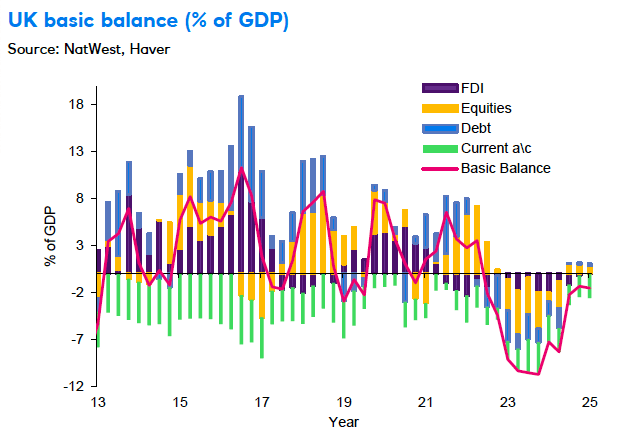
Image courtesy of NatWest.
The bank adds that the only potential upside scenario would be if fiscal risks prove overly priced, most notably around the November 2025 Budget.
NatWest says the outlook is once again dominated by the UK’s twin deficits, leaving sterling highly sensitive to monetary policy expectations, fiscal decisions and the relative growth outlook.
The bank warns that poor productivity performance remains a central constraint, creating a challenging backdrop for the currency.
Consensus projections for the next four quarters, compiled from leading investment banks.
Access the full forecast →
It says that capital inflows and demand for UK government bonds may not be sufficient to prevent further sterling weakness, “potentially significantly so.”
NatWest argues that any recovery in the pound appears limited, except against the dollar, where it sees a particularly negative outlook for the US currency.
By contrast, weakness against currencies linked to stronger growth and current account surpluses is described as “the path of least resistance.”
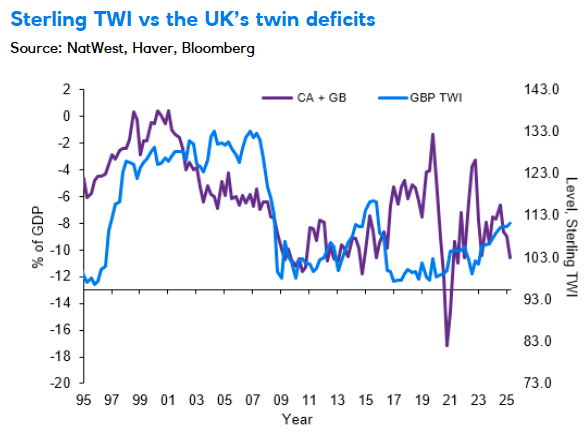
Image courtesy of NatWest.
The bank highlights that the UK’s twin deficits widened further in 2025, with a current account deficit of around 3% of GDP and a government budget deficit of roughly 4.5%.
Although foreign capital inflows broadly covered the current account shortfall, NatWest says this once again relied on the “goodwill” of overseas investors.
Looking ahead, the bank expects only a modest narrowing of these deficits, with the current account still projected to remain close to 3% of GDP.
It also warns that net gilt issuance will remain several multiples above pre-pandemic levels, at a time when global bond supply is also elevated.
This, NatWest says, raises the risk that bond yields could rise again, keeping concerns about debt sustainability firmly in investors’ minds.
While UK government bonds have outperformed many European peers and ten-year gilt yields look set to end the year lower, the currency has shown little benefit from this move.
NatWest suggests this reflects a trade-off between improved fiscal credibility and lower front-end interest rates, which have weighed on sterling.
Markets have priced a terminal Bank of England rate of around 3.4%, which the bank views as broadly fair but still vulnerable to further dovish repricing.
Areas of Resilience
Despite its bearish assessment, NatWest acknowledges areas of resilience in the UK outlook.
It notes that economic growth outperformed consensus expectations in 2025, particularly in the first half of the year.
The bank adds that UK growth is closely correlated with Europe, where prospects for the UK’s largest trading partner appear to be improving.
Overseas demand for gilts has held up, while domestic bank treasuries have emerged as an increasingly strong source of demand.
NatWest also notes that sterling tends to benefit from positive global risk sentiment, which could improve if US monetary policy places greater emphasis on growth over inflation in 2026.
However, it concludes that the most meaningful shift for the pound would come from a sustained improvement in productivity.
“A stronger productivity performance that sees stronger, inflation-free growth that limits pressure on government borrowing and attracts equity inflows from abroad is what could change the currency’s fortunes the most,” NatWest says.
Key Forecasts
The British lender and investment bank forecasts the pound to euro exchange rate to trade at 1.16 by mid-year 2026 and through to year-end.
The pound to dollar exchange rate is forecast to trade at 1.41 by mid-year and 1.42 by year-end.