
Picture by Simon Dawson / No 10 Downing Street.
The British pound builds year-end momentum against its main rivals.
The currency recorded its best day against the dollar and euro in a month Wednesday, with analysts attributing the performance to the pound to rising investor confidence that the Federal Reserve will cut interest rates next week and continue to deliver more support in 2026.
"Sterling is likely to maintain its upward momentum as expectations of a dovish shift from the U.S. Federal Reserve, in both policy and leadership, support risk appetite and favourable UK economic conditions after finance minister Rachel Reeves deftly navigated fiscal tensions around the autumn budget," says Paul Spirgel, a market analyst at Reuters.
Gains by pound sterling mean euro buyers are now looking at their best exchange rate since October 28, and dollar buyers see their best rate since October 27.
The pound traditionally benefits when global sentiment is bullish, given it is a currency that depends heavily on the mood of the global investors who hold billions of pounds worth of UK government debt.
But for that to happen home-grown worries must also be at a minimum. The distraction of the budget has now passed and there was some helpful news from S&P Global's monthly PMI survey of the UK economy's private sector:
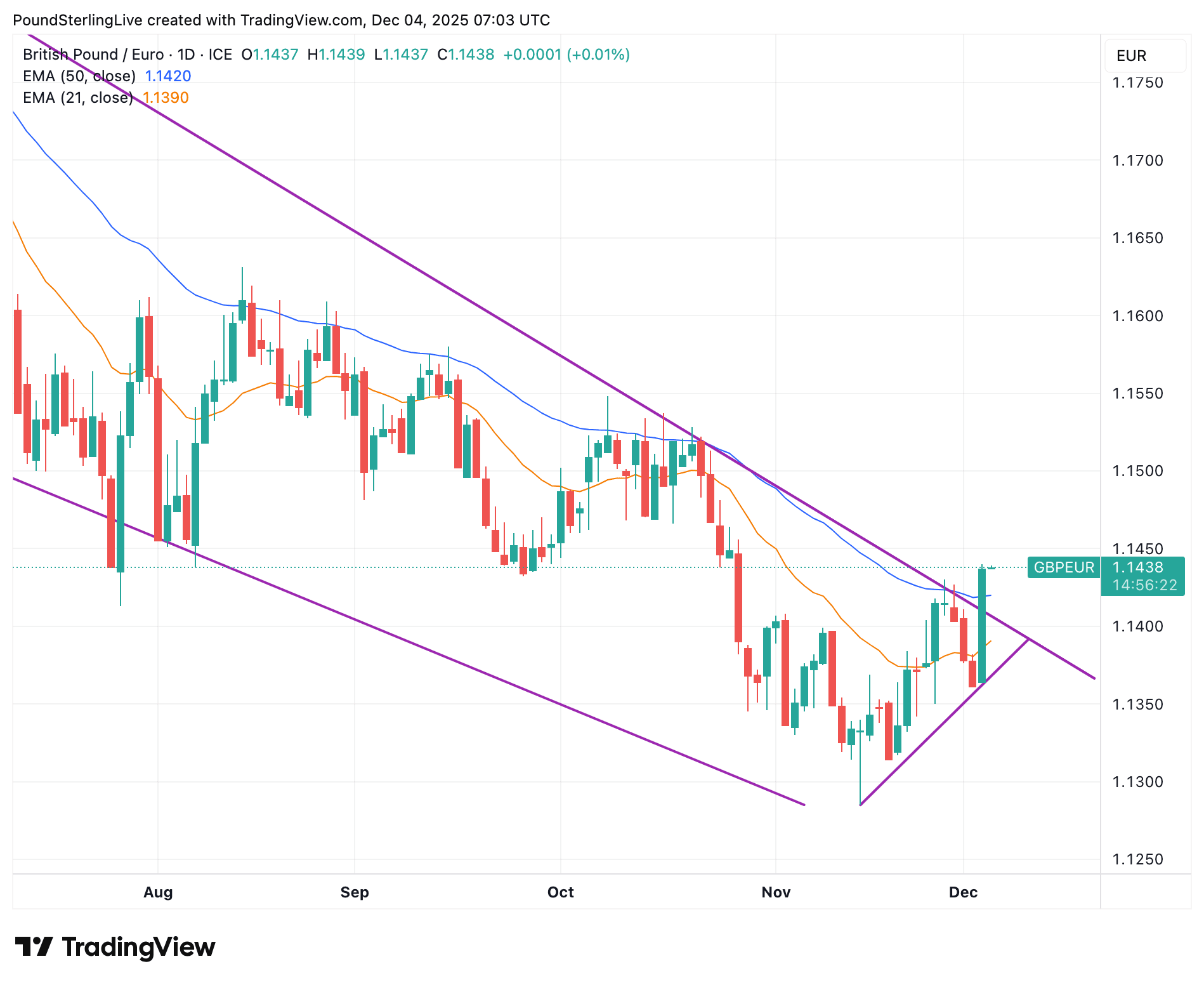
The pound to euro exchange rate rose above 1.14 after S&P Global revised its November services PMI from an initial estimate of 50.5 to 51.2, suggesting the economy didn't slow as much as previously feared in the run-up to the budget.
The rally means GBP/EUR is turning a corner on a multi-month run of weakness:
Consensus projections for the next four quarters, compiled from leading investment banks.
Access the full forecast →
But it's the dollar that looks to be the main release valve for FX markets right now: it fell against the pound and all other peers after investors ramped up expectations for further interest rate reductions at the Federal Reserve.
This, after the ADP jobs report showed another weakening in the labour market: the November ADP employment report read -32k, versus a consensus expecting a small 10k gain.
"With rate cuts seen through the lens of managing risks, this would suggest the aim is to proactively get ahead of downside risks, particularly in relation to the cooling in the labour market," says Justin McQueen, market analyst at Reuters.
Highly accurate consensus projections for the next four quarters, compiled from leading investment banks.
Access the full forecast →
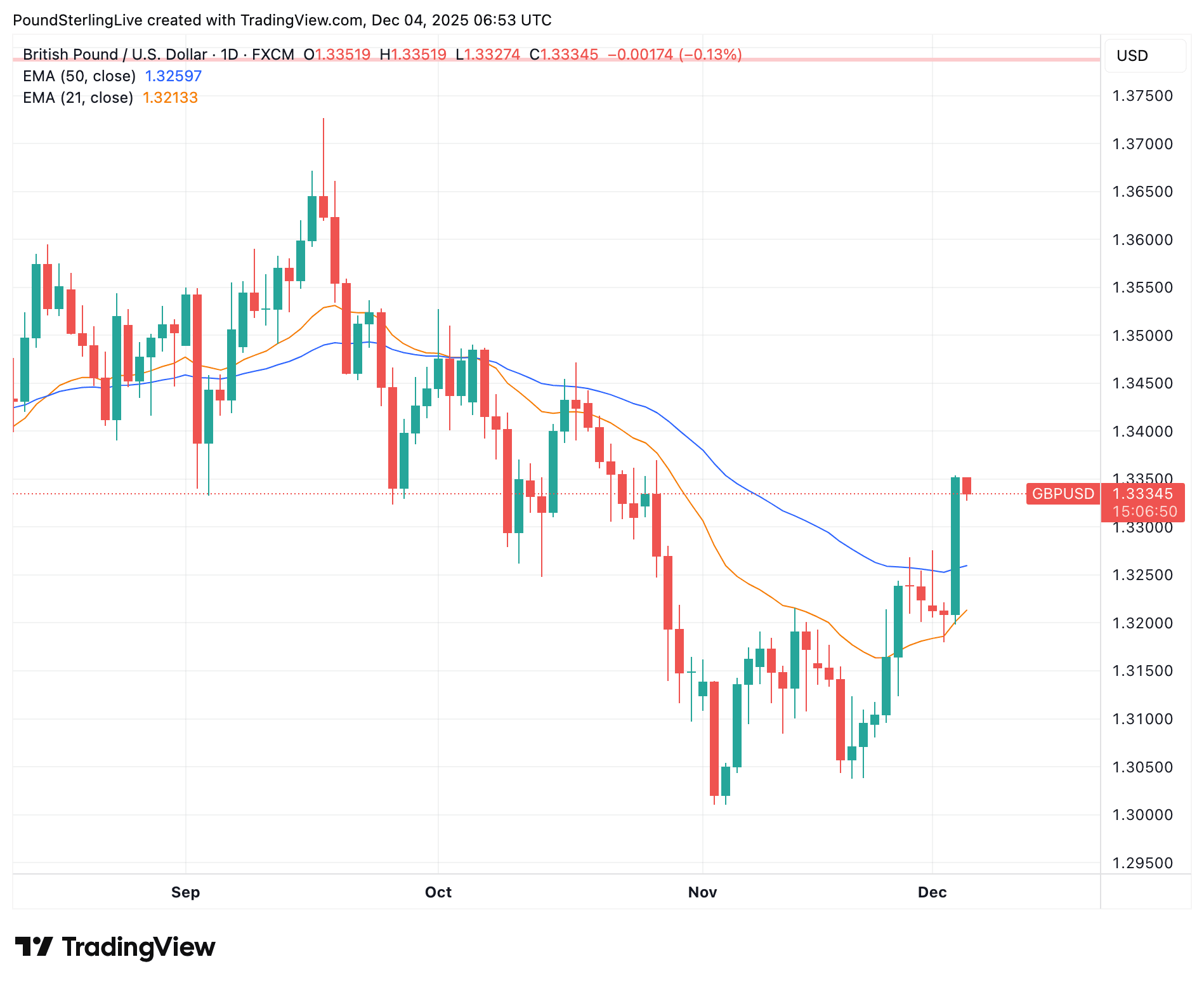
"Sterling surged over 1% versus the US dollar yesterday – its biggest one day rise since April. GBP/USD bulldozed through key moving averages on a path towards $1.34 though momentum stalled just shy of the 100‑day average around $1.3370," says George Vessey, Lead FX Strategist at Convera.
McQueen says that "for the dollar, risks lean lower" into next week's Fed decision. "Even more so after U.S. President Donald Trump hinted at NEC Director Kevin Hassett becoming the next Fed Chair, whose bias on rates is viewed as being more in line with Trump's and thus more dovish than the current Fed Chair Jerome Powell."
Hasset, a Trump acolyte who advocates an agenda of reducing interest rates, is now seen as an 80% shoo-in for the top job on Polymarket.
"Hassett has made it clear that he favours lower interest rates. This helped propel the GBPUSD up towards 1.3300, taking it to its best levels in over a month," says David Morrison, Senior Market Analyst at Trade Nation.
From a technical perspective, the GBP/USD rally is building, and further near-term upside is likely:
"With GBP/USD rising above it 55-DMA, currently at 1.3289, bulls are likely to drive sterling higher, and should the pound rise above the 200-DMA at 1.3322 they're likely to target mid-September highs above 1.35," says Spirgel.
If GBP/USD can rally faster than EUR/USD, which is possible given sterling's higher beta to global investor sentiment, then the year-end rally in GBP/EUR can also extend.
✳️ Secure today's exchange rate for a future payment. You may also book an order to trigger your purchase when your ideal rate is achieved. Learn more.