Image © Adobe Images
A second consecutive weekly advance leaves one analyst forecasting 1.1728.
The euro to dollar exchange rate (EUR/USD) is trending higher again thanks to sound Eurozone data and building expectations for a series of interest rate cuts at the Federal Reserve.
A survey of the Eurozone's private sector economy in November showed a robust performance that validated the European Central Bank's (ECB) policy to keep interest rates unchanged.
The S&P Global Composite PMI was upgraded from the initial flash release of 52.4 to 52.8, suggesting a sprightly end to the year is underway.
"EUR/USD rallied to above the $1.1650 mark, as markets reacted to an improved November Eurozone composite PMI and growing divergence in monetary policy expectations between the ECB and the Fed," says Axel Rudolph, Senior Technical Analyst at IG.
✳️ Secure today's exchange rate for a future payment. You may also book an order to trigger your purchase when your ideal rate is achieved. Learn more.
He adds the U.S. central bank is expected to cut rates in December, with a near 89% probability priced, whereas the ECB isn't likely to do so for much of next year.
This creates a formidable divergence in monetary policy outlooks that fundamentally supports euro-dollar upside.
"The move higher in the EUR/USD pair was mostly driven by the dollar falling across the board. Also helping the pair is the fact we had some stronger European PMIs from the services sector," says Fawad Razaqzada, Market Analyst at City Index.
Razaqzada adds that the euro is receiving additional tailwinds on hopes for an eventual ceasefire between Ukraine and Russia, after the latter said negotiations were "constructive".
Talks are ongoing, with Russia denying suggestions that Putin had rejected outright the U.S. proposals for ending the war.
"This also helped the single currency," says Razaqzada. The City Index analysts adds bullish momentum in euro-dollar is growing:
"The EUR/USD forecast remains modestly positive for now. A touch more stability in overall risk sentiment is probably required before the dollar can weaken more convincingly against the more risk-sensitive currencies."
✳️ Secure today's exchange rate for a future payment. You may also book an order to trigger your purchase when your ideal rate is achieved. Learn more.
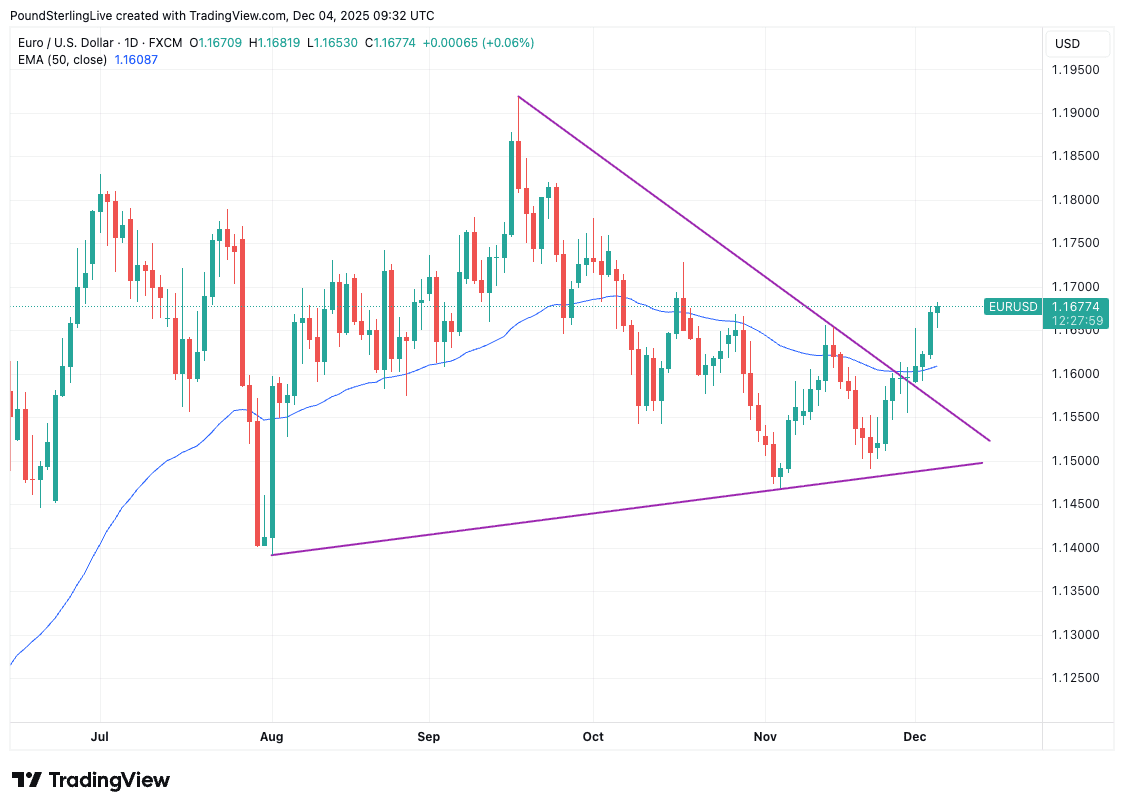
The exchange rate's daily chart shows gains extending into a second consecutive week, following a modest push higher in November.
"Recent price action has been decisively bullish, and the fact that pair has climbed above several key levels is clearly a positive development in as far as the technical EUR/USD forecast is concerned," says Razaqzada.
He explains that the rate recently broke above resistance at 1.1600 and 1.1650. These levels had previously acted as barriers, so the key question now is whether EUR/USD can hold above them-and if so, whether it can build on this momentum to reach 1.1700 and beyond.
"The next upside target above 1.1700 comes in at 1.1728, the most recent swing high. Beyond that, 1.1800 is the next significant level to watch. We’ll reassess the broader outlook if and when price reaches those highs," he says.
On the downside, 1.1600 is now the immediate support area. Below that, the 1.1550 region offers additional support. However, the key support zone remains unchanged: the broad area between 1.1460 and 1.1500, which has repeatedly acted as a strong floor in recent months.
A Small Business Recession Grips America
The dollar was lower across the board midweek after the U.S. November ADP employment report read -32k, disappointing consensus expectations for a 10k gain in employment.
The market appeared to be particularly reactive to the details of the report, that suggest a worrying slowdown in the small business and SME segment, which is the backbone of the American economy:
Companies with fewer than 50 employees shed 120k jobs, the largest one-month decline since May 2020.
"Weakness was concentrated among small businesses, where the number of jobs fell by no less than 120,000 during the month, the most since the pandemic," says Jocelyn Paquet, an economist at NBC Capital Markets.
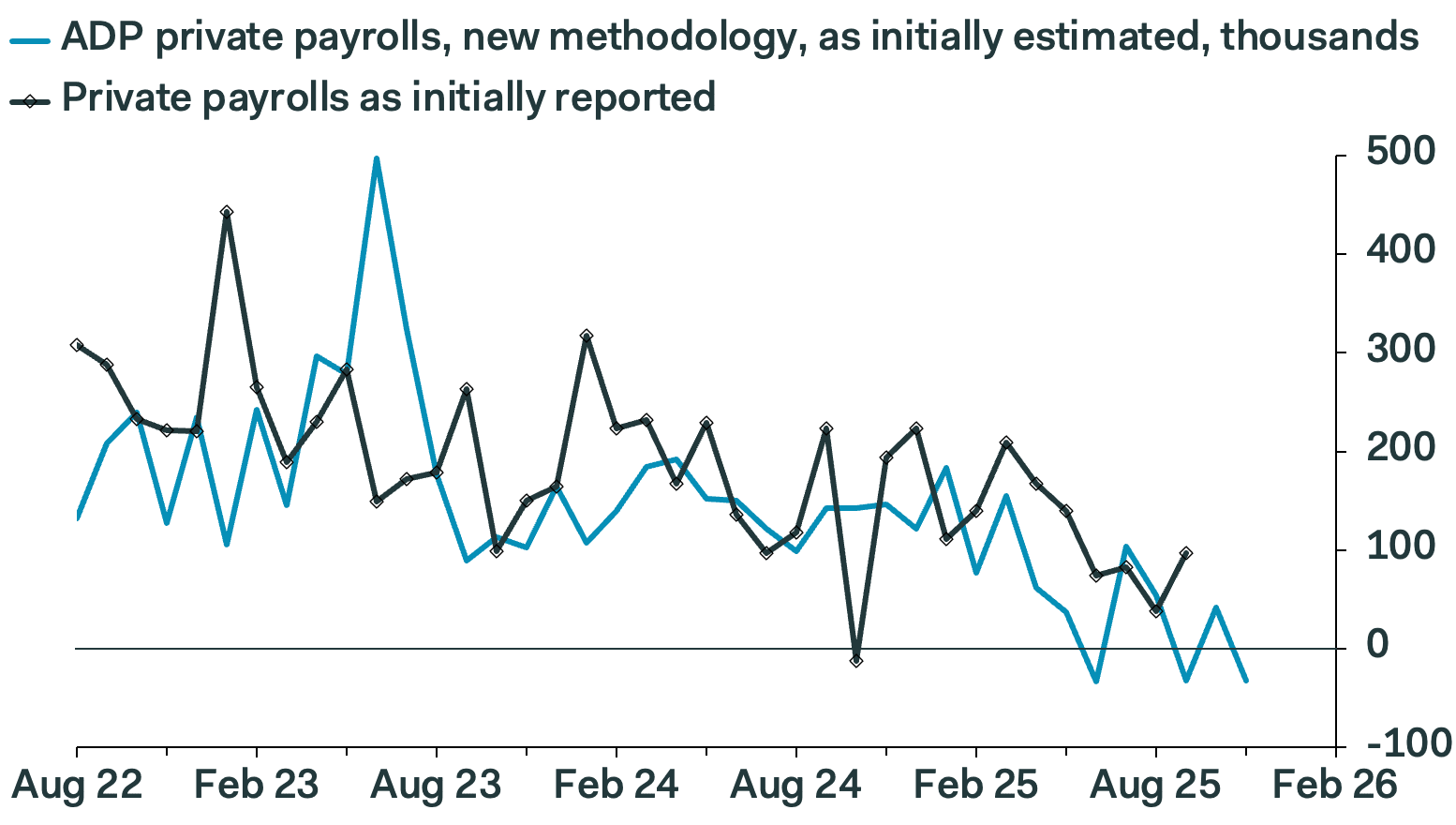
Image courtesy of Pantheon Macroeconomics.
The headline data suggests a robust U.S. economy, but there are growing concerns that this simply reflects the massive AI capex centred on a handful of mega companies.
The 'real' economy looks to be struggling, and this is something the Fed will think it can remedy by lowering interest rates.
"This weak report, coming just before the Federal Reserve’s final policy meeting, intensifies concerns about a more rapid deterioration in the labour market, sending the U.S. Dollar lower against all G10 currencies and causing the odds of a rate cut next week to climb to 93%," says Antonio Ruggiero, an analyst at Convera.
With further cuts in 2026 likely, the dollar can stay offered.