Image © Adobe Images
The euro has decent support despite renewed tensions in the Middle East.
Euro-dollar trades at 1.1695 on Tuesday, having dipped by a quarter of a per cent during Monday's holiday-thinned trade.
That weakness was a response to weekend news that the U.S. and Iran were no closer to resolving their conflict and that tensions were likely to be on the upswing again.
"US equities retreated from record highs as Iranian missiles targeted the United Arab Emirates while Tehran warned that it was tightening its grip on the Strait of Hormuz. But implied volatilities remained low (the VIX near 19 up less than 2 pts)," says a daily note from investment bank Natixis.
To be sure, the market is not panicking; we've seen it all before, and talks will likely resume in the coming weeks.
That should limit downside potential in euro-dollar and we're looking for support at the 200-day simple moving average (SMA) - at 1.1675 - to hold for now.
In fact, the pair has not closed below this technical market since April 09, and last week's series of tests of this level were not breached.
That means the short-term should favour price action between 1.1675 and an interim consolidation zone high at 1.1750.
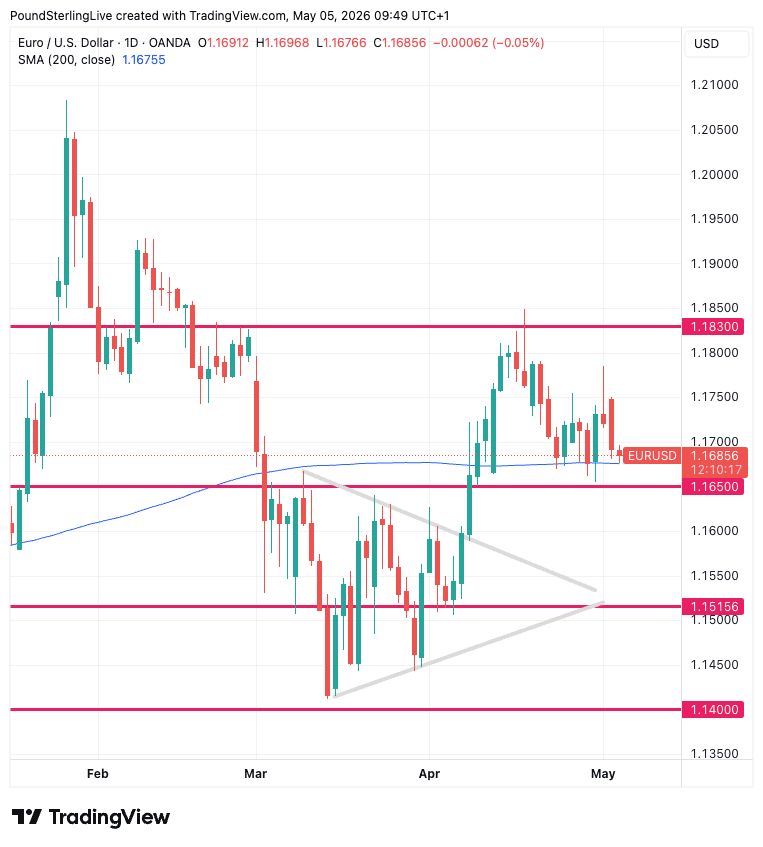
Yes indeed, the pair is caught in a bit of a rut that sees it consolidate in the short term: on the one hand we have U.S. stocks near record highs thanks to solid corporate earnings, and on the other we have negativity and high oil prices due to the Middle East conflict.
So conflicting risk signals create conflicting forces in FX that ultimately see the pair anchor just above the 200-day SMA.
While supported above the 200-day SMA, technical lore suggests the pair should ultimately edge higher.
That would extend a trend that has been in place for some time now, and reopen the door to a test of 1.20 late this year.
Consensus projections for the next four quarters, compiled from leading investment banks.
Access the full forecast →
Interest rate developments that favour the euro and a general reversal of U.S. dollar overvaluation will likely drive that trend.
The euro found support last week after the ECB held at 2.00% and President Christine Lagarde confirmed a June hike was discussed "in depth."
That is as firm a hint as any that Eurozone interest rates could soon rise, while those in the U.S. are likely to stand pat, creating a convergence in real rates that would typically support the euro relative to the dollar.
It's one reason why consensus continues to back a higher euro-dollar in the coming weeks, even if the near-term tensions in the Persian Gulf give reason for pause.